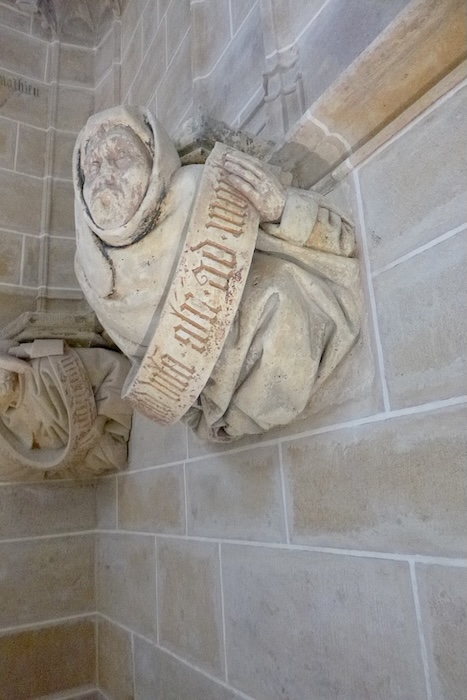
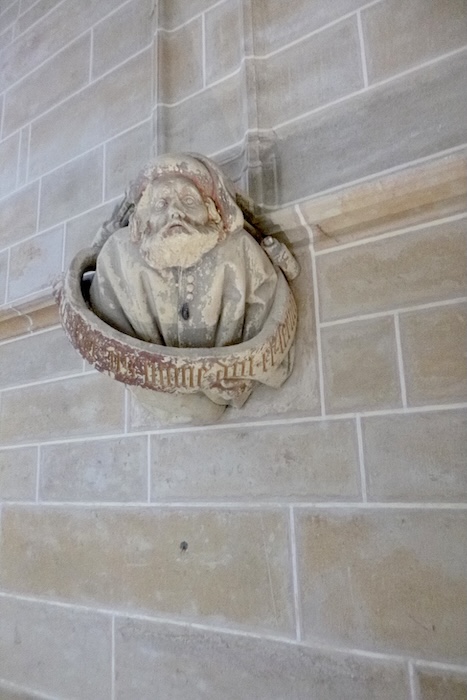
Cluny, the light of a vanished world
DIDIER HEUMANN, ANDREAS PAPASAVVAS
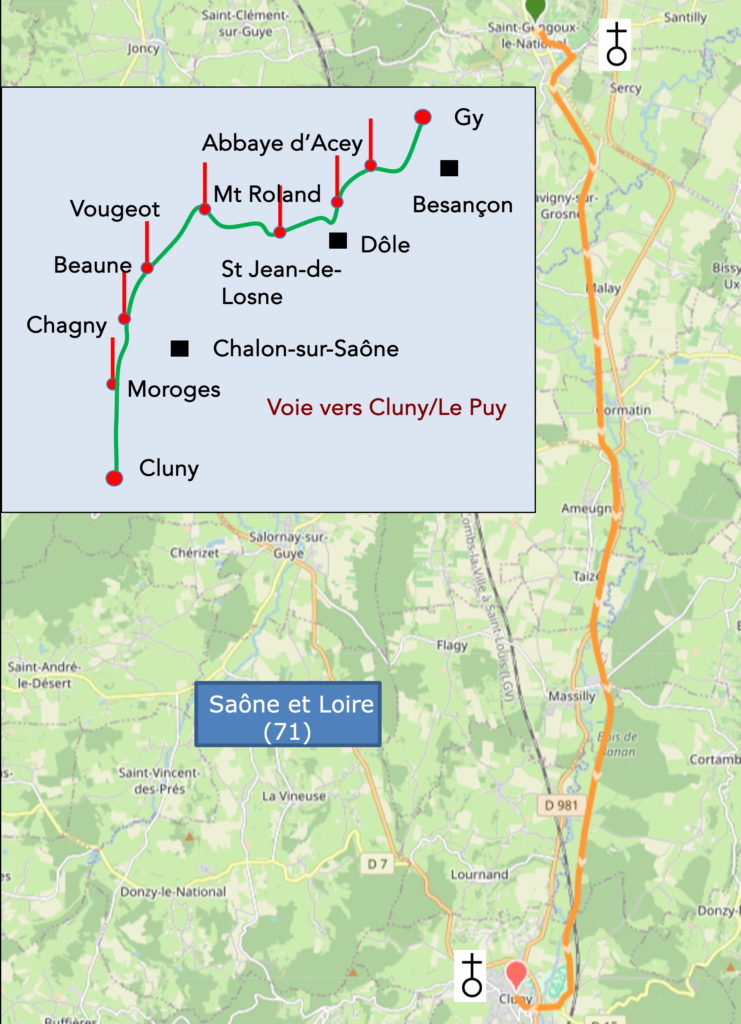
We divided the course into several sections to make it easier to see. For each section, the maps show the course, the slopes found on the course, and the state of the route (paved or dirt roads). The courses were drawn on the « Wikilocs » platform. Today, it is no longer necessary to walk around with detailed maps in your pocket or bag. If you have a mobile phone or tablet, you can easily follow routes live.
For this stage, here is the link:
https://fr.wikiloc.com/itineraires-randonnee/de-saint-gengoux-le-national-a-cluny-par-la-voie-verte-167800441
| This is obviously not the case for all pilgrims, who may not feel comfortable reading GPS tracks and routes on a mobile phone, and there are still many places without an Internet connection. For this reason, you can find on Amazon a book that covers this route.
If you only want to consult lodging of the stage, go directly to the bottom of the page. |
 |
Cluny is a small town in Saône et Loire, in southern Burgundy, known throughout medieval Europe for its abbey. Founded in 910 by William the Pious, it very quickly became a major religious and cultural center. Its abbey, now partly destroyed, was for several centuries the largest church in the Christian world before the construction of Saint Peter’s in Rome. Cluny stood at the heart of an immense monastic network, hundreds of abbeys across Europe followed its rule and depended on its abbot. The monks lived according to the Rule of Saint Benedict, in prayer, work and silence. It was also a place of art, music and learning, where Romanesque sculpture flourished, liturgical music developed and manuscripts were copied.
History, however, was cruel to this masterpiece. After the Revolution, the abbey was sold as national property, then dismantled stone by stone. Its colossal vaults collapsed, its towers were brought down, and the materials were used to build houses in the surrounding area. Of the immense abbey church, more than one hundred and eighty meters long, only part of the south transept, the bell tower of the holy water, and a few bays remain today, yet they are enough to suggest its former grandeur. Despite these losses, Cluny retains a profound charm. Its ruins, its conventual buildings, its reconstructed cloister, its medieval houses and its quiet lanes still speak of the spiritual and artistic power it once embodied. It is a place of memory and silence, but also a living place, animated by festivals and visitors who come seeking a trace of the breath of great monastic history.
On such a route, which is no longer the Camino de Santiago but an alternative way, there is obviously no shell marking. As the Greenway runs continuously from one town to another, no signposting is necessary. Of course, some pilgrims will prefer to follow the Camino de Santiago, which reached St Gengoux le National the previous day. For them, here is the route.
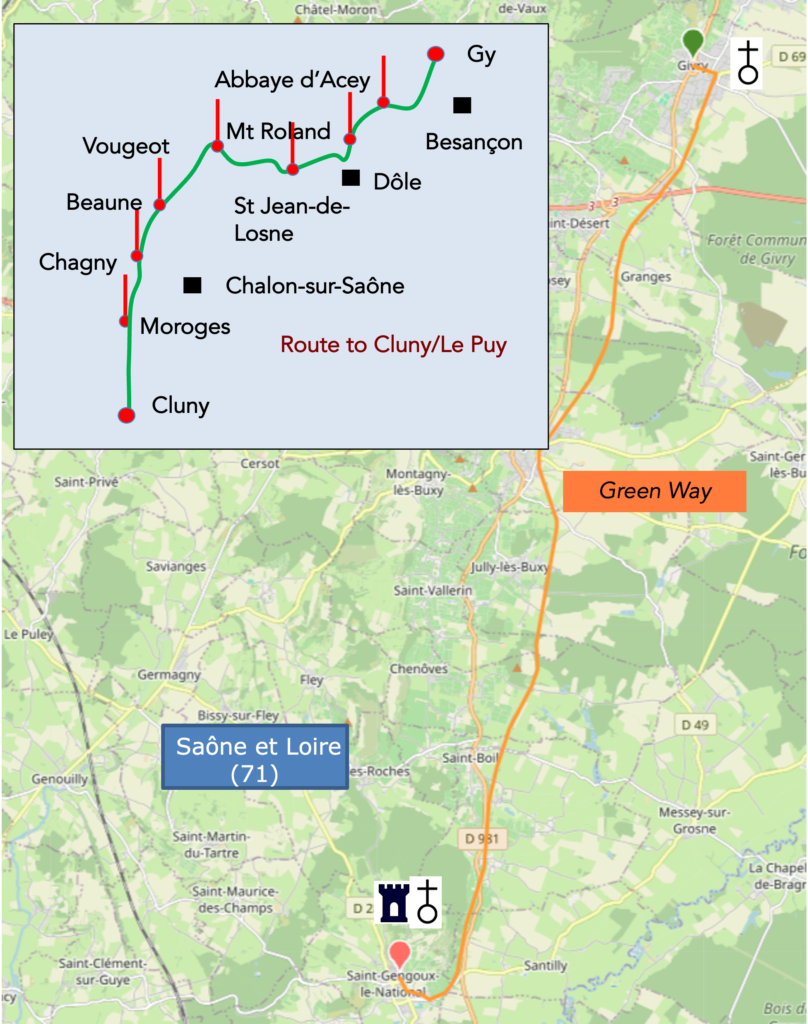
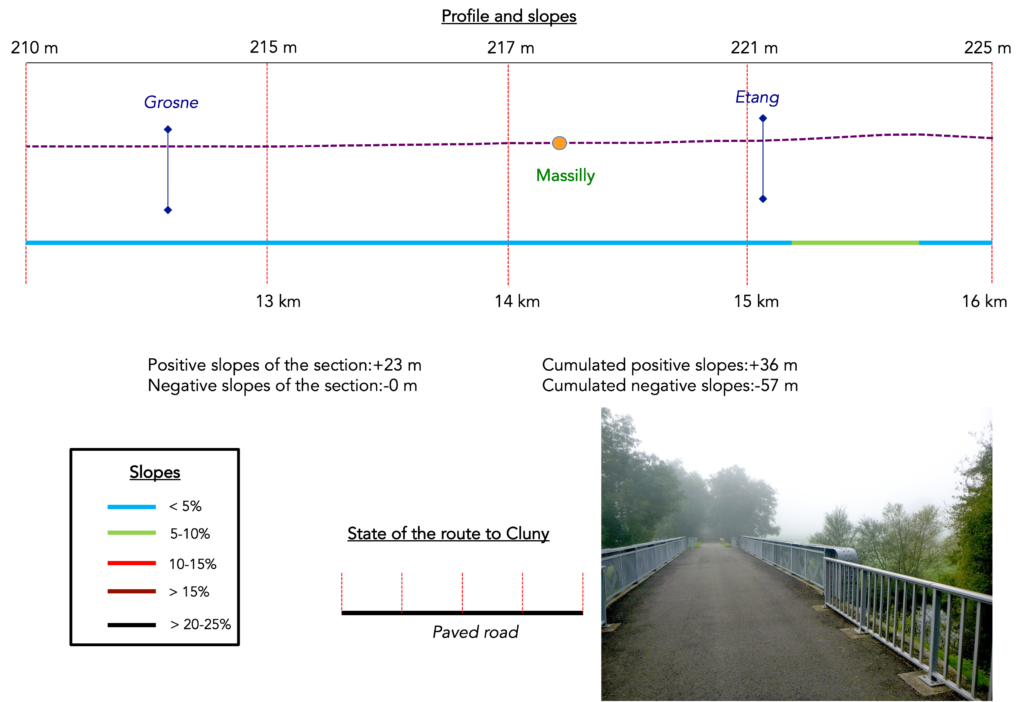
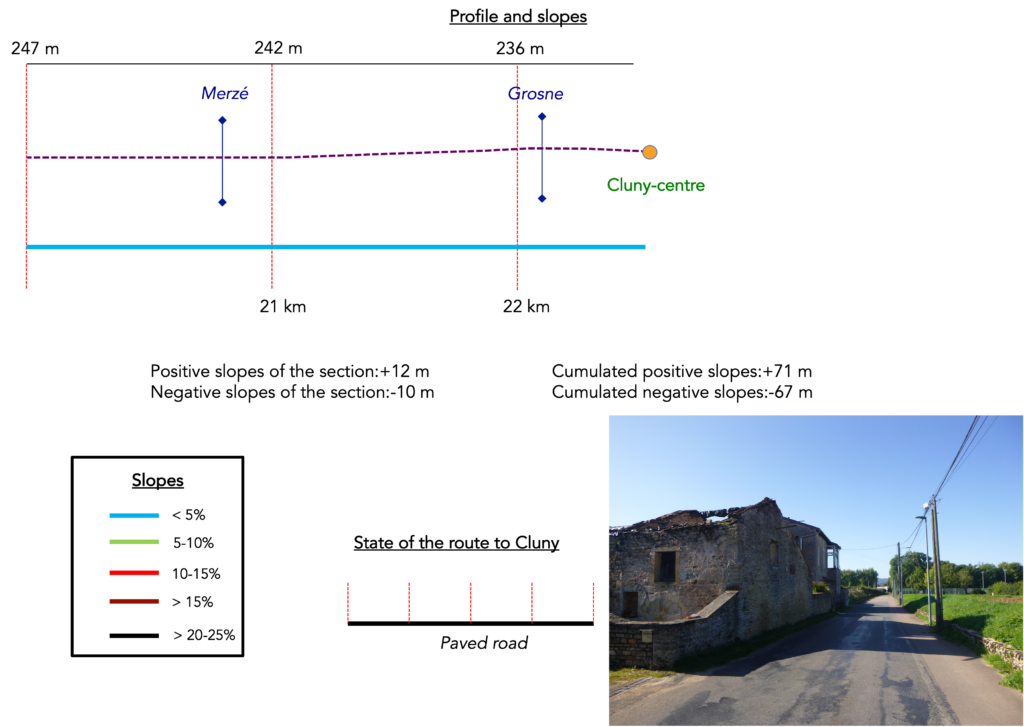
Difficulty level: The journey is almost flat, with at times a very slight incline that you will hardly notice (+71 meters/- 67 meters). This is not the case if you follow the waymarked Camino de Santiago from St Gengoux le National (+367 meters/-358 meters).
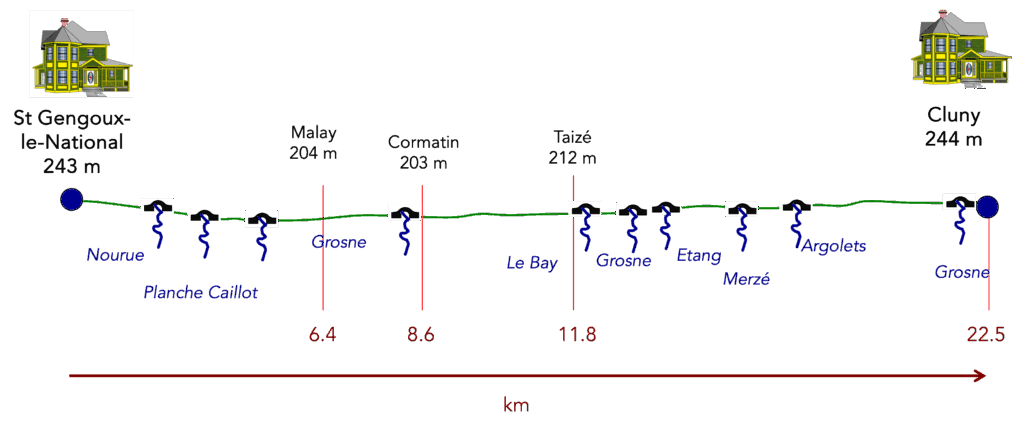
State of the route: Today, this stage runs entirely on the paved surface of the cycle path:
- Goudron : 22.5 km
- Chemins : 0 km
Sometimes, for reasons of logistics or housing possibilities, these stages mix routes operated on different days, having passed several times on these routes. From then on, the skies, the rain, or the seasons can vary. But, generally this is not the case, and in fact this does not change the description of the course.
It is very difficult to specify with certainty the incline of the slopes, whatever the system you use.
For those seeking « true elevations » and enthusiasts of genuine altimetric challenges, carefully review the information on mileage at the beginning of the guide.

Section 1: On the cycle path
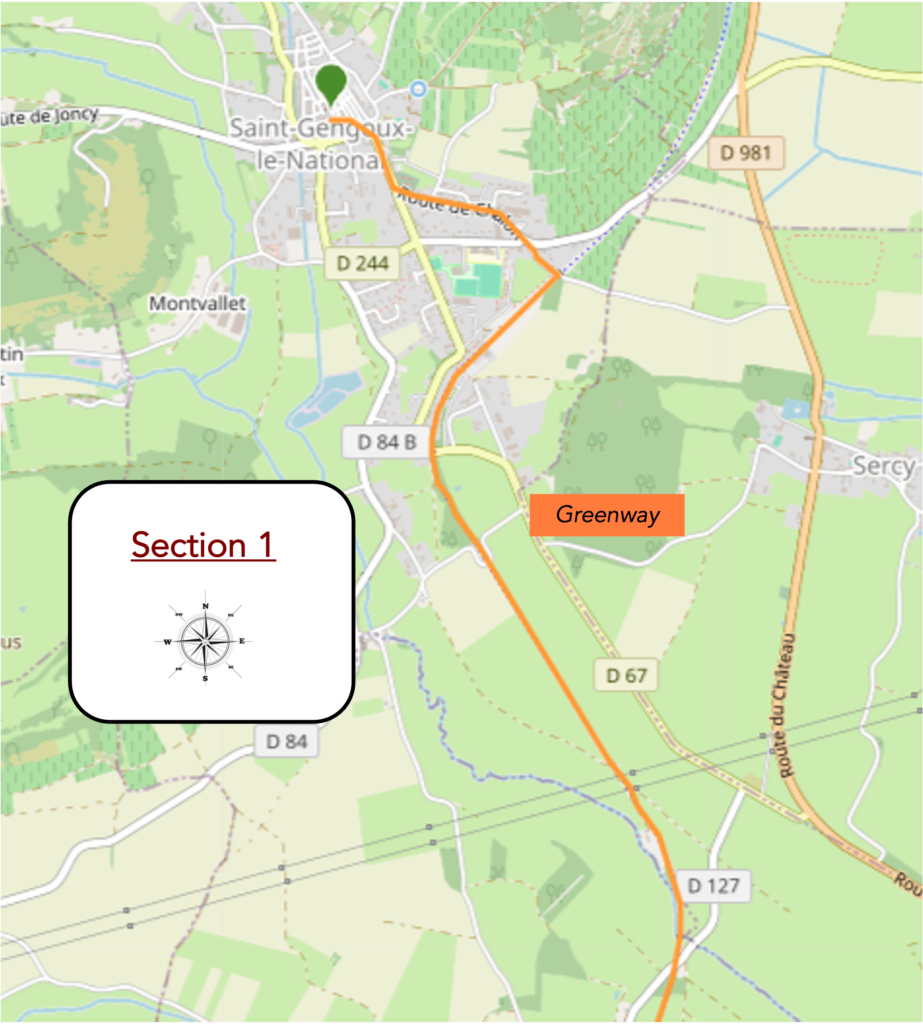
Overview of the route’s challenges: a route with no difficulty at all.
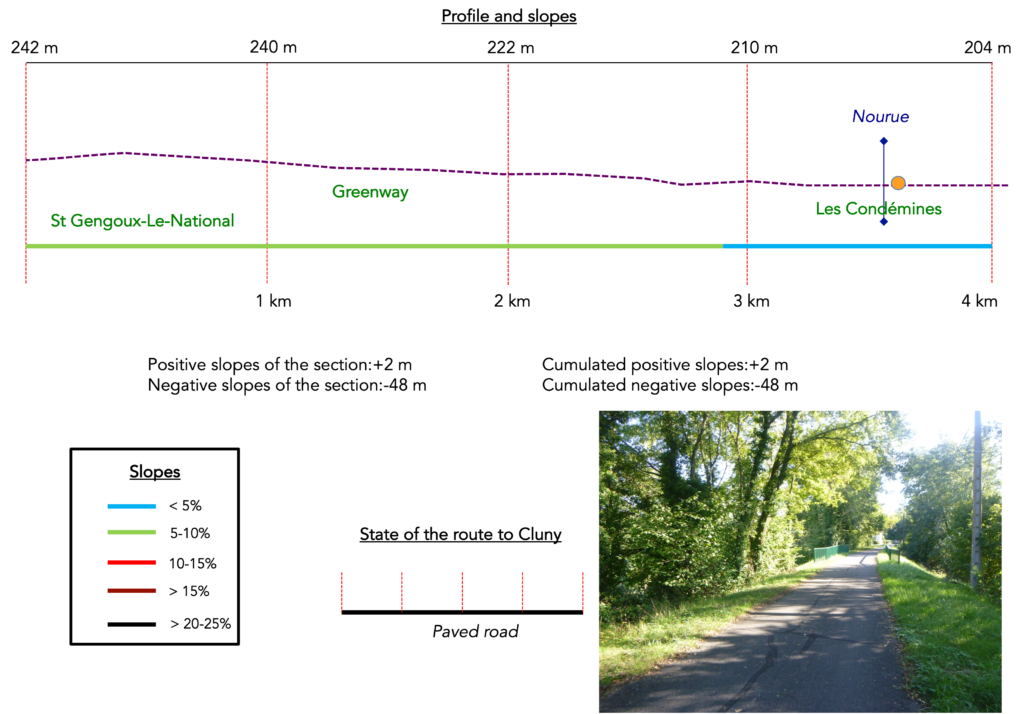
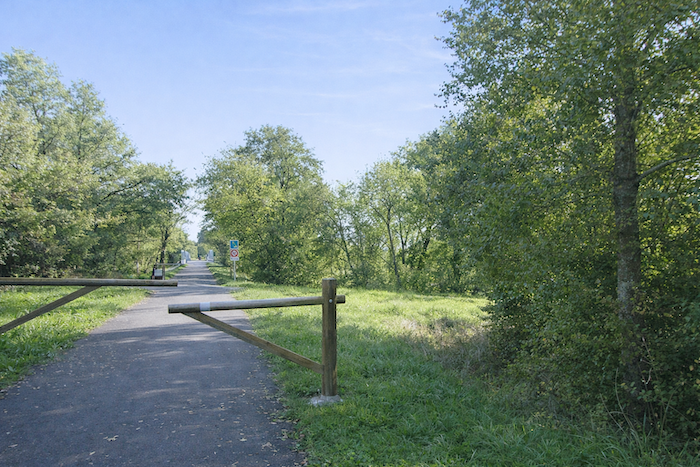
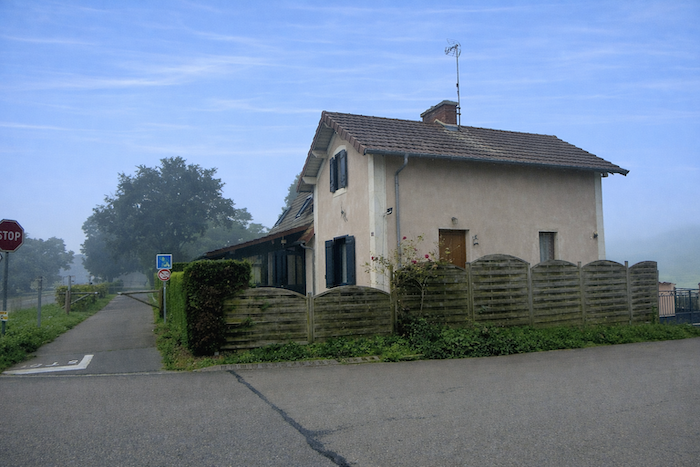
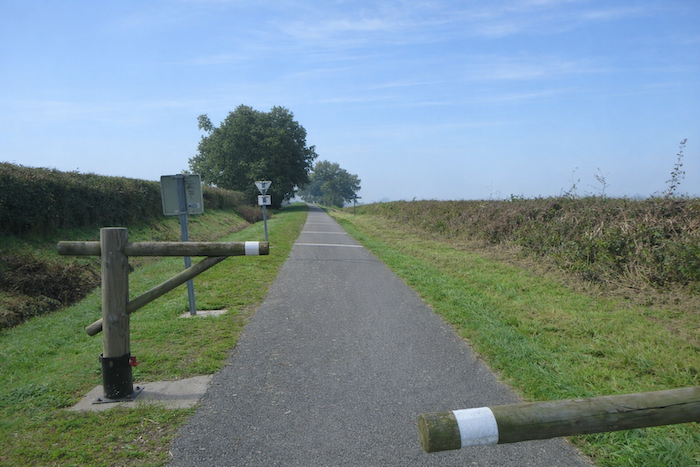
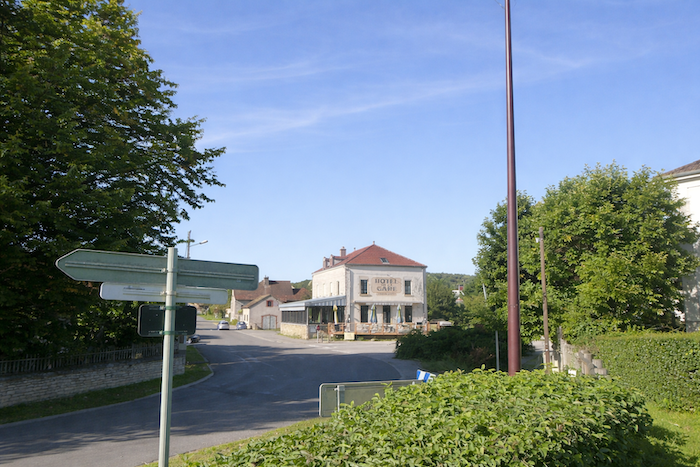
| From the small town, you will have to descend nearly a kilometer to rejoin the cycle path. At the bottom of St Gengoux le National, near the vanished railway line, stands the Hôtel de la Gare, like an unmoving witness to a time when trains brought life to the valley. Today, it is the cycle path that prolongs its memory, gliding discreetly just a few steps from its walls. |
 |
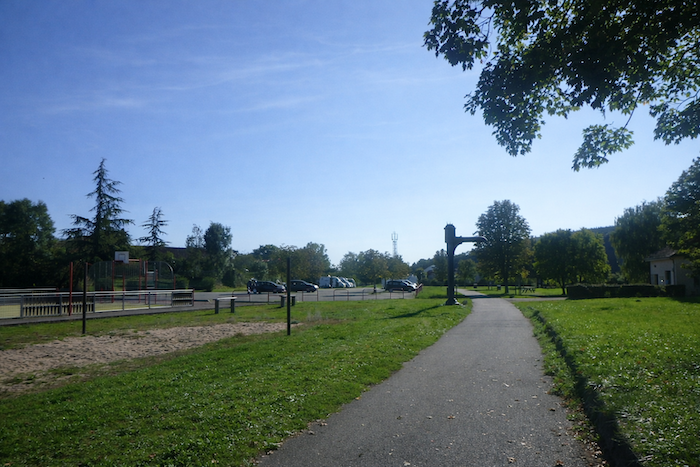 |
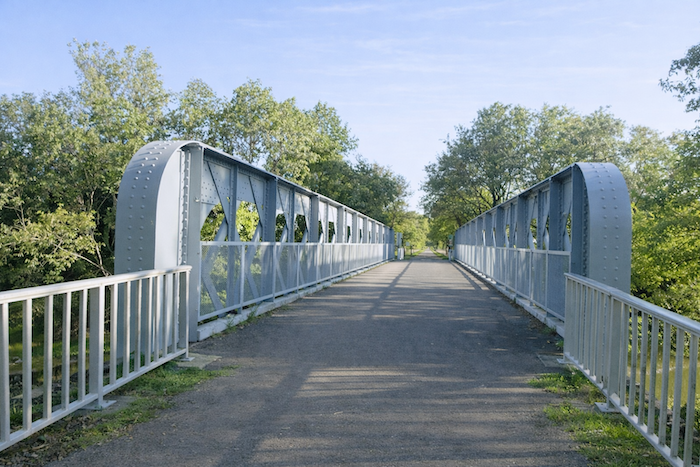
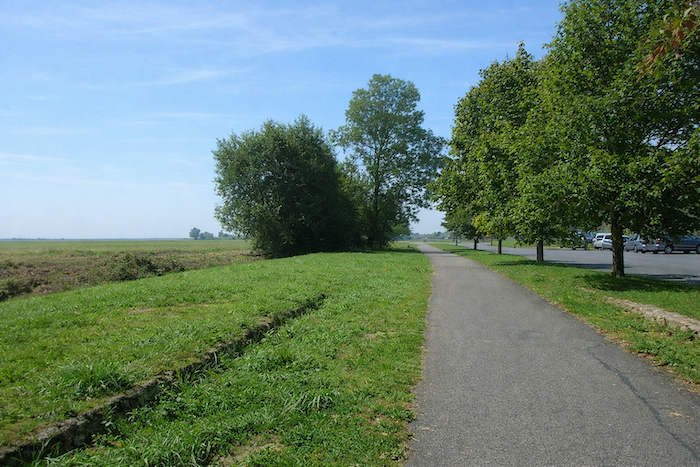
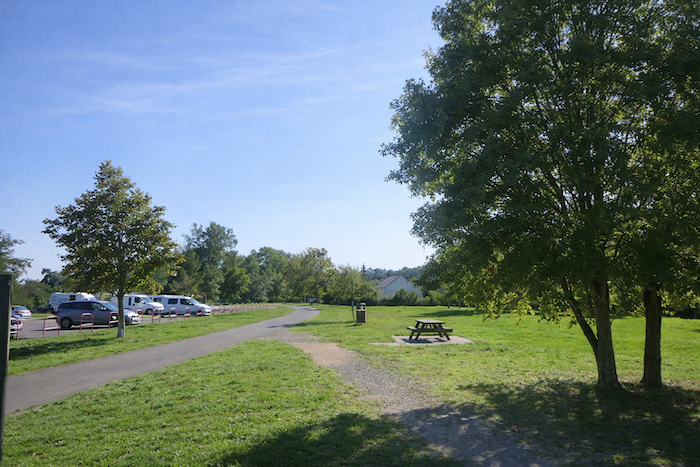
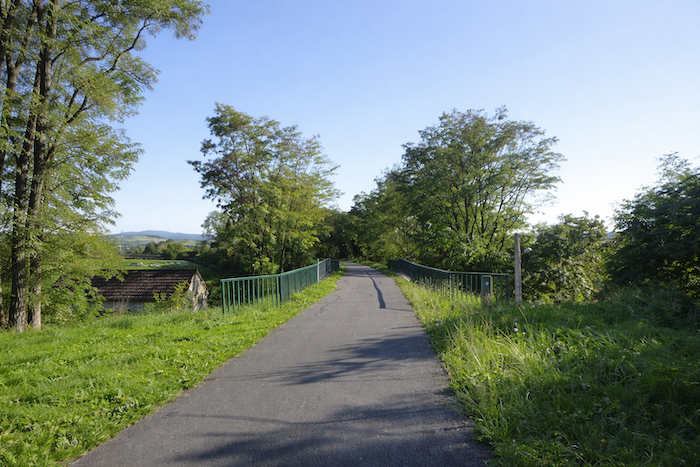
| The cycle path then enters a shaded park, running alongside the orderly rows of camper vans, like a curious modern bivouac set upon the traces of former travelers. It heads straight toward the departmental road D49, which it quickly crosses on a viaduct, cutting across the road like a taut thread in the fabric of the landscape. |
 |
 |
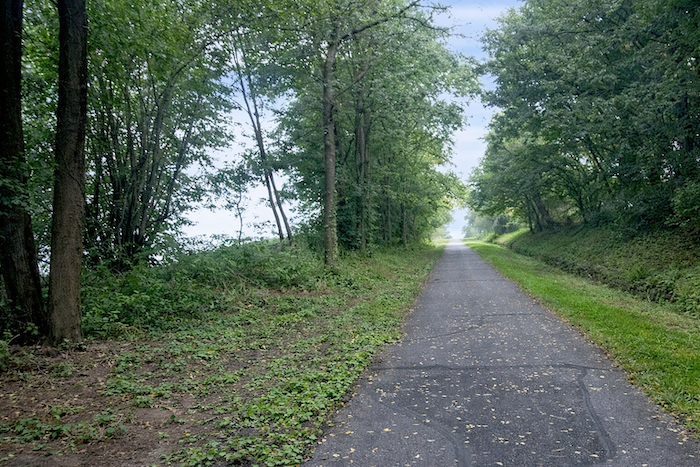
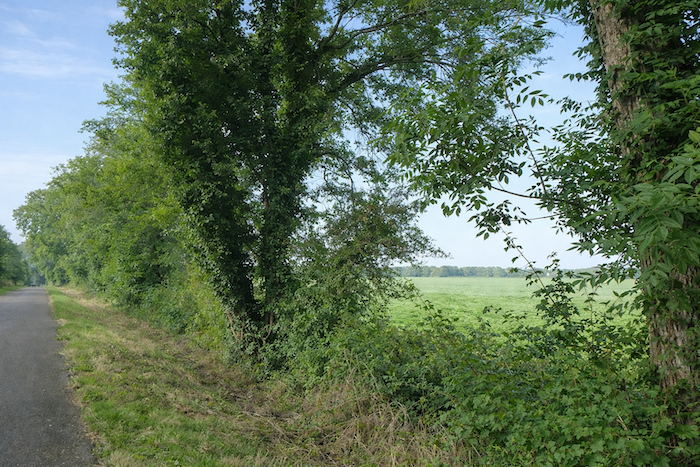
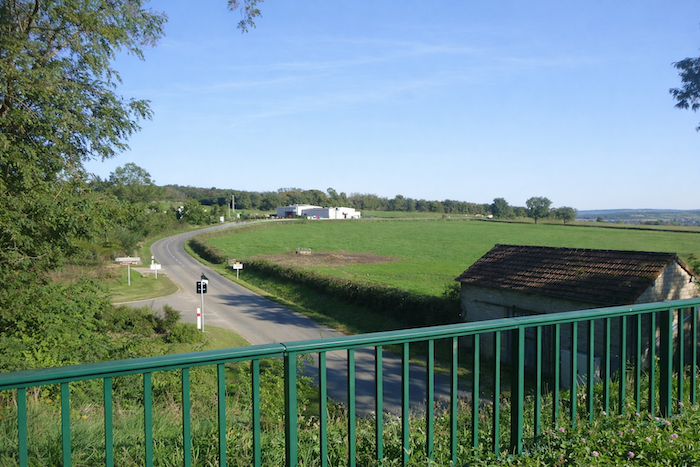
| Then, suddenly, it slips beneath the trees. The air grows cooler there, almost damp, and one has the impression of entering a vegetal corridor. |
 |
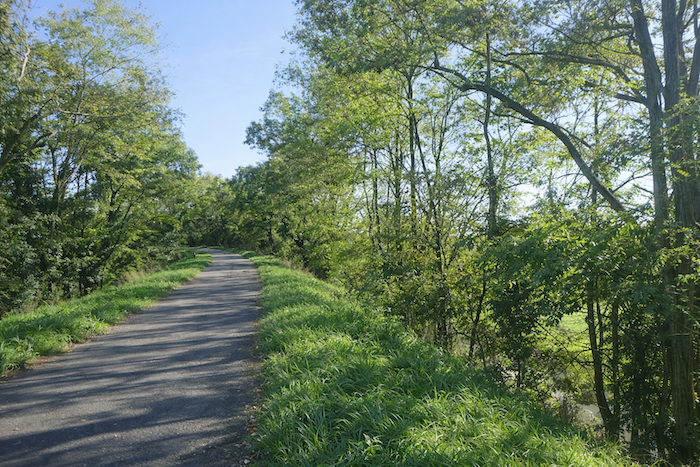 |
| Here, young poplars raise their pale columns, and ashes, numerous and confident, sometimes take precedence over the oaks themselves, as if nature had chosen to redistribute the roles upon its vast stage. |
 |
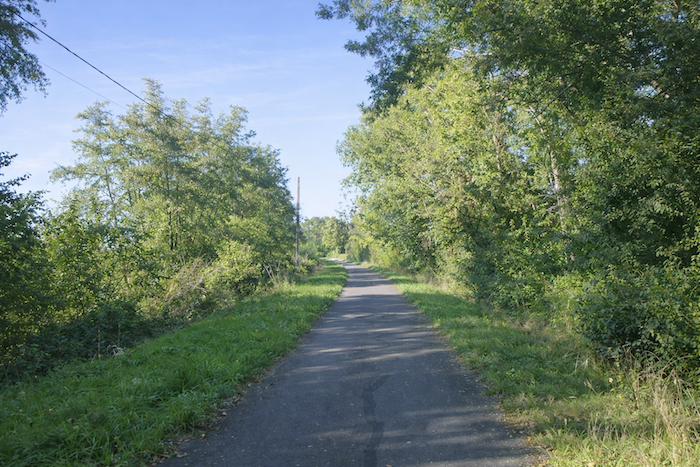 |
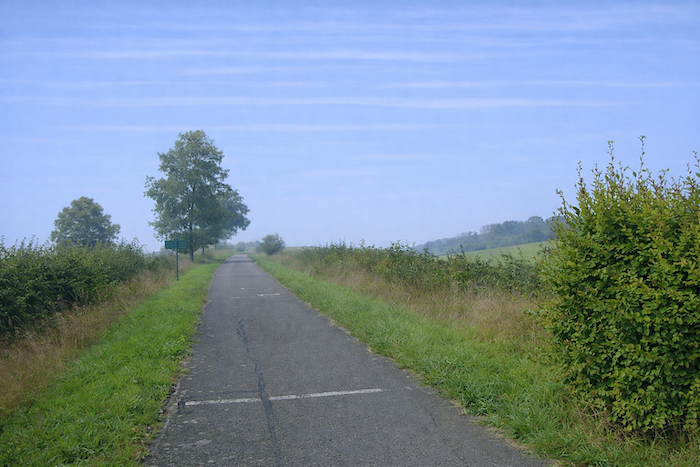
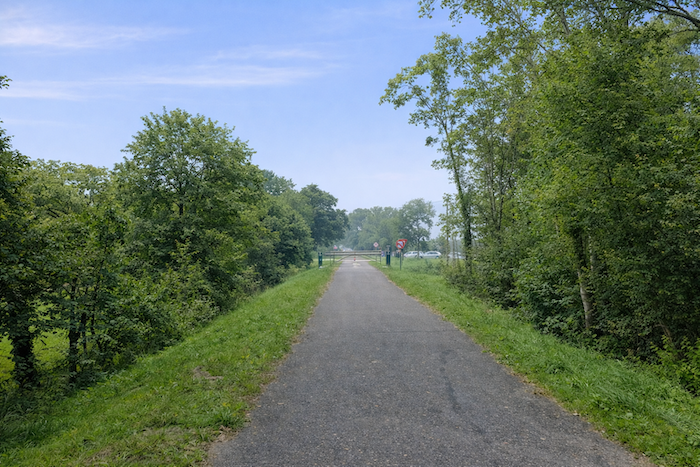
| The cycle path continues, monotonous and faithful to itself, always similar, at times slightly winding but most often straight, interrupted only by a few crossings with small transverse roads. A kilometer passes in this way, in a steady rhythm between shadow and light. |
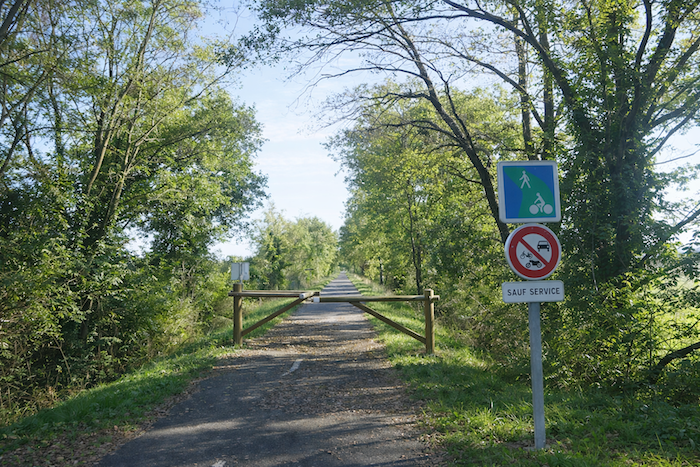 |
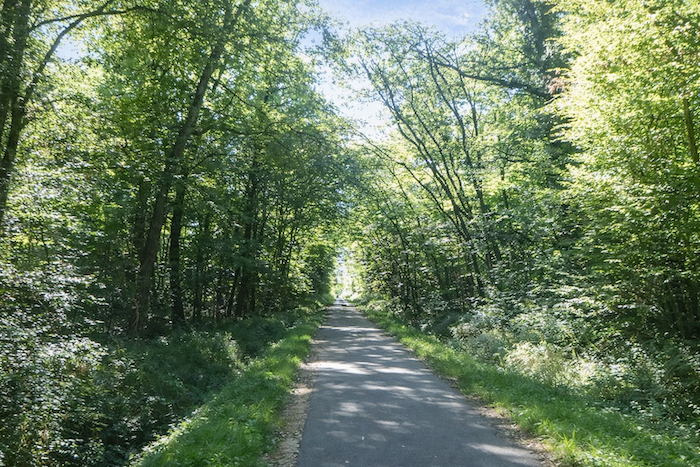 |
| Soon it crosses the stream of the Nourue, which flows modestly through a setting of rural grace. Wild grasses bend in the wind, willows lean over as if to listen to its murmur, and everything breathes a gentle bucolic softness. |
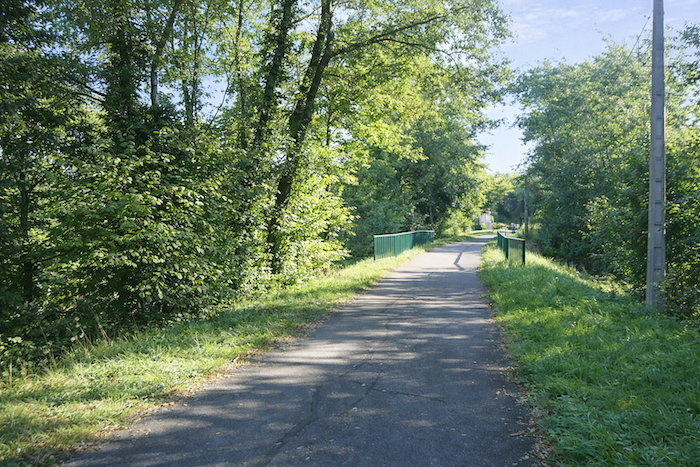 |
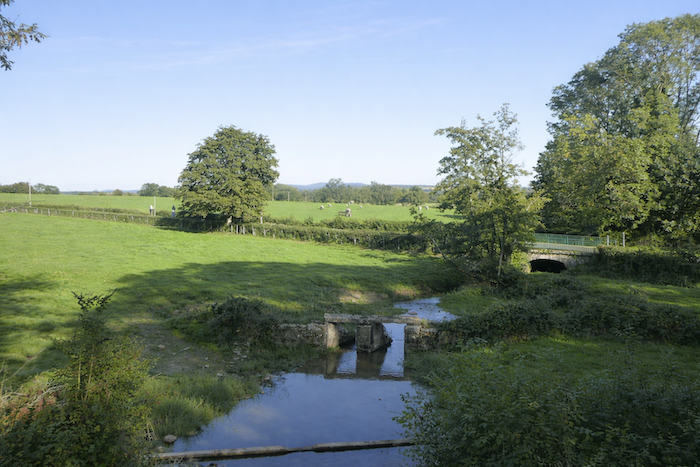 |
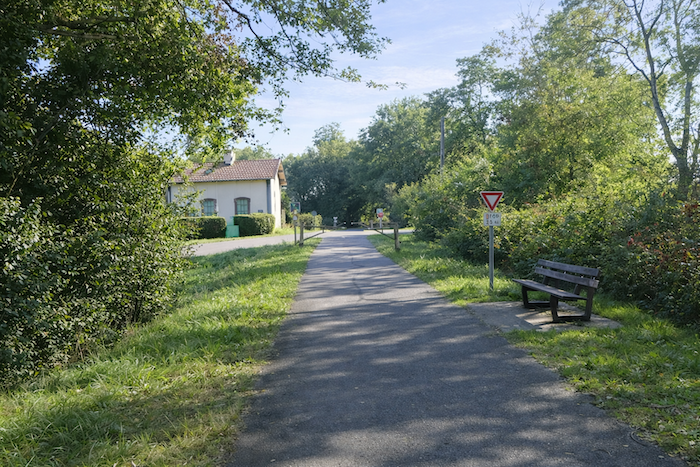
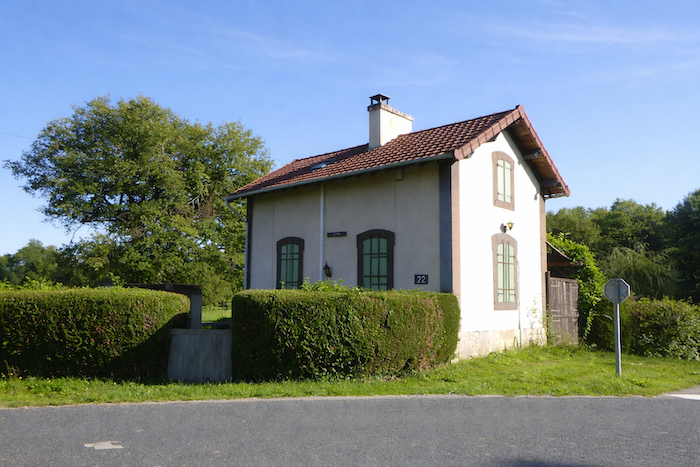
| Along the stream, the path runs beside the small station of Les Condamines, a silent building without future, no doubt abandoned for eternity. Its closed facade, worn by time, still evokes the halts of former days, when a few hurried travelers stepped down quickly onto the platform. |
 |
 |
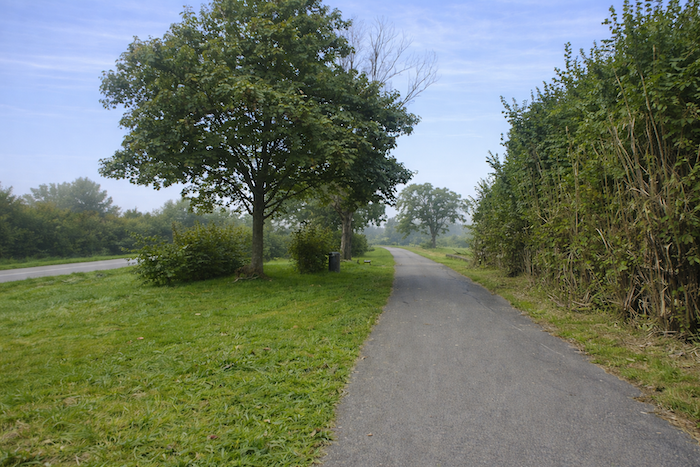
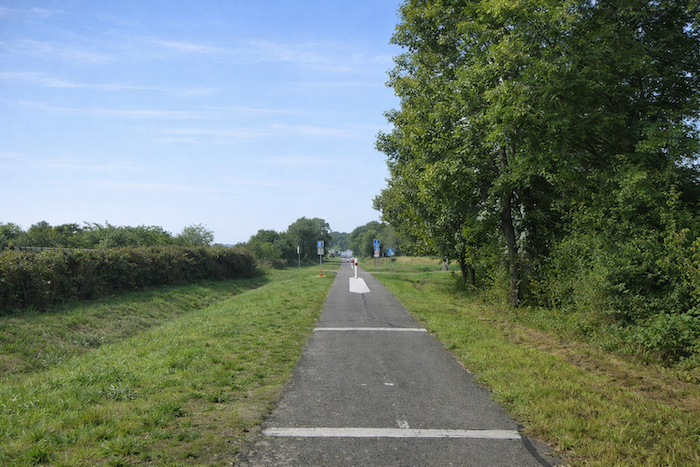
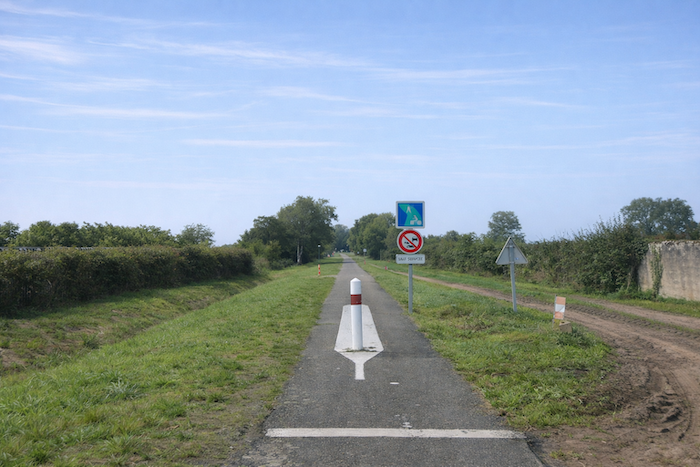
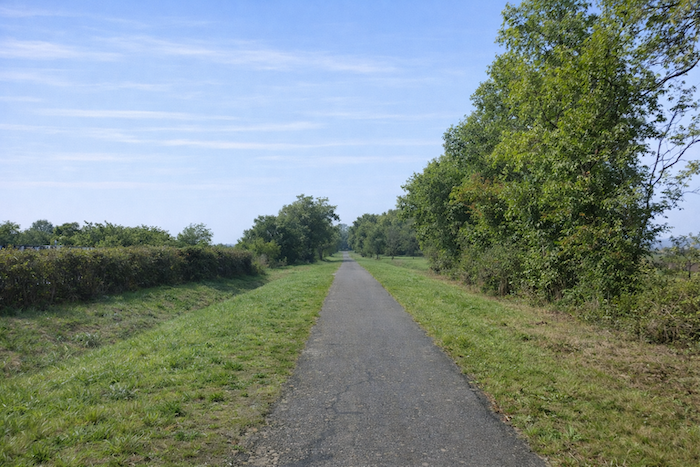
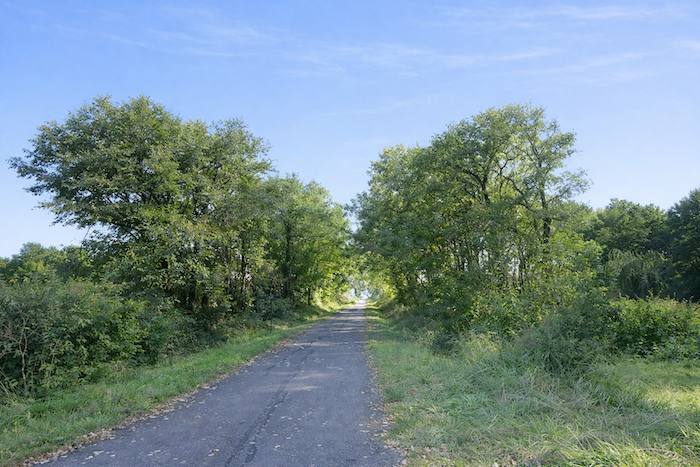
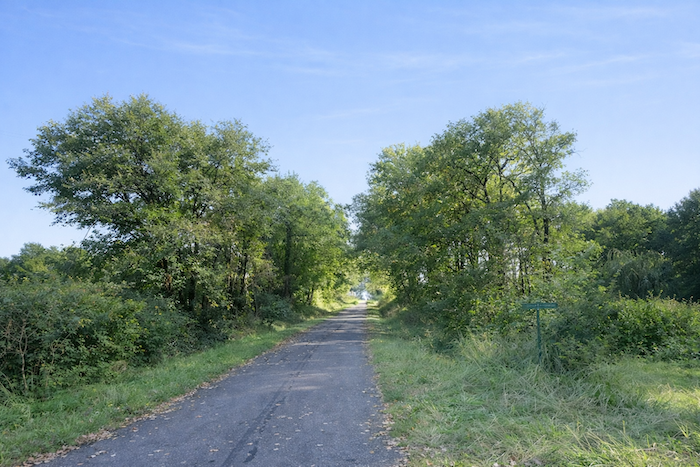
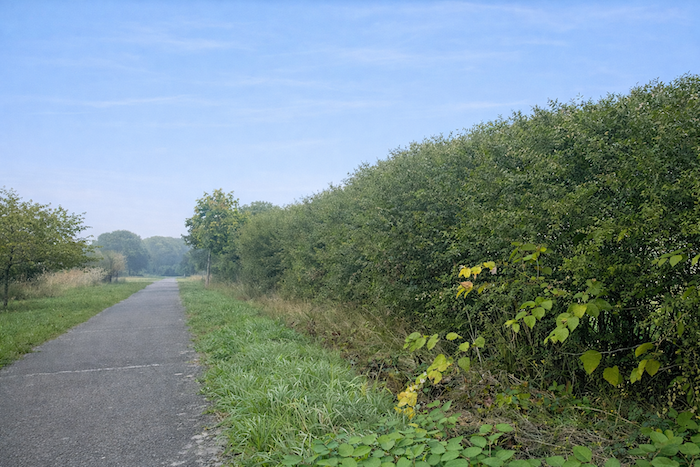
| But already the route resumes its obstinate pace. The path sets off again, straight and relentless, at times almost to the point of tedium. No longer enclosed by vast woods, it is now bordered by fine hedges of leafy trees, dense and regular, forming a green corridor that marks the way for cyclist and walker alike, |
 |
 |
Section 2: Here, a beautiful river crosses the cycle path
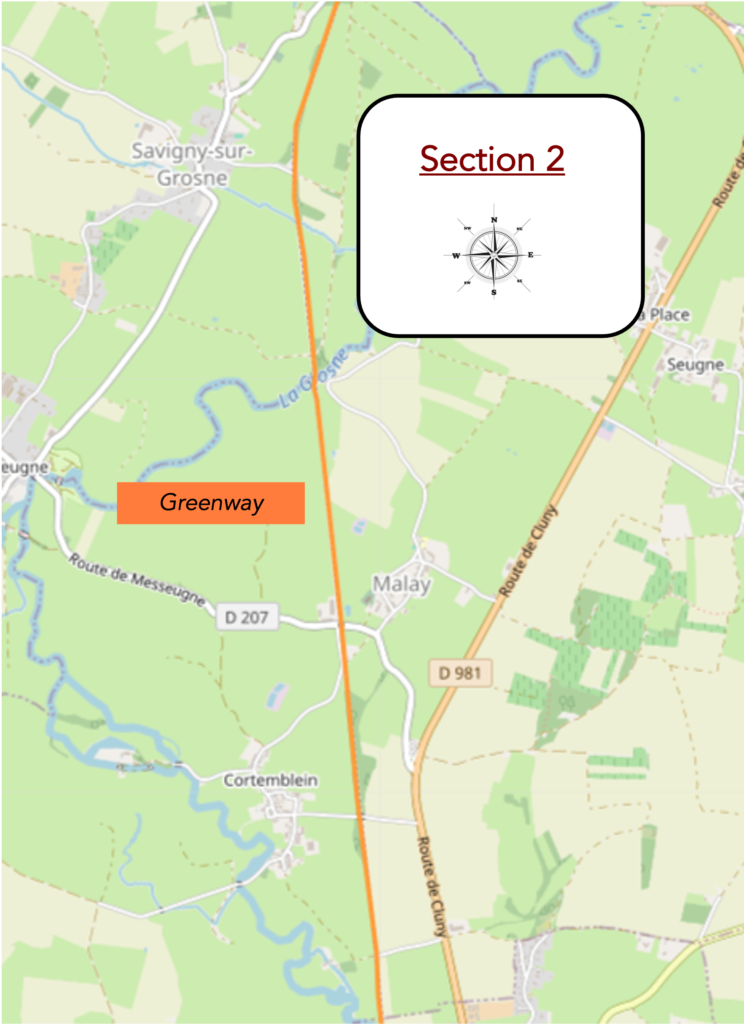
Overview of the route’s challenges: a route with no difficulty at all.
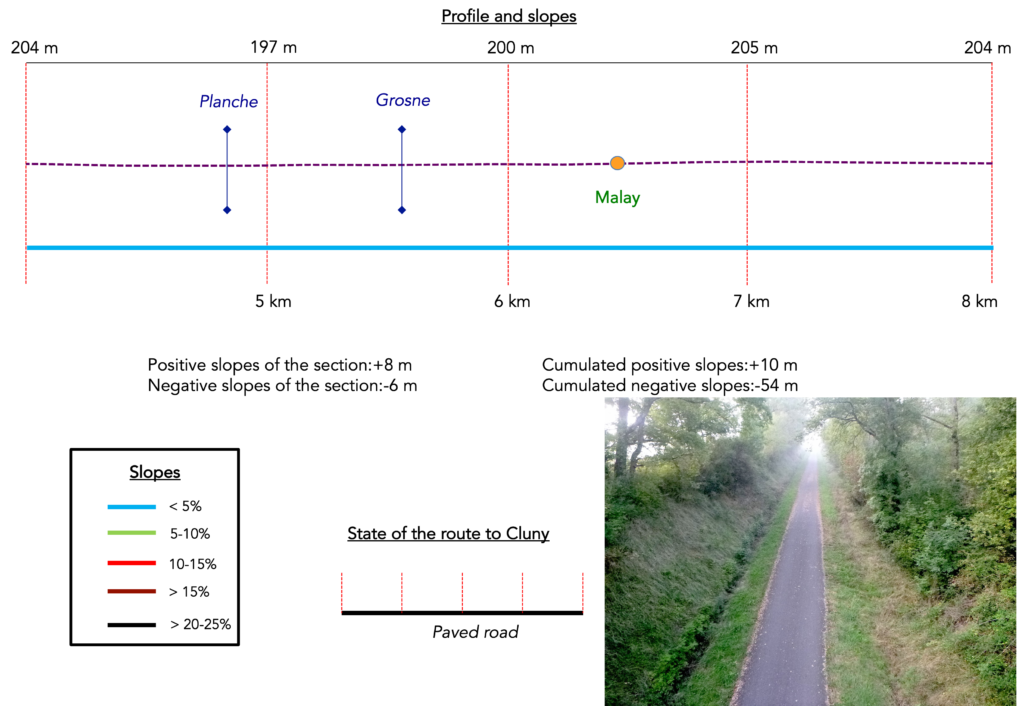
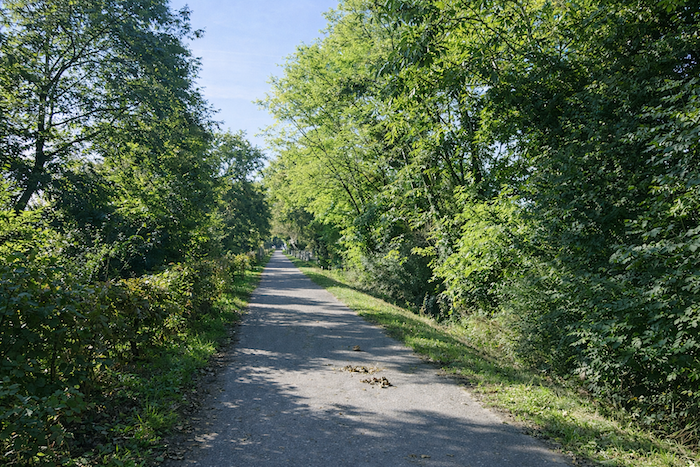
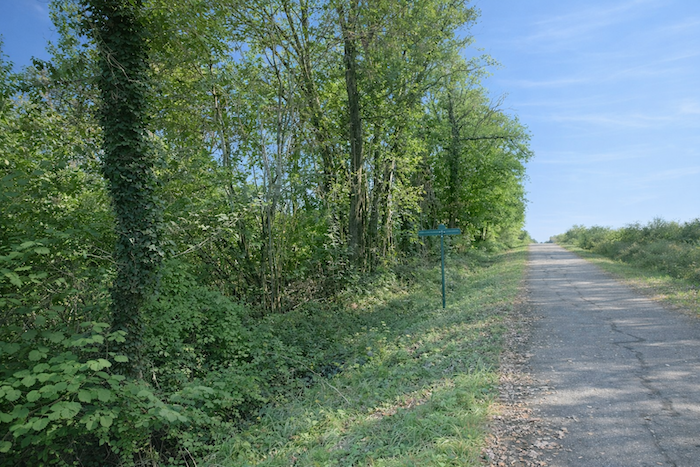
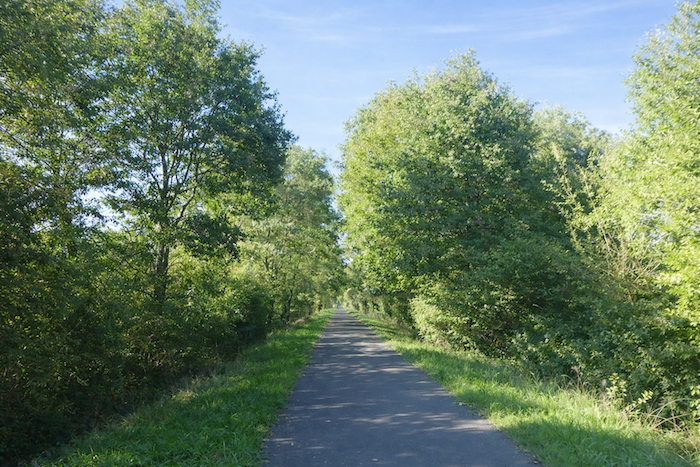
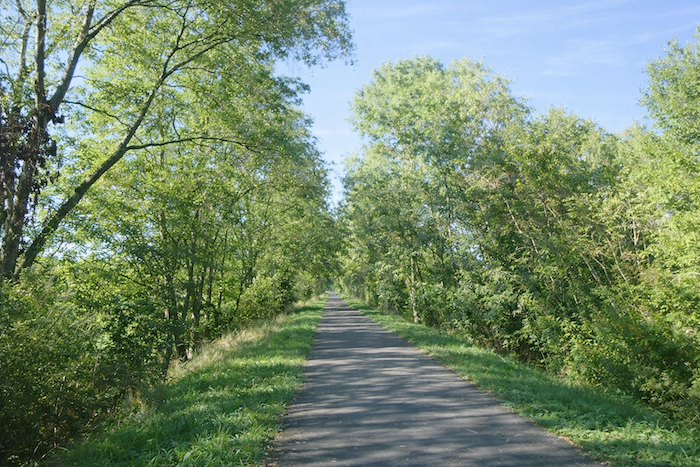
| Then the cycle path stretches on again, almost docile, for nearly another kilometer, always sheltered by the benevolent shade of leafy trees. Their branches sometimes meet above the way, forming a vegetal nave where the traveler advances in silence, wrapped in the scent of moss and humus. |
 |
 |
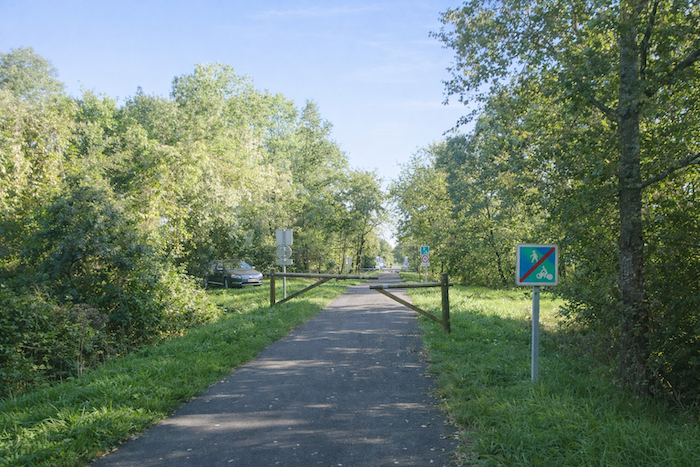
| A little farther on, a new intersection appears, like an invitation to choose, a hesitant branching between several paths. Yet the path keeps its logic and its determination, continuing along its untroubled line. |
 |
 |
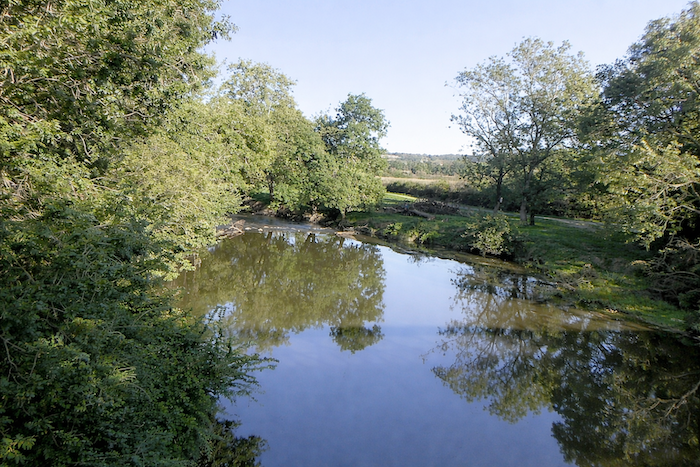
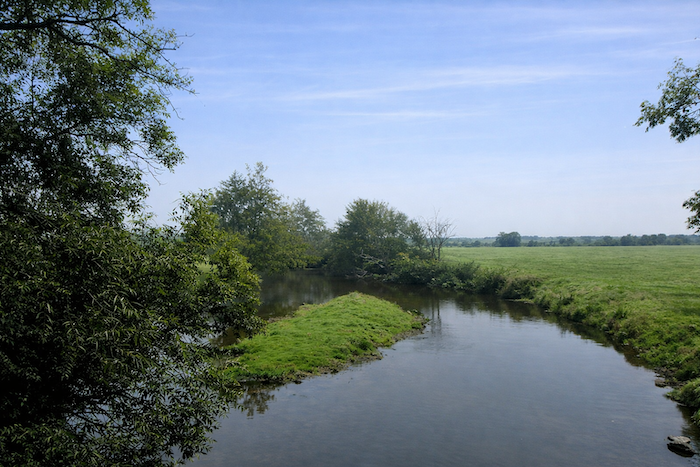
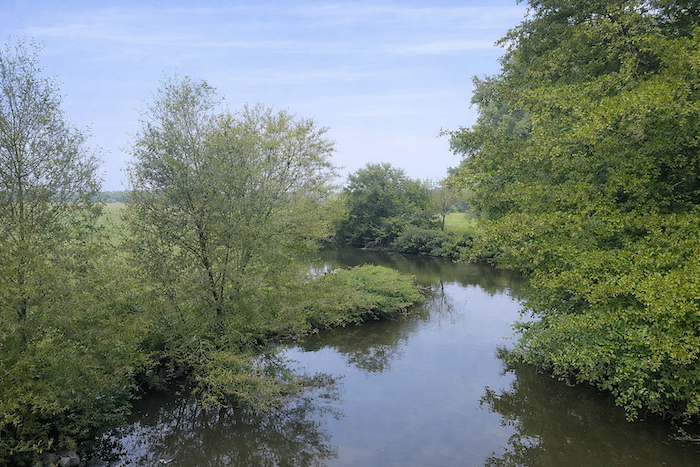
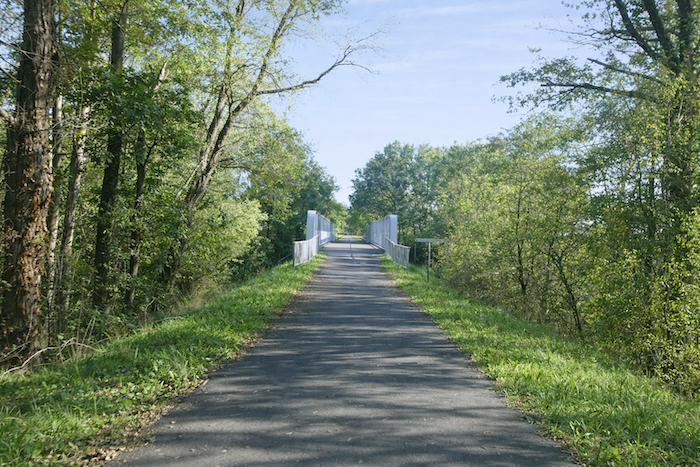
| It then crosses the Grosne, the only large river in the region, which you will encounter again later on your route. Its course, a little over one hundred kilometers long, rises in the hills of Beaujolais before losing itself in the broad Saône near Chalon sur Saône. Here, you are moving upstream, almost against the current of its history. The Grosne, dark and tranquil, draws wide meanders across the countryside, tracing its soft curves through meadows and poplar groves. It imposes upon the landscape its slow and almost meditative breathing. |
 |
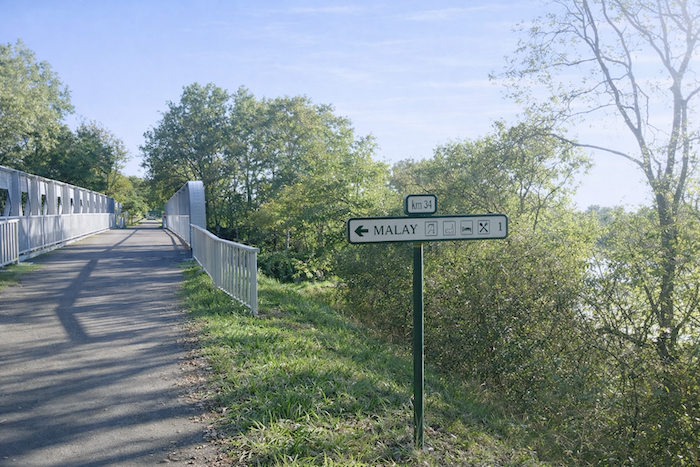 |
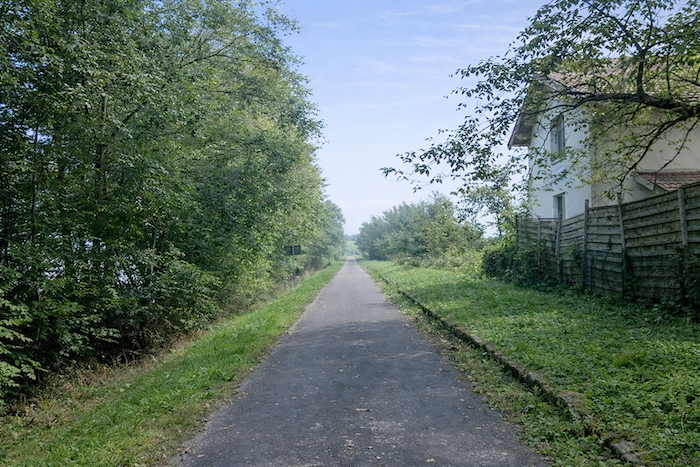
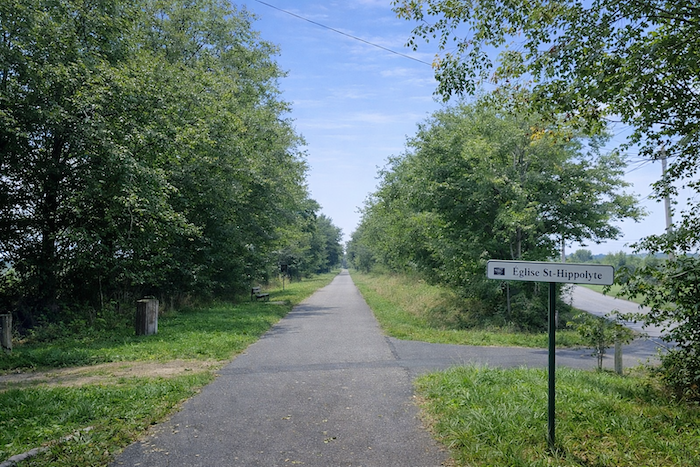
| After crossing the Grosne, the path runs alongside the abandoned station of Malay, a ghost of the railway past, before a sign points toward the church of Malay. Cyclists, eager for distance, and walkers, carried along by the thread of the path, continue straight ahead, even in fine weather, without turning aside. |
 |
 |
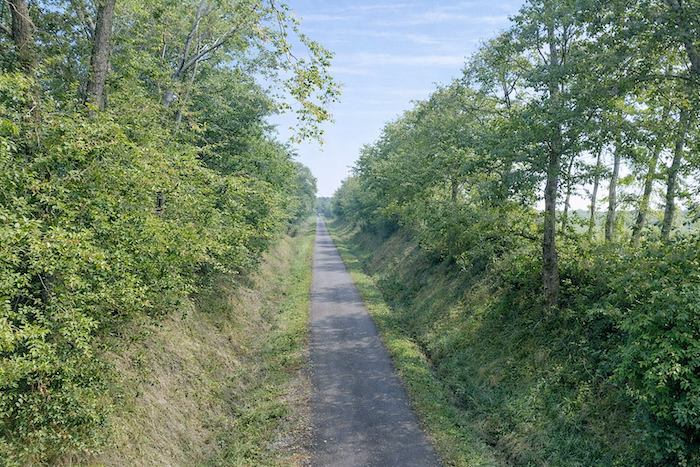
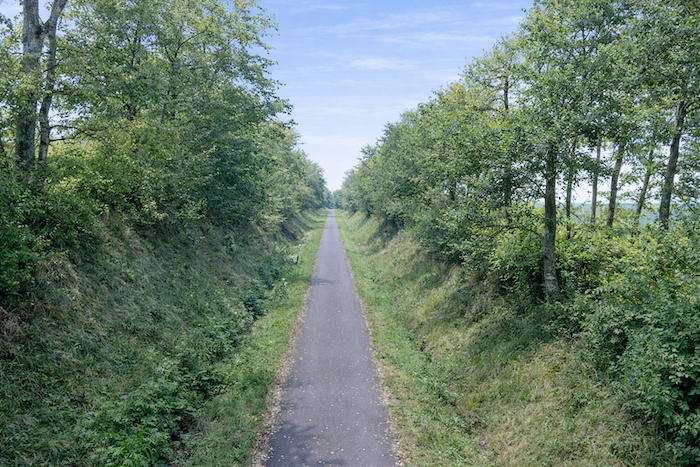
| Much farther on, after a good kilometer of straight line, the path passes beneath a bridge carrying the road that links Malay to Cortemblin. If you take the trouble to climb the embankment, you discover from this vantage point the almost disconcerting image of the path, a straight line stretching as far as the eye can see, absorbed by monotony. Once again, straightness prevails, for trains in former times had little regard for bends. |
 |
 |
Section 3: More kilometers on the cycle path
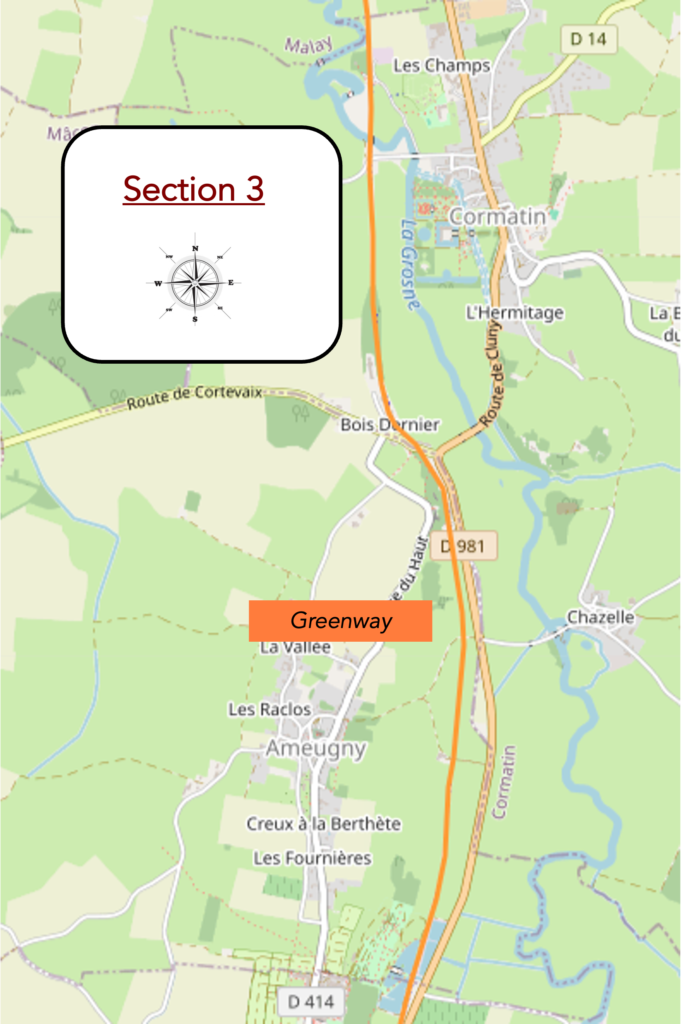
Overview of the route’s challenges:a route with no difficulty at all.
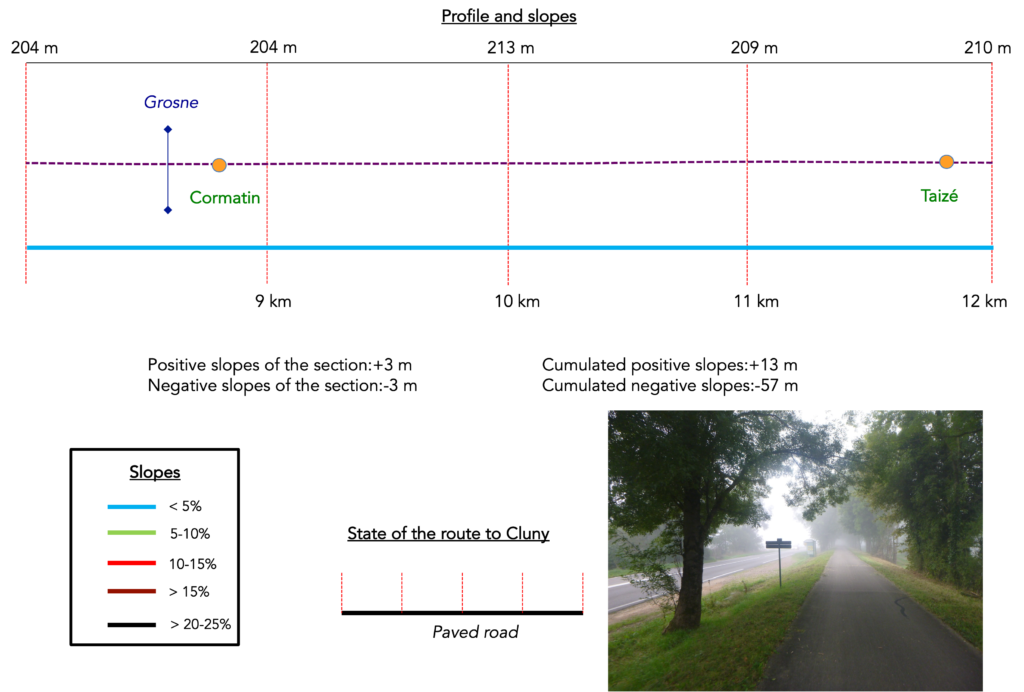
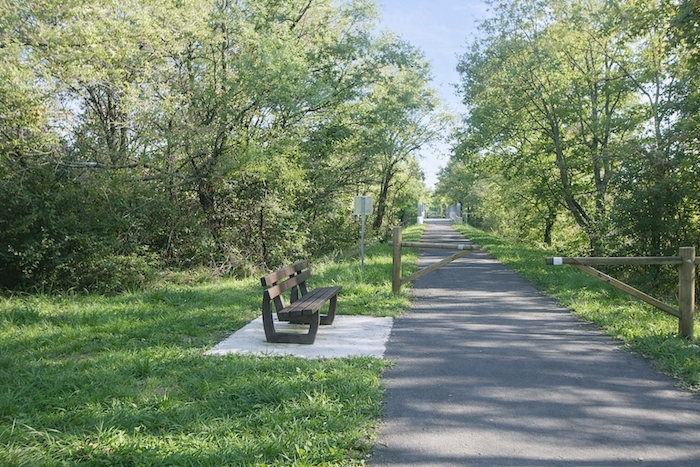
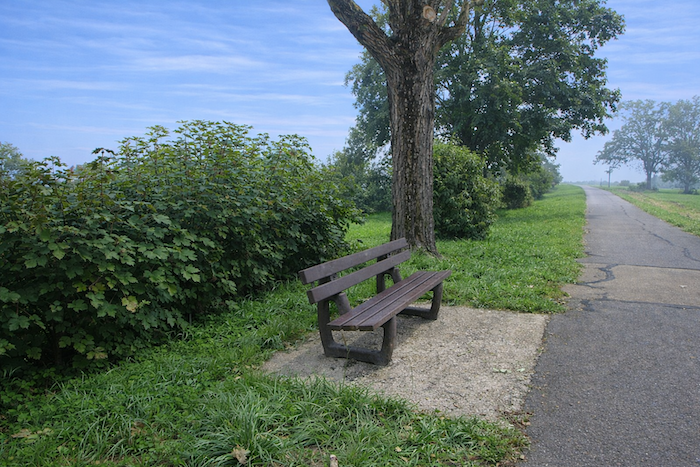
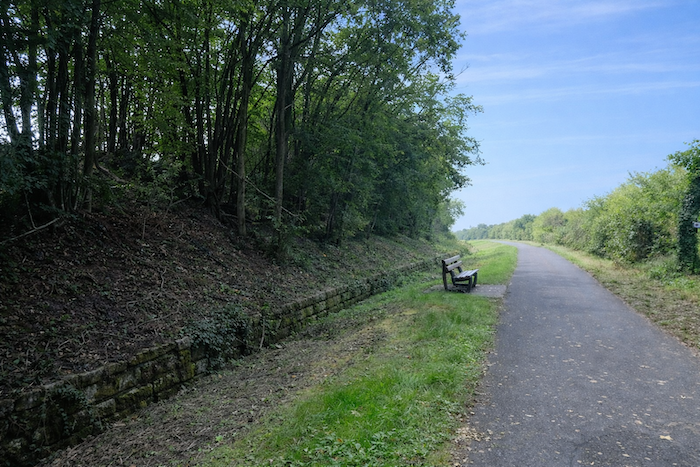
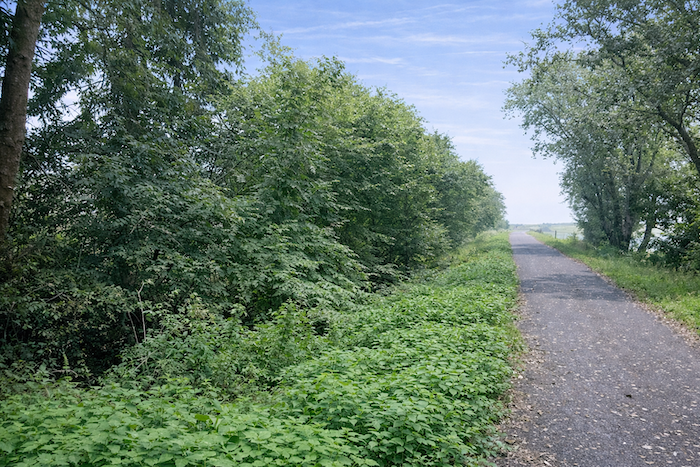
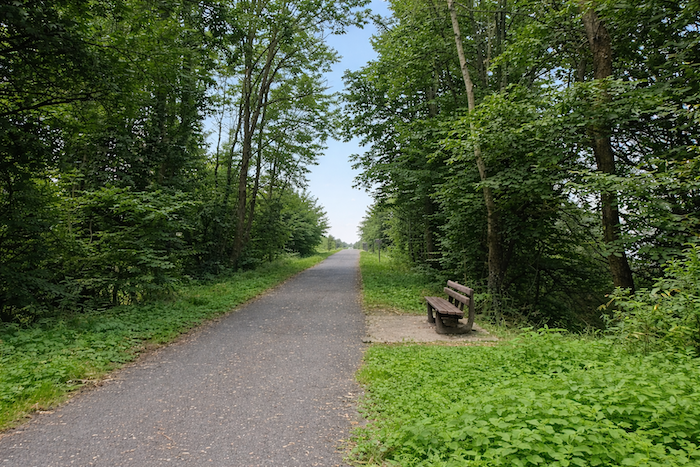
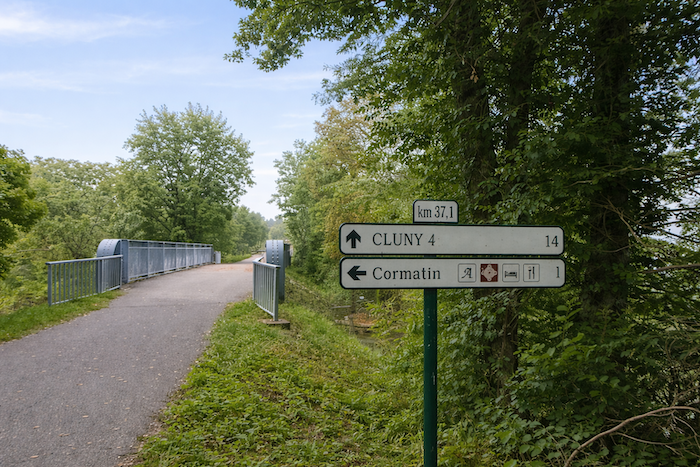
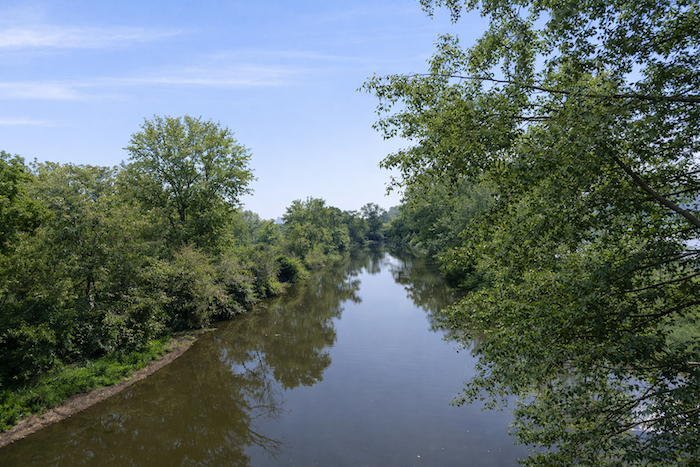
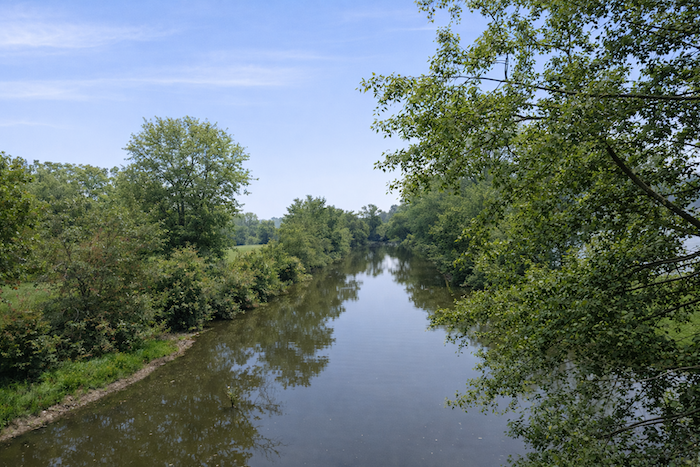
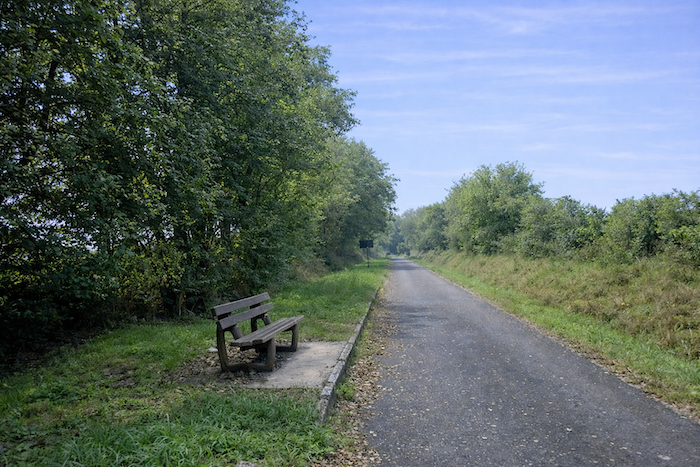
| The cycle path continues along its line, like a stubborn thread that refuses to yield to the opacity of morning. The only landmarks, modest yet essential, become discreet halts, a bench inviting rest, an intersection offering hesitation, or sometimes a simple indication of a detour, a number measuring the patience of the walker. Here, the path reaches the turning for Cormatin. You will likely meet many cyclists heading toward the village, drawn by its promise. Cormatin, with its lively shops and welcoming restaurants, offers a pause before the long-awaited arrival in Cluny. For a cyclist, a one-kilometer detour is merely a breath within the momentum. For a walker, it is another matter, a hesitation, a calculation of fatigue. Here, the path once again draws near the Grosne, that ribbon of water which accompanies the route like a shifting shadow. |
 |
 |
 |
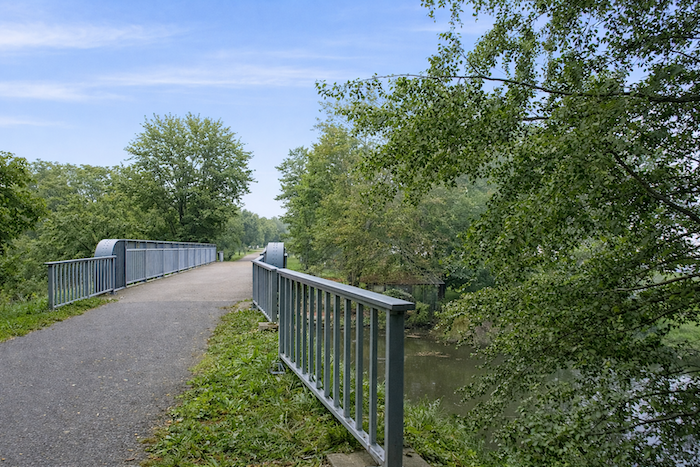 |
| Under the veil of fog as under the brilliance of sunlight, the river transforms itself. Wrapped in mist, it becomes spectral, mysterious and gray. Revealed by the sun, it turns into a bright mirror scattered with light. It is at once the same and another, now a muted voice, now a resonant song. |
 |
 |
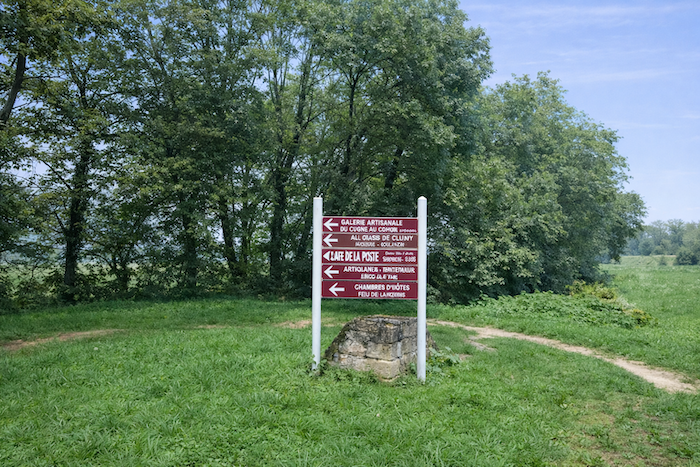
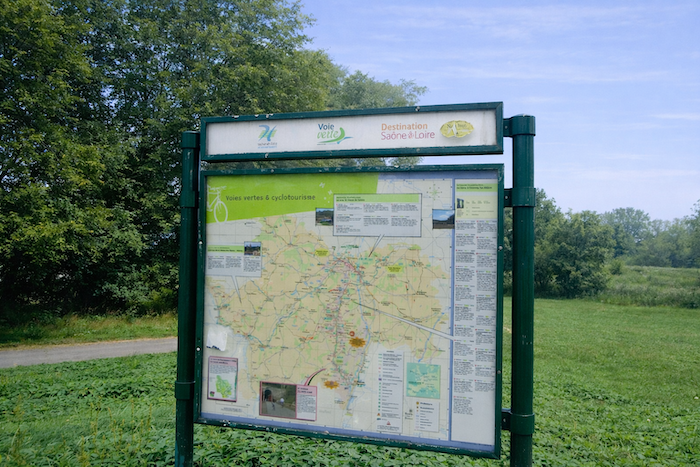
| Still following the hedge of tall trees that form a natural corridor, the straight path stretches onward and meets yet another intersection for Cormatin. There, tourist attractions are displayed with the insistence of signs inviting you to discover even more, and as if to entice the traveler, additional loops are proposed for cyclists, promises of cheerful detours and unexpected pauses. |
 |
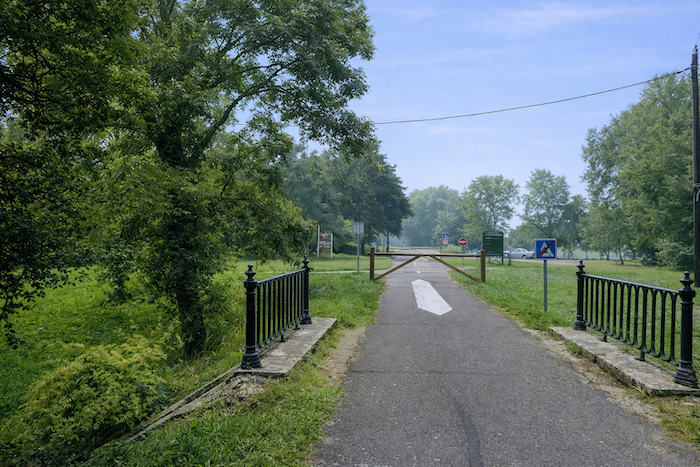 |
| And the greenway continues its route with obstinacy, straight as a fixed thought, insistent as a melody that cannot be dismissed, unyielding as a rule whose authority nothing can bend. It imposes its rhythm upon the walker without concession. |
 |
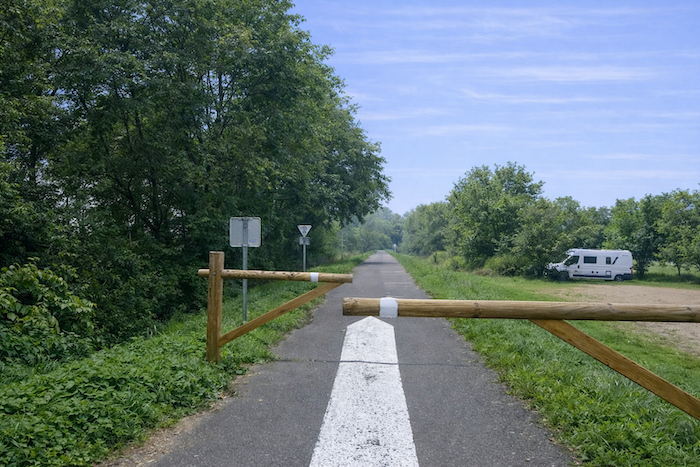 |
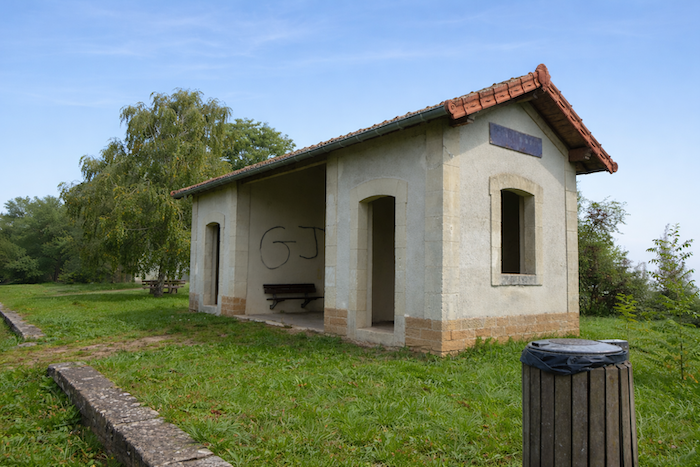
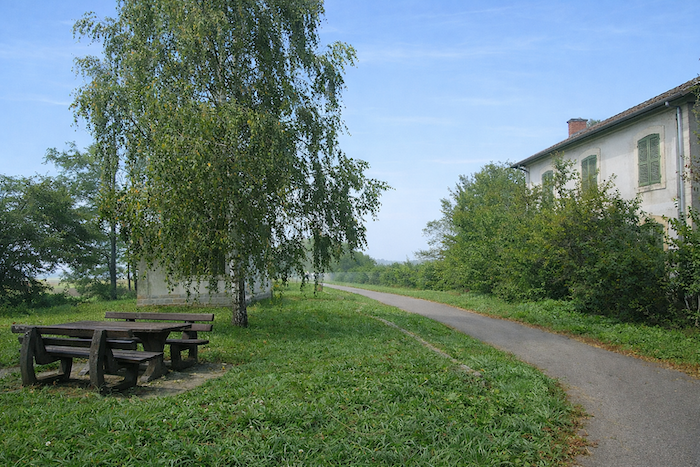
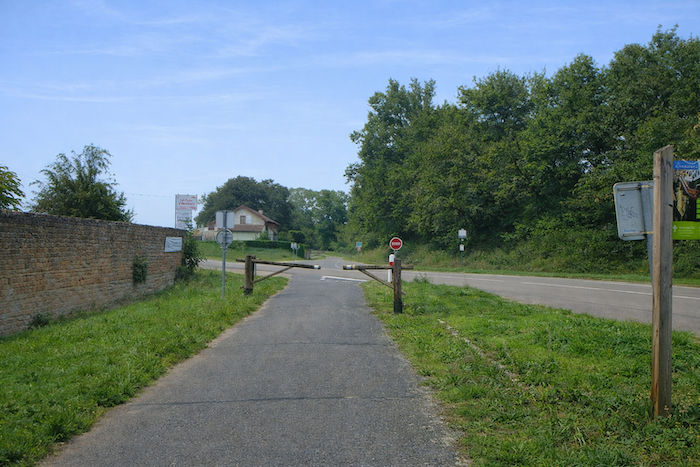
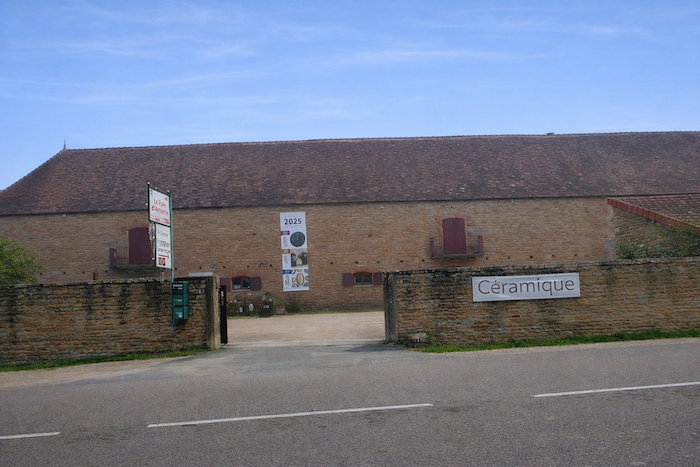
| Soon it reaches the place called Le Papyllon, where the station, now silent, stands like a scar from the past. Abandoned and disused, it remains a witness to an era when trains beat through the countryside. There, the path crosses a small departmental road, discreet, beside which a ceramics workshop stands, almost like an artistic pause in the midst of monotony. |
 |
 |
 |
 |
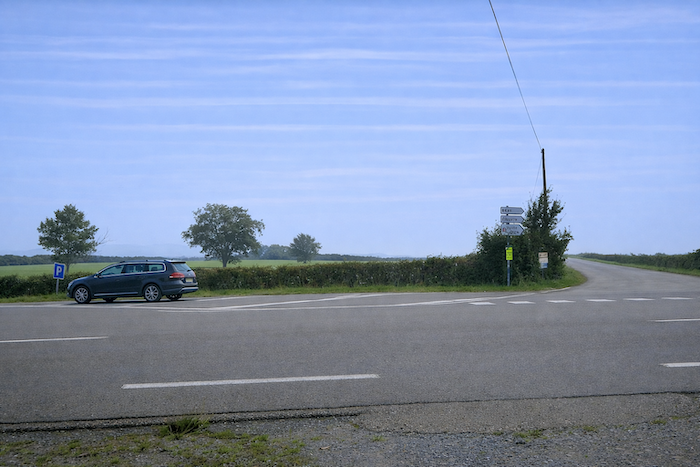
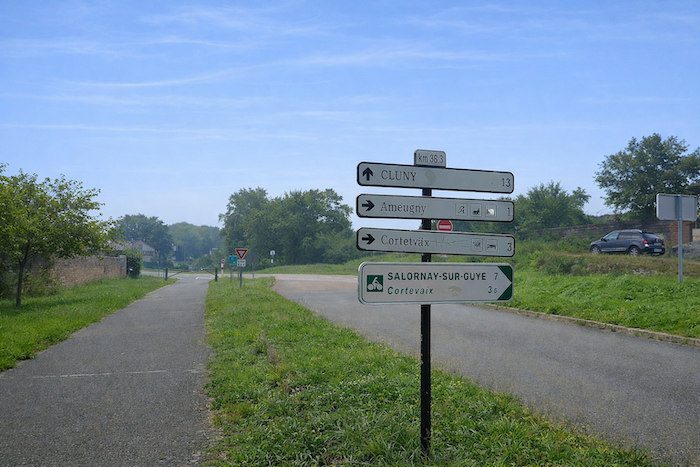
| On this uniform way, weariness may appear. The flatness, kind to the legs, can weigh upon the mind. The absence of effort sometimes becomes another effort, that of resisting boredom. The rare points of interest remain the intersections, those crossings of the path where one hopes at last that something might happen, an unexpected break in monotony. Here is another. A few steps away, another intersection opens toward Ameugny or Cortevaix. Here you are invited to stay overnight, there to visit a Romanesque church, an ancient treasure suggested to cyclists. For you, attentive walker or traveler, the essential message remains more prosaic, thirteen kilometers still separate you from Cluny. |
 |
 |
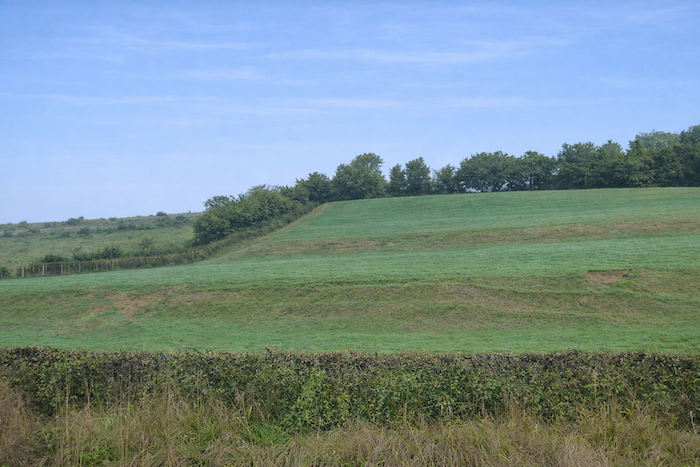
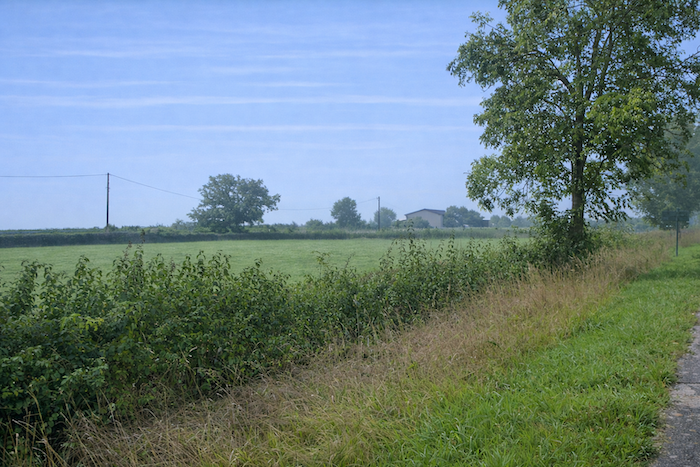
| The setting here softens and becomes more pastoral. Green meadows stretch out peacefully, like a carpet sown with grasses moving in the wind. The fields breathe a simple serenity, and in the freshness of dew or the scent of cut grass one senses a discreetly pulsing life. Cows, calm silhouettes, lend this landscape a familiar and almost intimate character, as if the countryside itself were offering you its hospitality. |
 |
 |
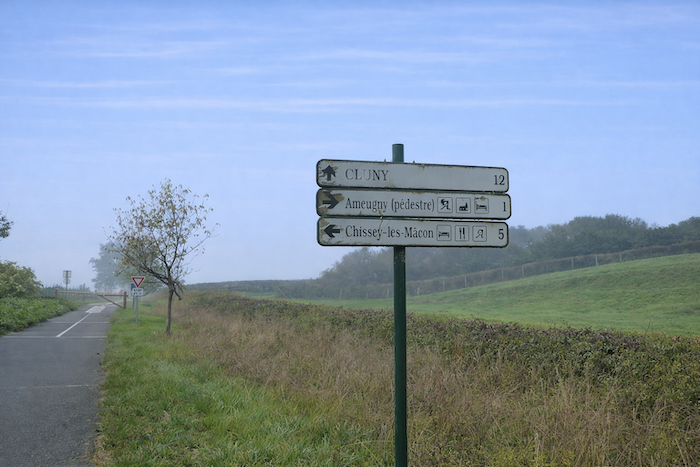
| Another intersection, almost immediate, leads you toward Ameugny, very close, just steps from the path. Barely a kilometer has passed since the last turning, and already the signs remind you that Cluny remains twelve kilometers away. The number inscribed there acts like a small measure of time, a promise for hurried cyclists, a reminder of effort for patient walkers. |
 |
 |
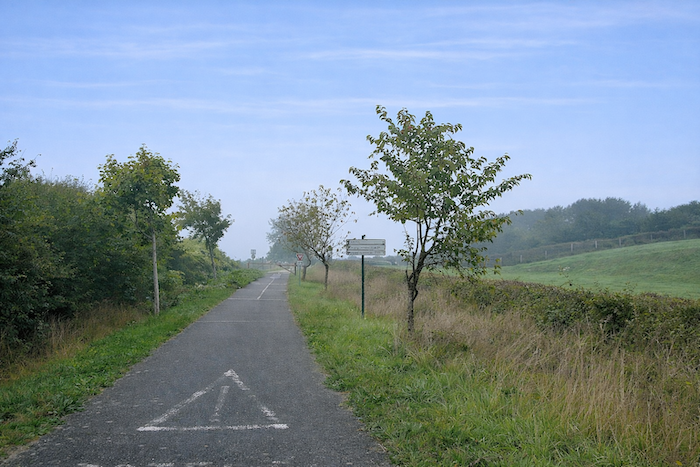
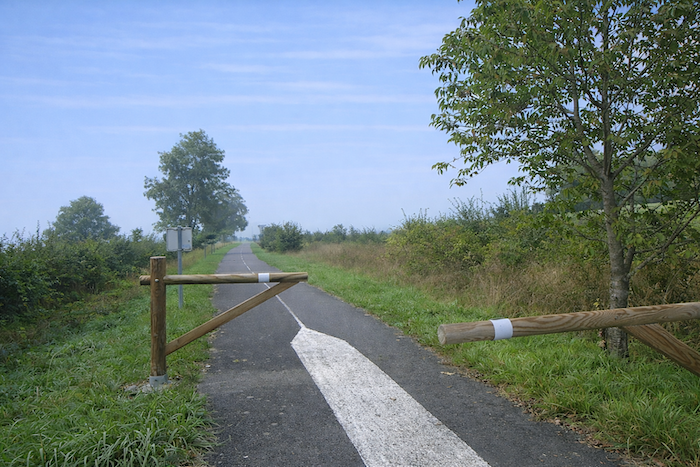
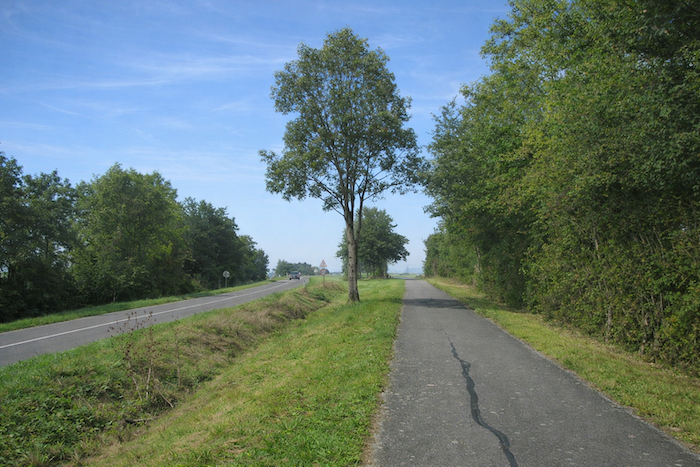
| Nothing catches the eye along this stretch, nothing sparkles, except the certainty that you are gradually drawing closer to the main departmental road D981. This broad and noisy road seems to announce the modern world imposing itself beyond the hedge, fast cars, a gray ribbon rushing ahead, in sharp contrast with the peaceful slowness of the greenway. |
 |
 |
| Now you move parallel to this artery, advancing side by side, as if two temporalities were walking together, that of engines and asphalt, hurried and tense, and that of the tranquil step or the smooth turning of wheels on the cycle path. The two routes follow one another without meeting, each faithful to its own rhythm, until the turning for Taizé. |
 |
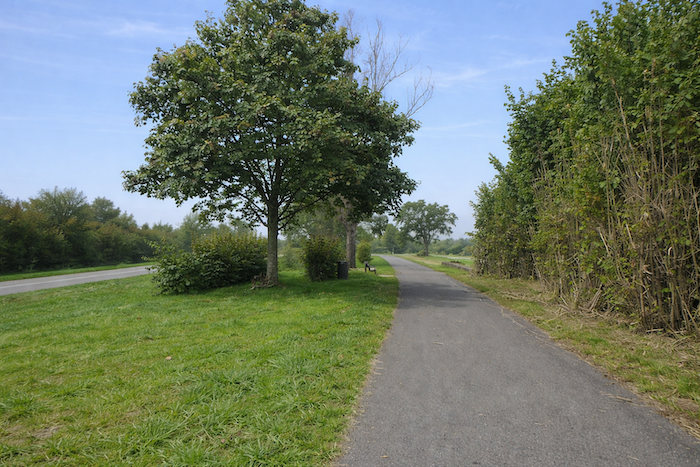 |
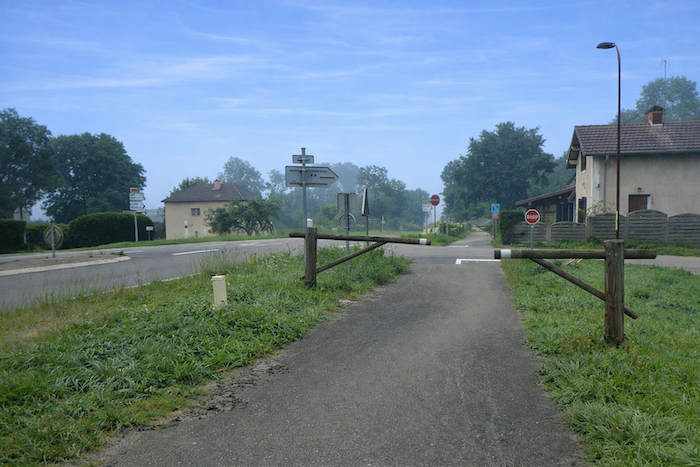
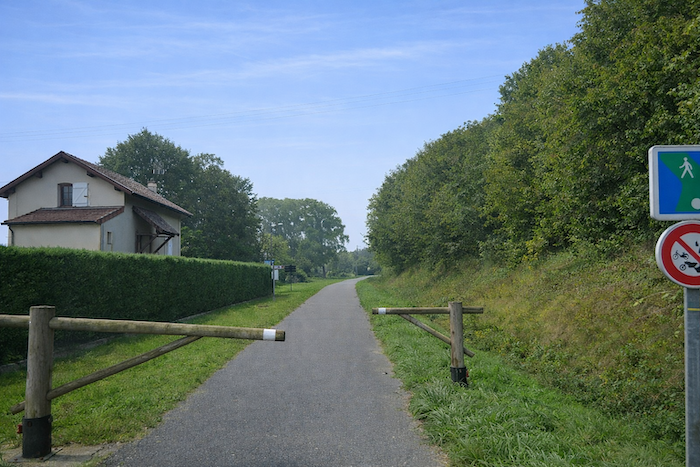
| Soon the cycle path reaches this turning. Here, a small station still stands, and one senses that it is inhabited, as if it had refused the fate of other abandoned buildings. This structure, both witness to the railway past and sign of present life, gives the place a singular presence, almost warm in the midst of monotony. |
 |
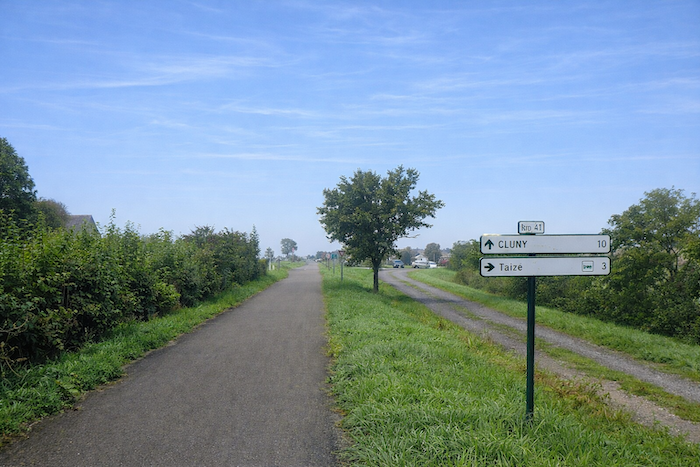 |
The community of Taizé lies not far from here, barely a kilometer from the cycle path. It is a Christian monastic community, ecumenical and fraternal, which took root in this corner of Saône et Loire in 1944 under the impulse of Roger Schutz, a Swiss pastor. Today it still gathers around eighty brothers from many horizons, Catholic, Protestant and Anglican. Their choice is that of essentials, a life of prayer, simplicity, sharing and celibacy. For the traveler, Taizé is at once a spiritual halt and a window open to the universal, a place outside time where fraternity can be heard resounding.
Section 4: More kilometers on the cycle path
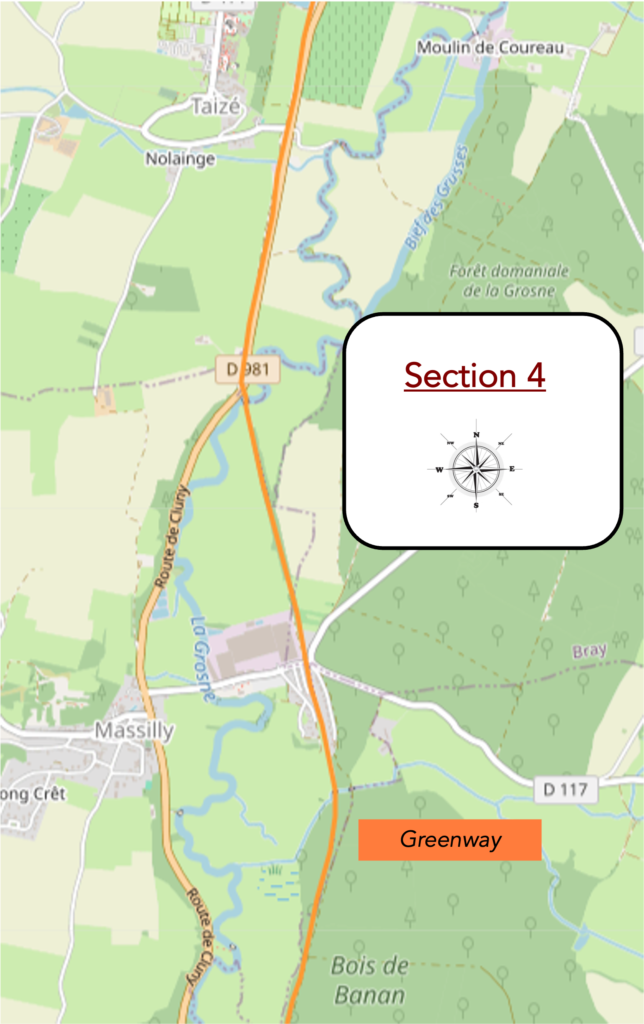
Overview of the route’s challenges: a route with no difficulty at all.
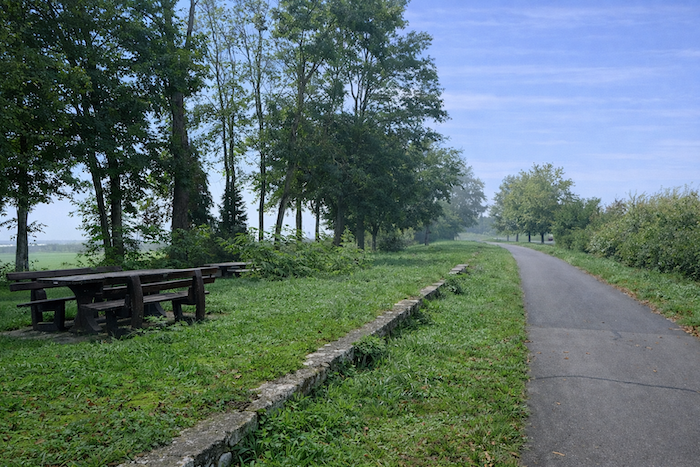
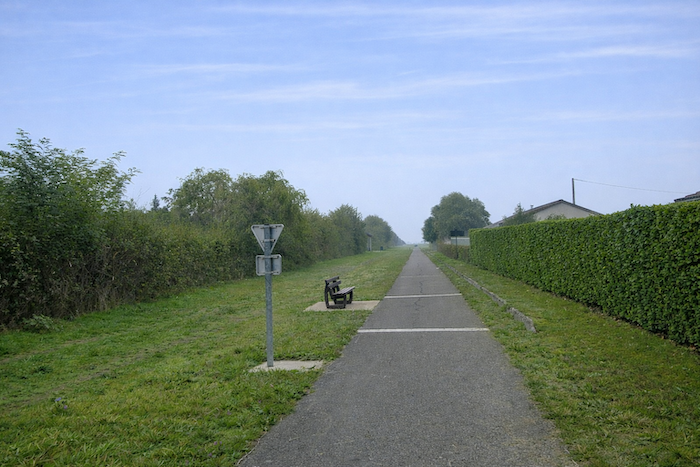
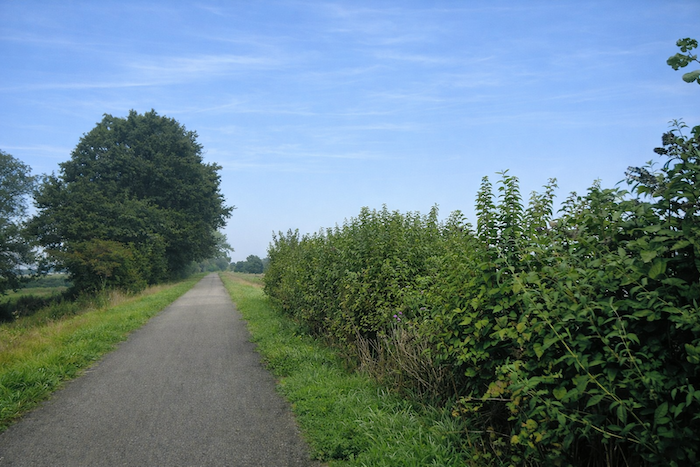
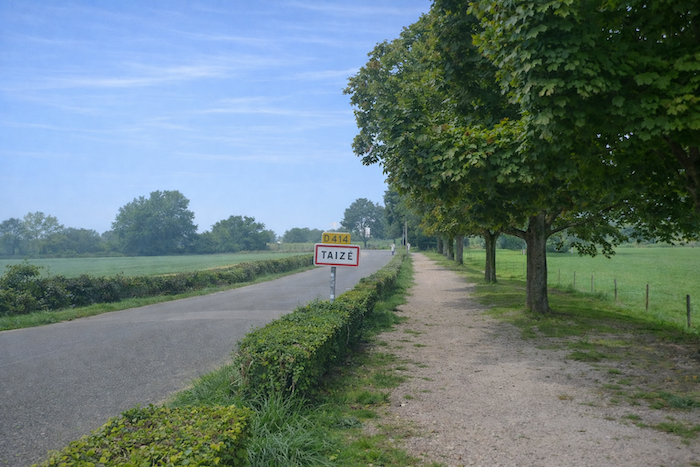
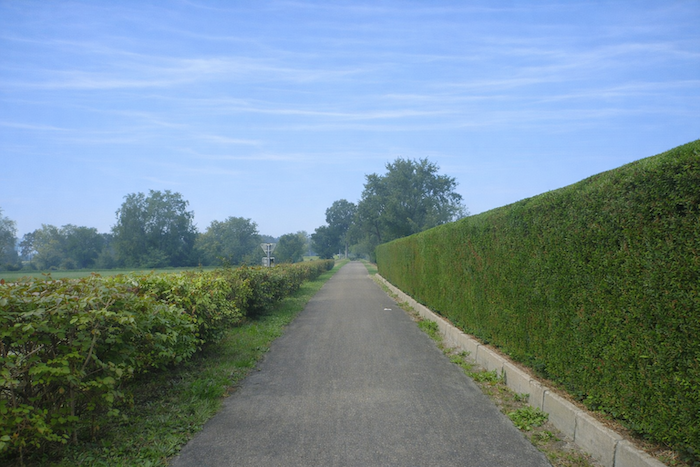
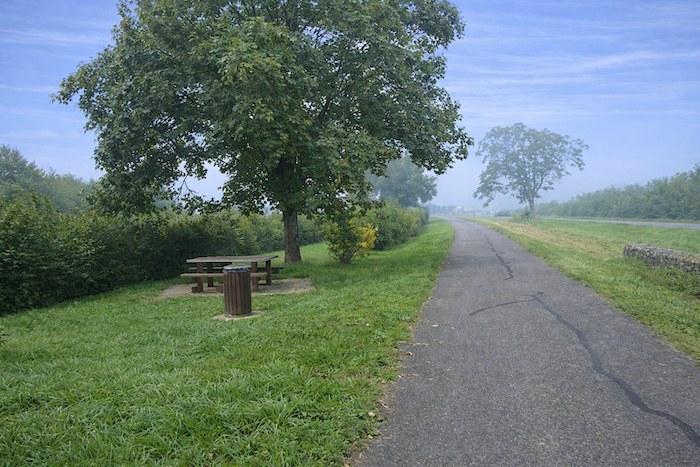
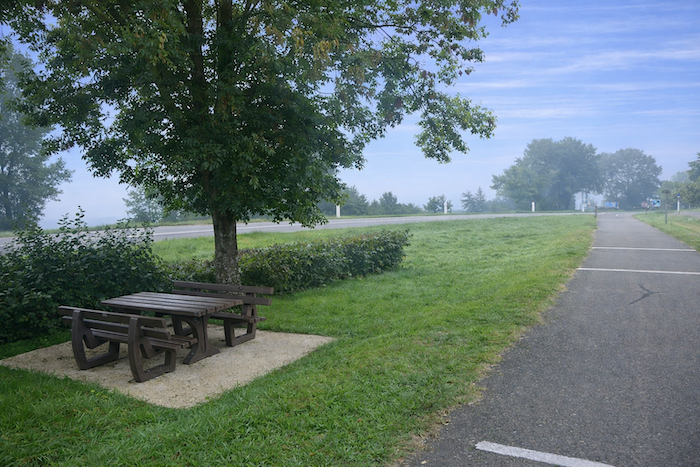
| From the turning for Taizé, the cycle path resumes its course, straight as an obstinate idea, smooth and predictable, almost monotonous in its eternal regularity. It unrolls its ribbon of asphalt without end, without detour, without surprise, sometimes interrupted only by the discreet presence of a solitary bench. These halts often seem almost unnecessary, as if the path, too easy, never truly required rest. The way advances effortlessly, a faithful companion running alongside the departmental road, silent witness to a tranquil journey. |
 |
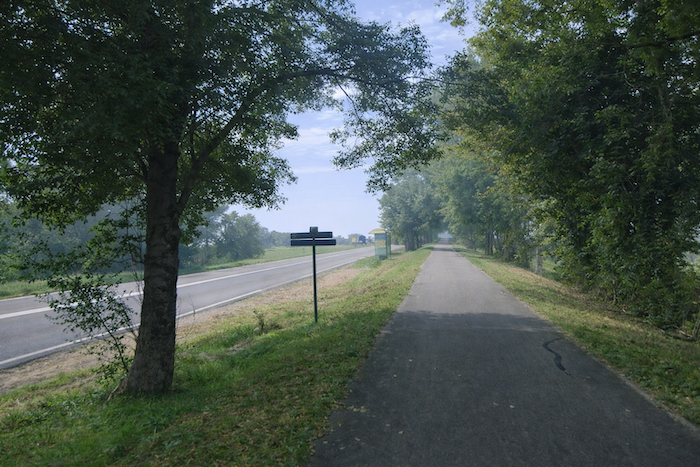 |
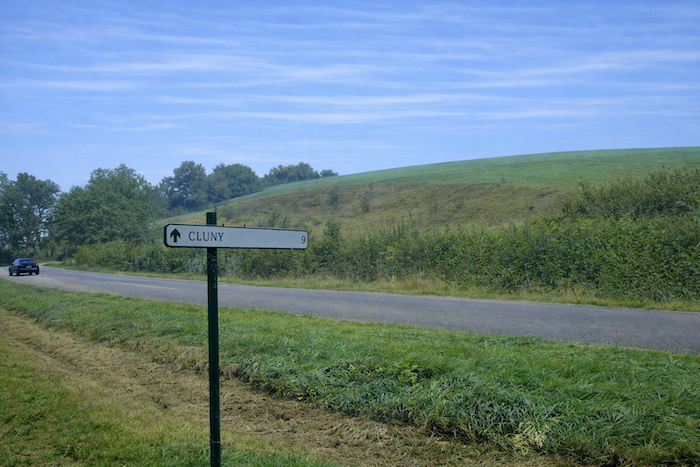
| A little farther on, it slips between two roads, a fragile link drawn across the landscape. Nine kilometers from Cluny, you continue forward, carried almost in spite of yourself by the momentum of the path, as if drawn along by a movement that nothing can halt. Distance is no longer an obstacle but a simple fact. |
 |
 |
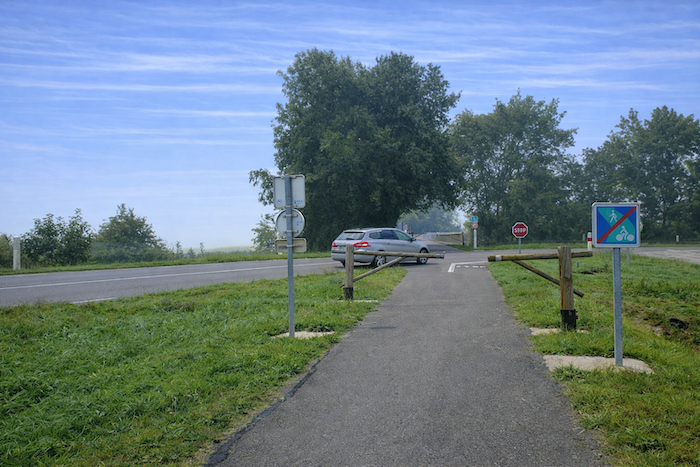
| Then, weary perhaps of its own monotony and as if seeking to vary the scene, the path allows itself a small change. It crosses the main departmental road and moves to the other side. This road, important in the local geography, does not bear the burden of heavy traffic. Here you cross a sparsely inhabited countryside where cars rarely disturb the quiet. The journey continues at the measured rhythm of a land that breathes slowly. |
 |
 |
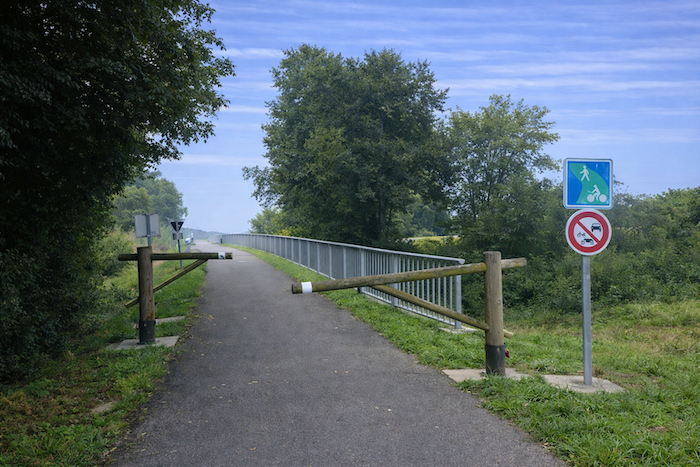
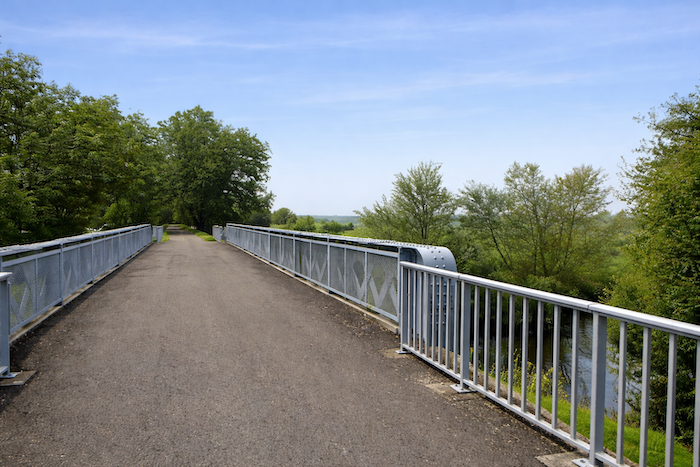
| The cycle path then crosses the Grosne once more. The river remains faithful to itself, dark and secretive, slipping beneath foliage and vanishing among willows, alders and tangled undergrowth. One might imagine overhearing a whispered confidence between trees and water, a murmur of freshness beneath the leaves. |
 |
 |
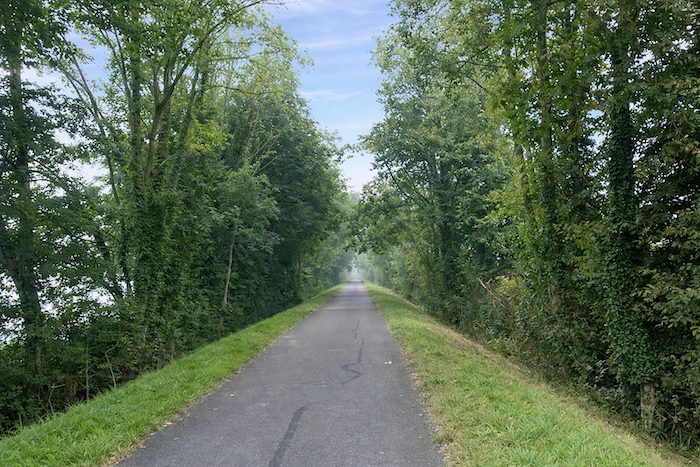
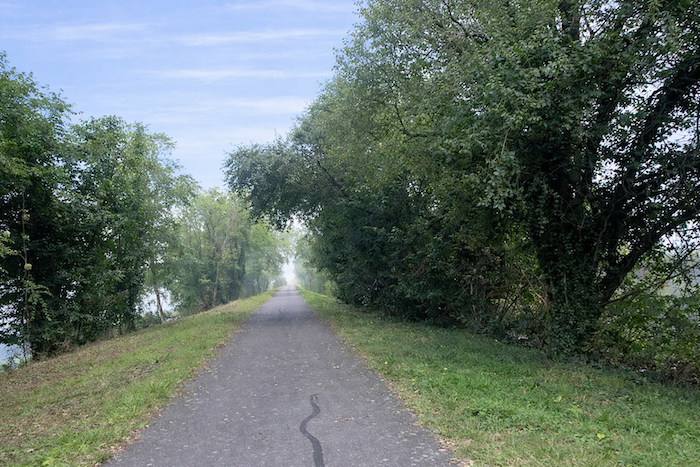
| And the greenway resumes its steady progress, as if it had paused only briefly beside the river. The path remains the same, a narrow strip of asphalt unrolling its simplicity beneath the vigilant presence of oaks, maples and beeches. These trees, standing like patient sentinels, filter the light, cast shifting shadows and give the cyclist the impression of moving through a silent nave where each trunk serves as a column. |
 |
 |
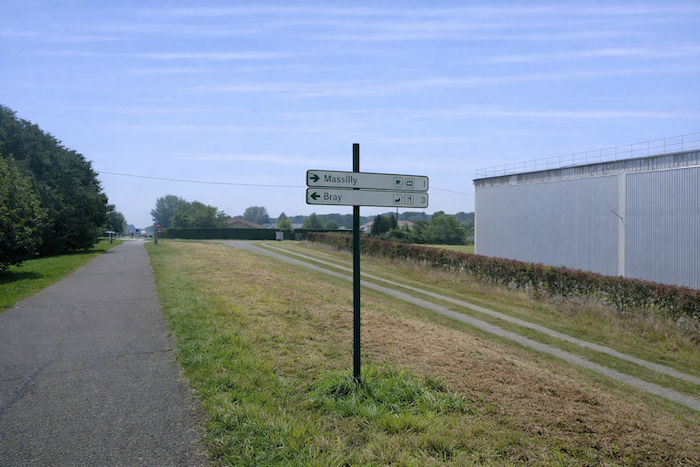
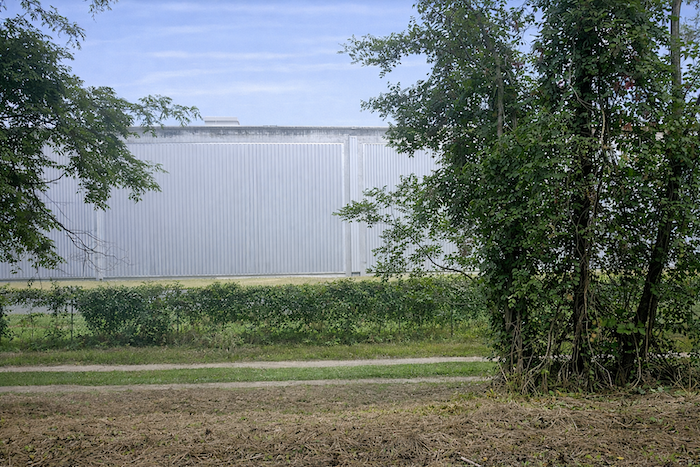
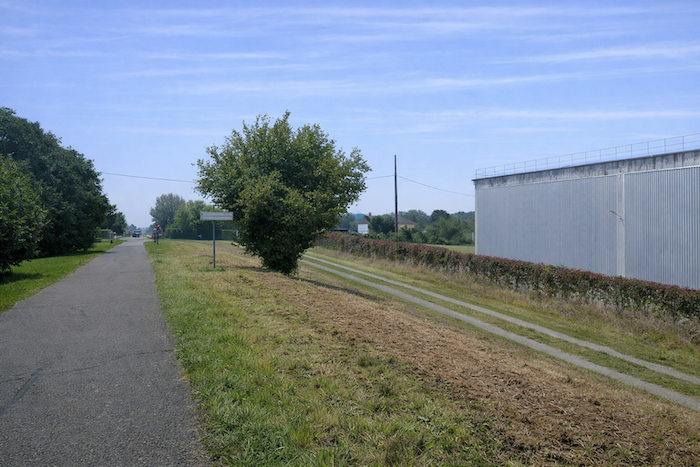
| Emerging at last from wooded avenues and unspoiled nature, the path draws momentarily closer to civilization. It runs alongside the imposing mass of a factory, a gray silhouette set at the edge of the way. In Massilly stands a well-known company specializing in the manufacture of metal packaging. Founded by Robert Bindschedler, the factory embodies industrial solidity in the heart of the countryside. As the cyclist passes, the transition feels abrupt, from the peace of trees to the muted rumble of machines, from vegetal permanence to the fleeting world of metal. |
 |
 |
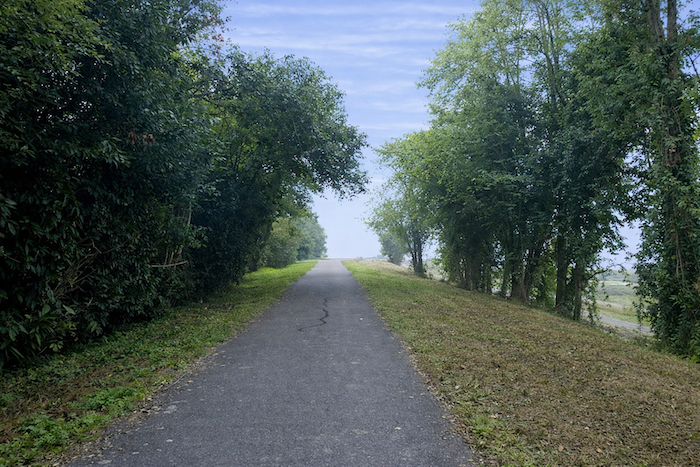
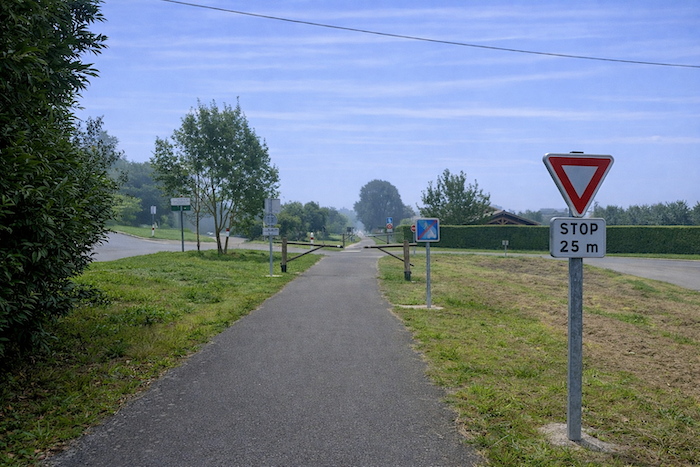
| Then the cycle path regains its momentum, skirting the wood of Banan and brushing its edges. It remains faithful to itself, yet still confined, held close beneath the tall leafy trees that extend their protective branches. Here again, nature envelops and tempers the journey, as if reminding the traveler that despite human intrusions, it remains the true master of the landscape. |
 |
 |
Section 5: Gradually, the cycle path draws closer to Cluny
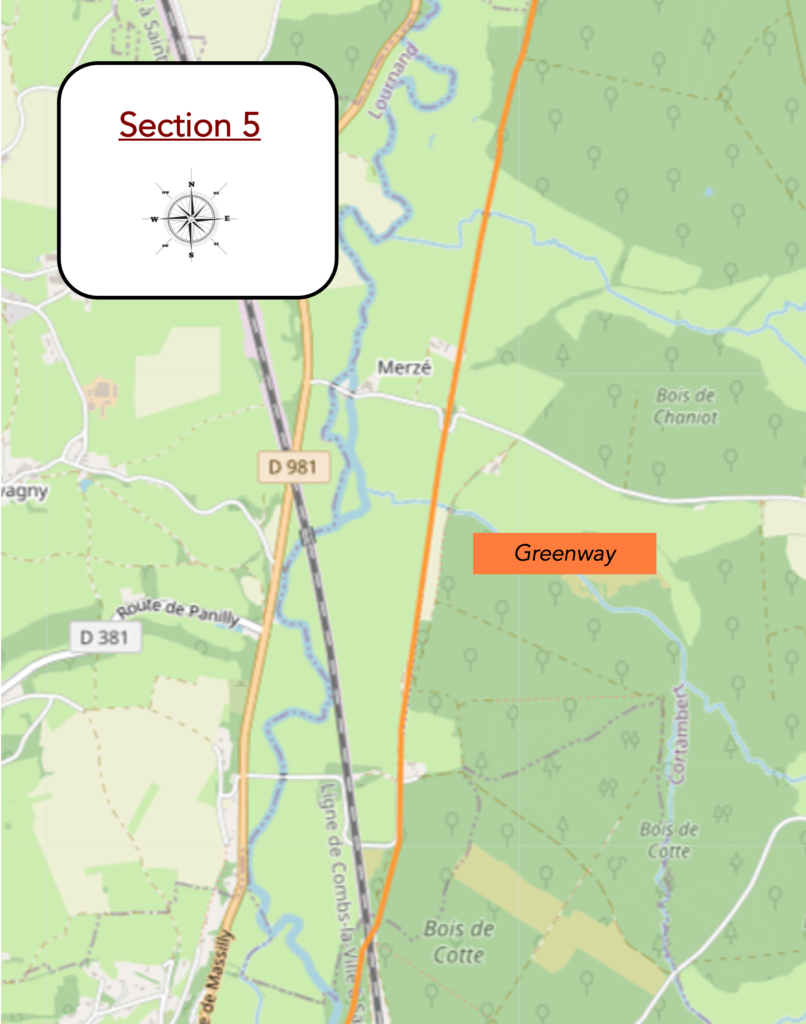
Overview of the route’s challenges: a route with no difficulty at all.
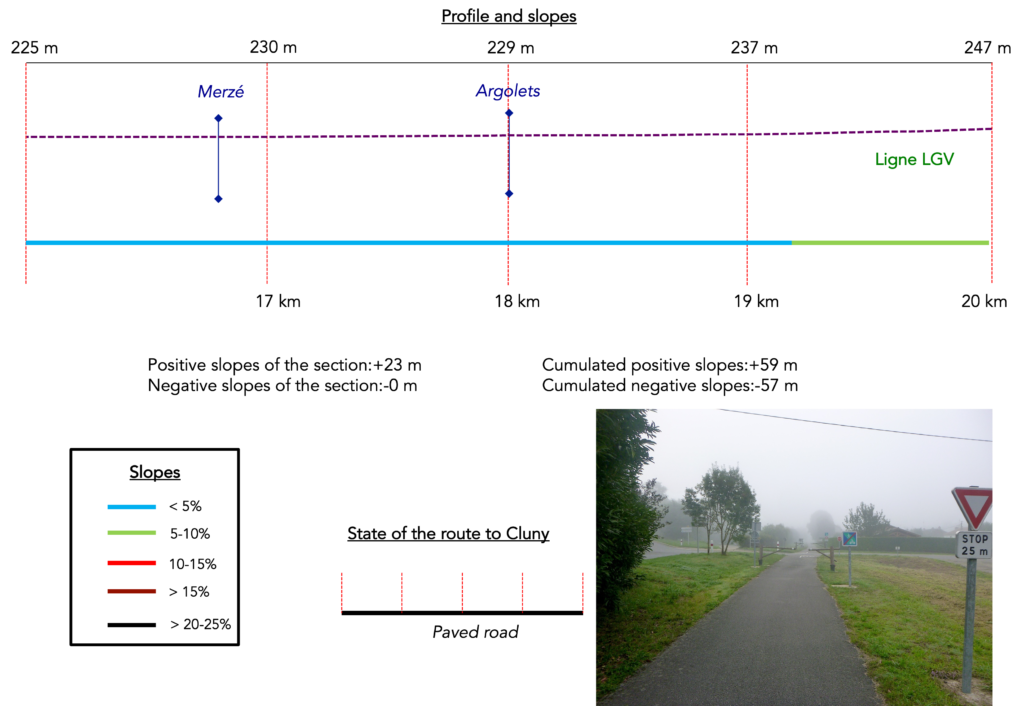
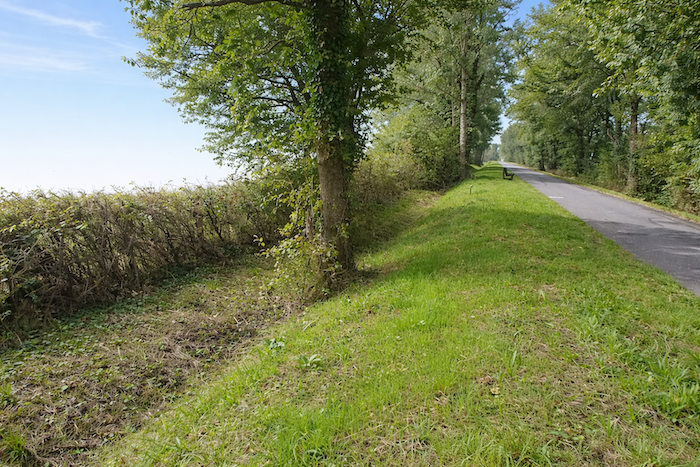
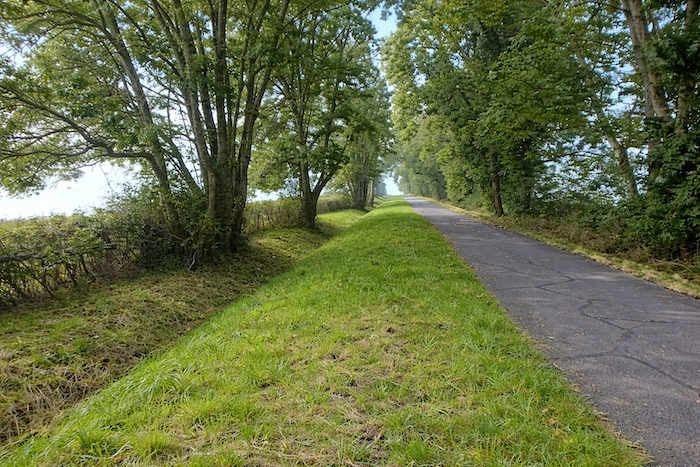
| On the paved path, which once again stretches toward that improbable infinity where the horizon seems to dissolve, rises a majestic procession of trees. Maples, splendid in their blazing crowns, mingle with shaggy ashes whose branches fall in cascades. They extend the alignment of great oaks, solid as ancient pillars, and slender beeches, rising like the columns of a woodland cathedral. The journey here takes on the solemnity of a natural procession, as if each tree, witness to time, were silently accompanying the steps and wheels of those who follow this way. |
 |
 |
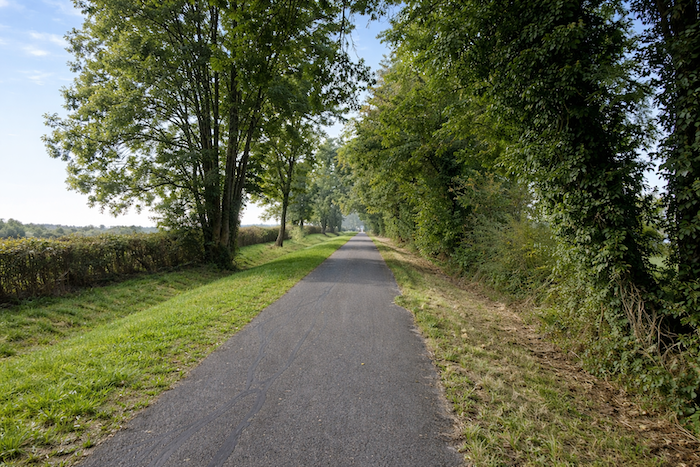
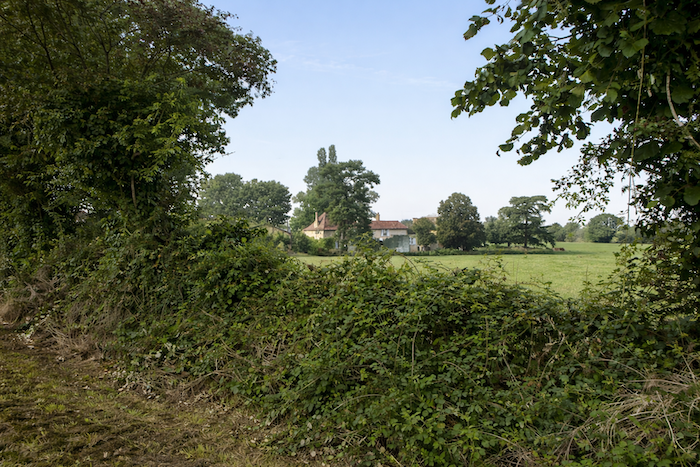
| A little farther on, the silhouette of a fine residence appears, hidden behind a curtain of trees. It emerges like a whispered secret, a promise of history and buried memory. Shortly after, the path meets a discreet intersection with an agricultural road, a simple dirt track where one imagines slow moving machines passing with heavy steps, witnesses to rural life. |
 |
 |
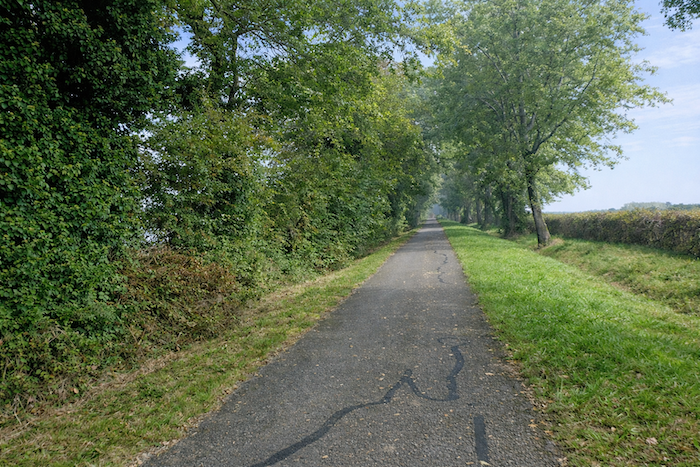
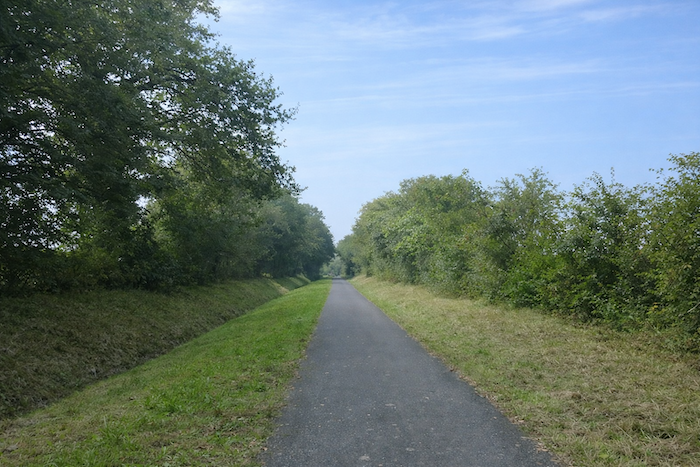
| Straight lines then follow one another, relentless, punctuated by modest crossings with other rural roads. The landscape repeats itself, almost spellbinding, like an obstinate melody. Here, no steeple, no hamlet interrupts the solitude. The villages remain distant, withdrawn behind hills or woods, leaving the traveler uncertain of position. One advances without clear markers, in a geography both familiar and elusive. |
 |
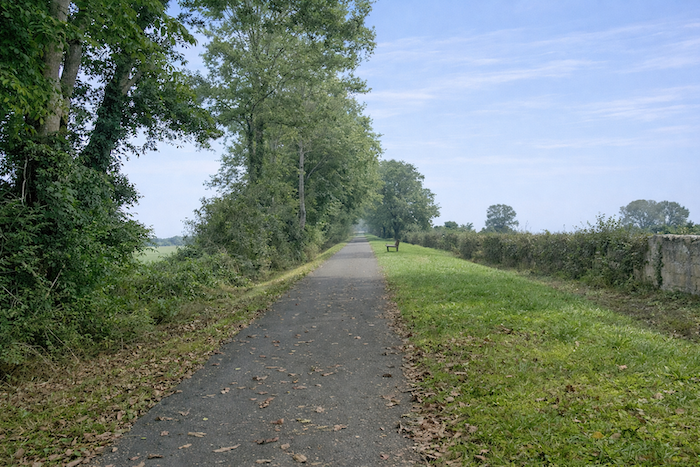 |
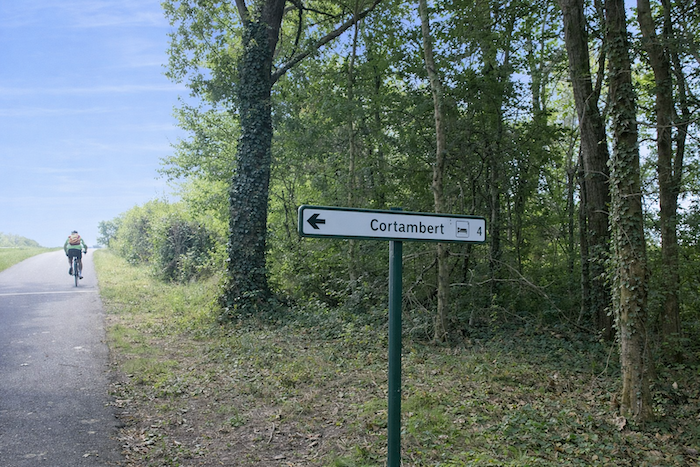
| Yet at the turn of a sign, a turning announces Cortambert. The village, however, remains far away, four kilometers from the path. Like a promise that does not wish to be reached too quickly, it keeps its distance. |
 |
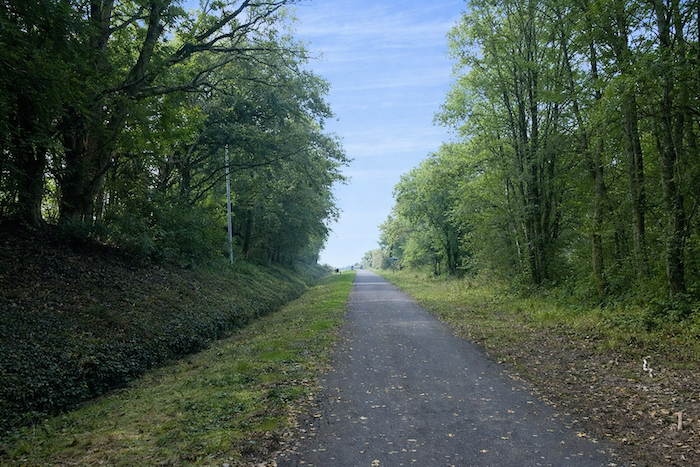 |
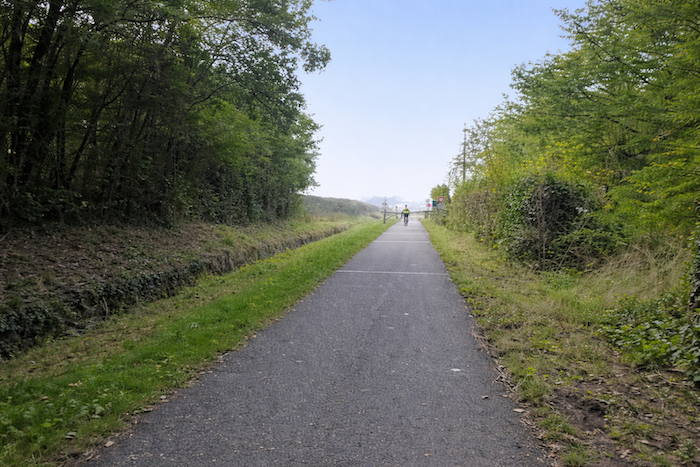
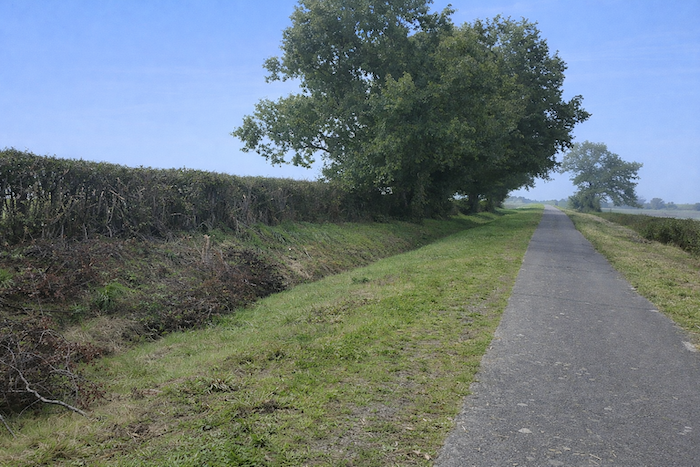
| From this crossing, the story resumes its course, identical and yet always new. The path remains faithful to itself, bordered by trees. Their immutable presence softens monotony and lightens the step. It might seem like repetition, but here repetition becomes soothing, a gentle breathing that turns each step into an encounter with shadow and light. |
 |
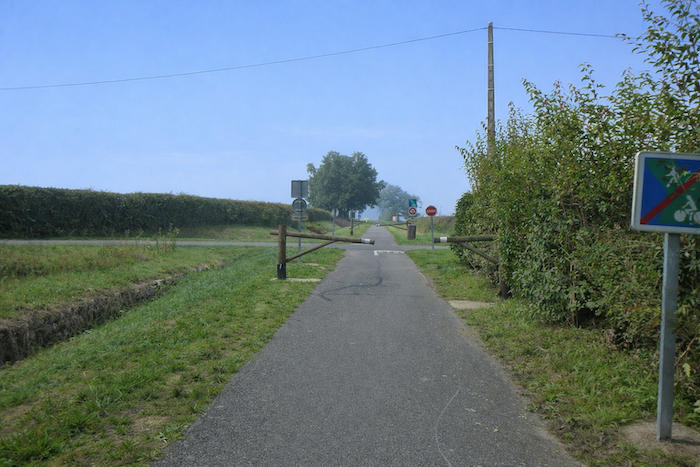 |
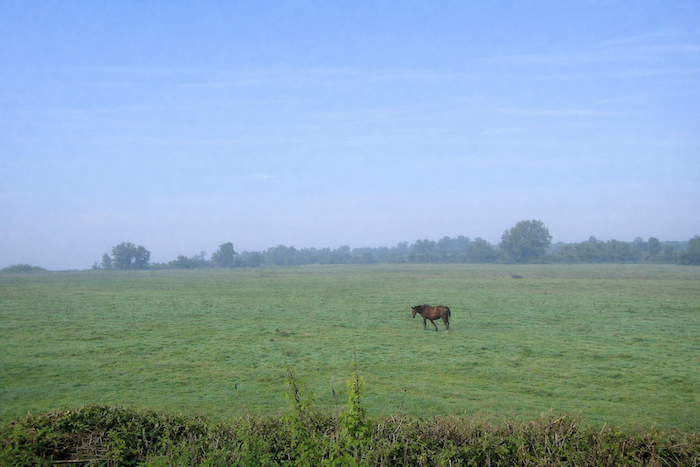
| In the surrounding landscape, small meadows open up. They stretch like offered clearings, scattered with tranquil livestock. Cows and horses, peaceful silhouettes, punctuate the green grass with white and brown shapes. The countryside reasserts itself, simple and alive. |
 |
 |
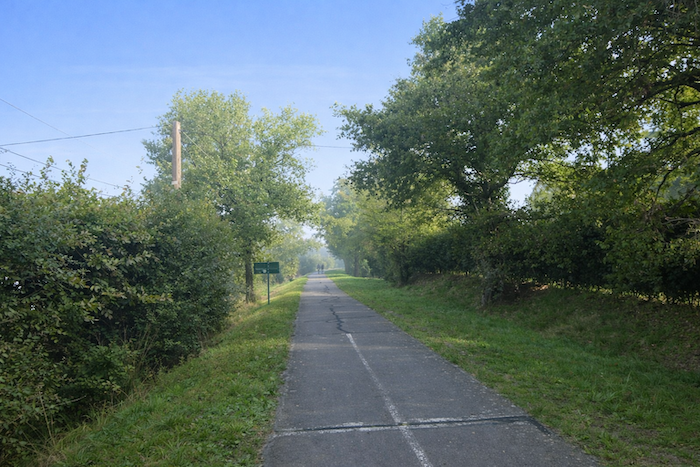
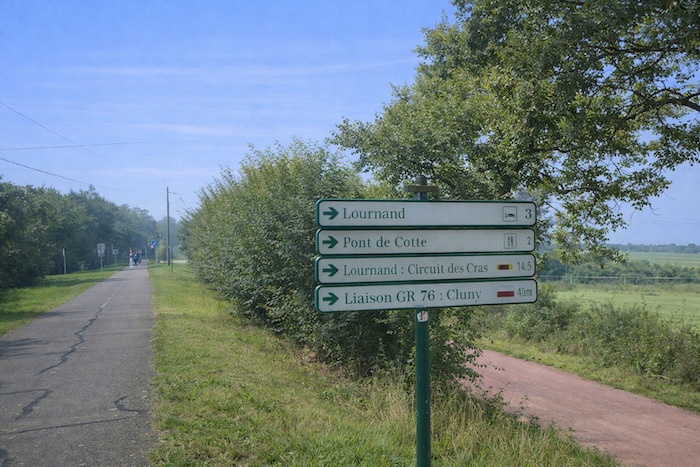
| A little farther still, another turning appears, that of Lournaud. It marks a stage after nineteen kilometers of route, like a discreet sign of the distance already accomplished. Here the adventure is measured not in fatigue, but in tranquil distance. |
 |
 |
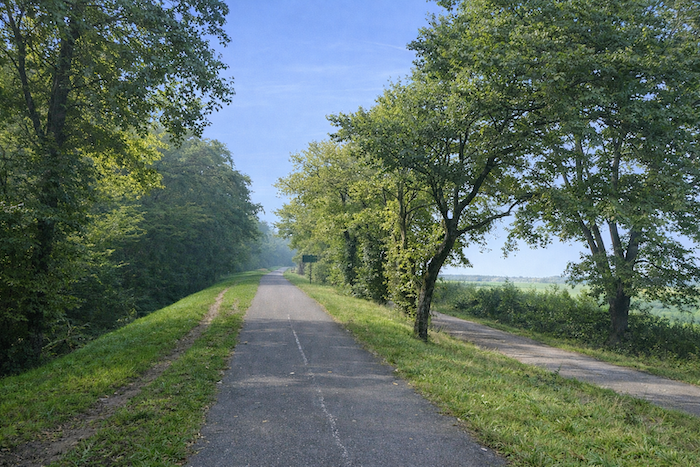
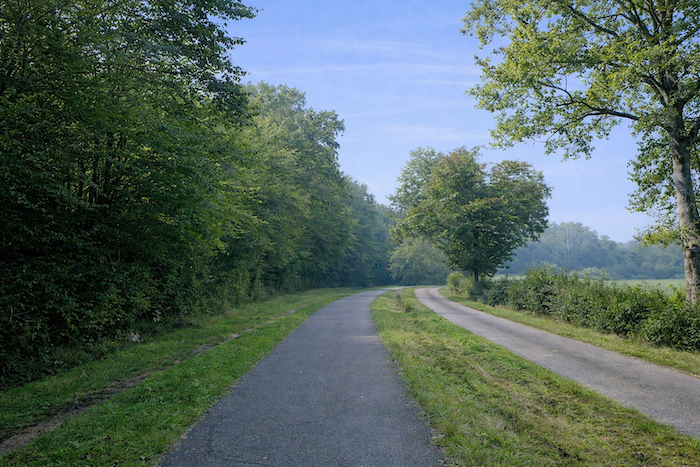
| Then a small road begins to accompany the path, like a faithful but silent sister. It remains empty, deserted by vehicles, and only your movement fills the space. At times a cyclist passes, an ephemeral silhouette gliding away into the distance. Solitude remains the principal companion, gentle and persistent. |
 |
 |
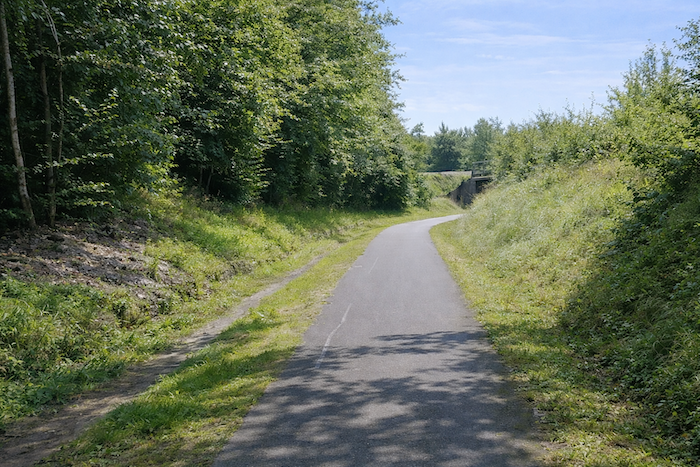
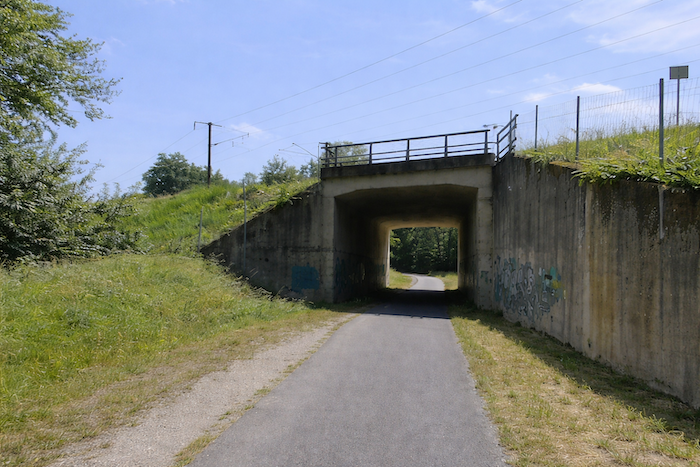
| Soon after, the cycle path passes beneath the high-speed railway line. Here it is the Paris Lyon TGV that roars as it speeds by. The rumble tears through the air like a flash of metal, a brutal reminder of the modern world. The train rushes on, imperious, while the path remains there, humble and silent. Two tempos of time meet here, the lightning pace of the machine and the patient rhythm of the traveler. |
 |
 |
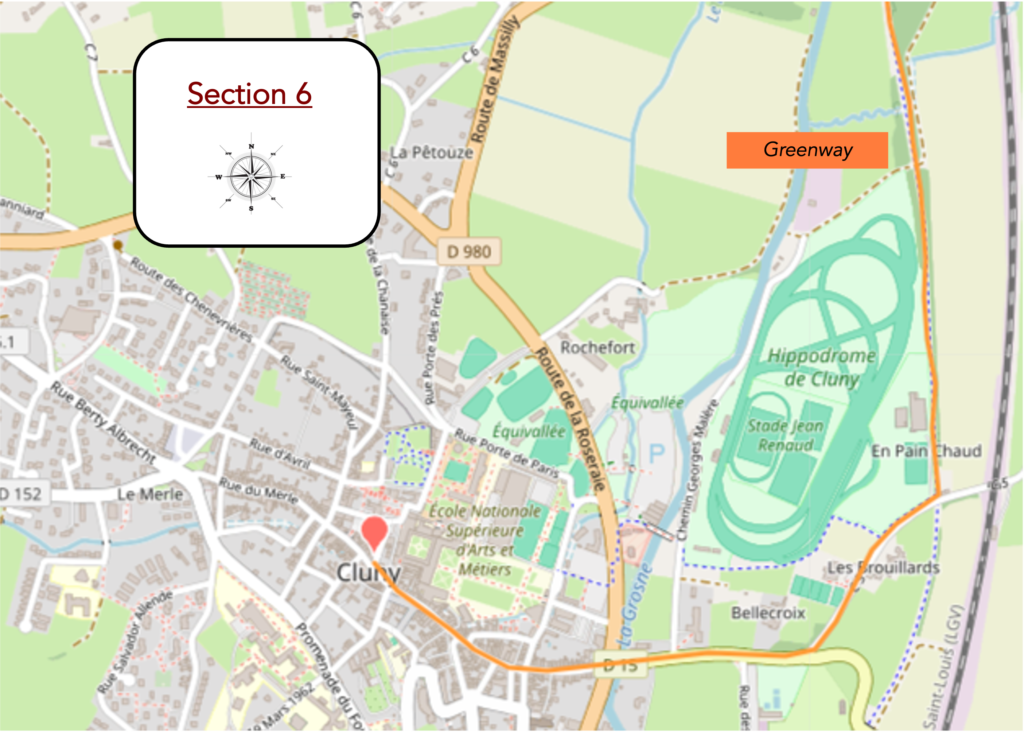
Section 6: The cycle path reaches Cluny
Overview of the route’s challenges: a route with no difficulty at all.
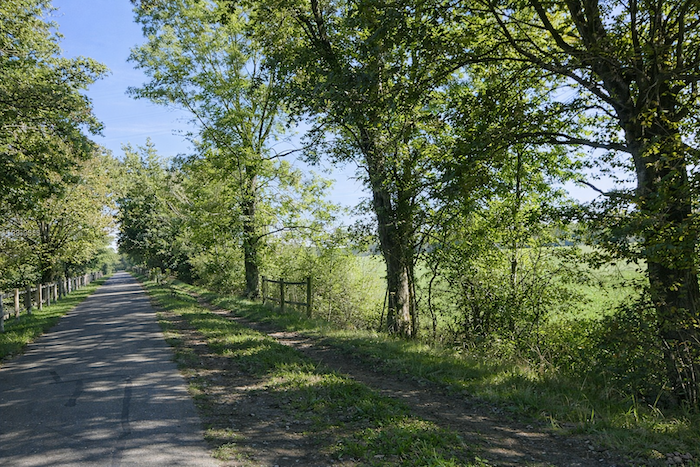
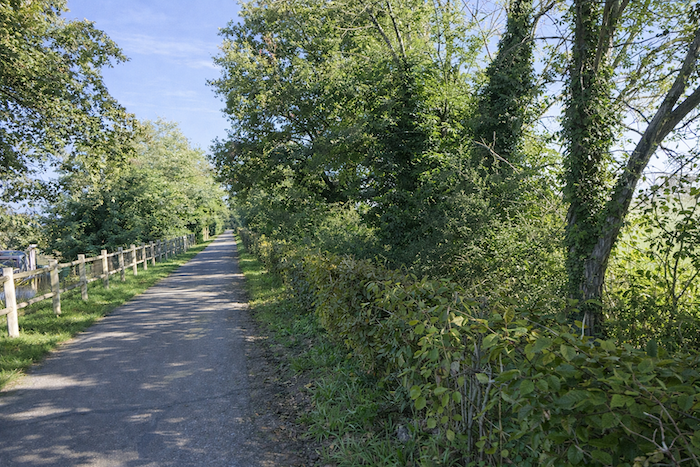
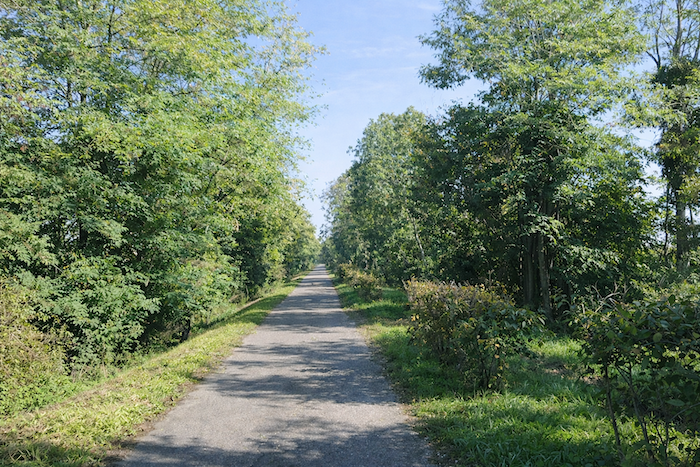
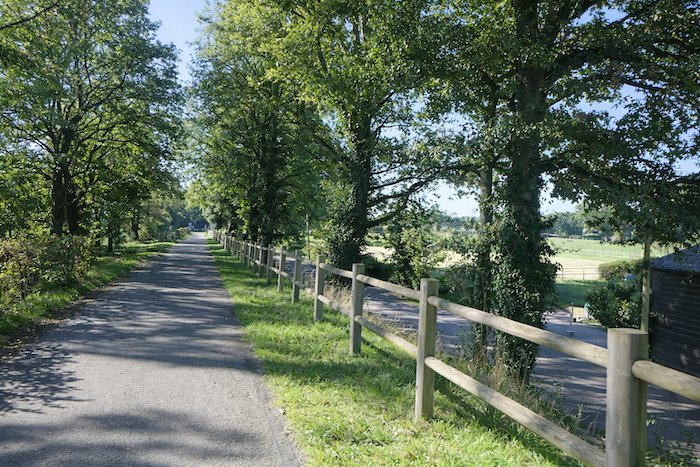
| The cycle path continues beneath light filtered through tall trees that stand watch like old guardians. Their branches open bright clearings where one breathes more freely, as if the way, until then subdued, suddenly recovered its taste for daylight. |
 |
 |
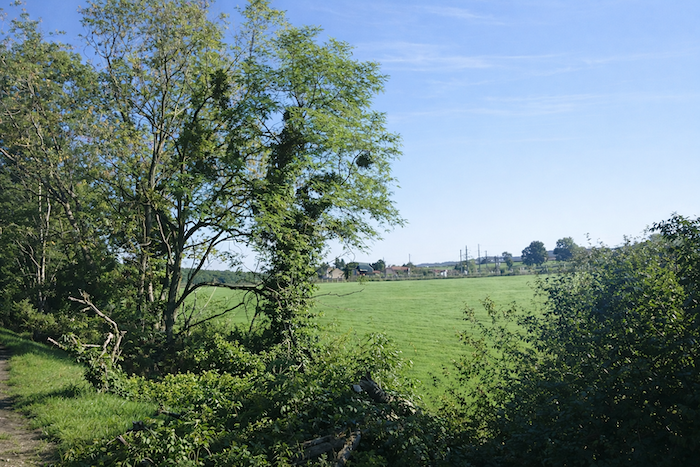
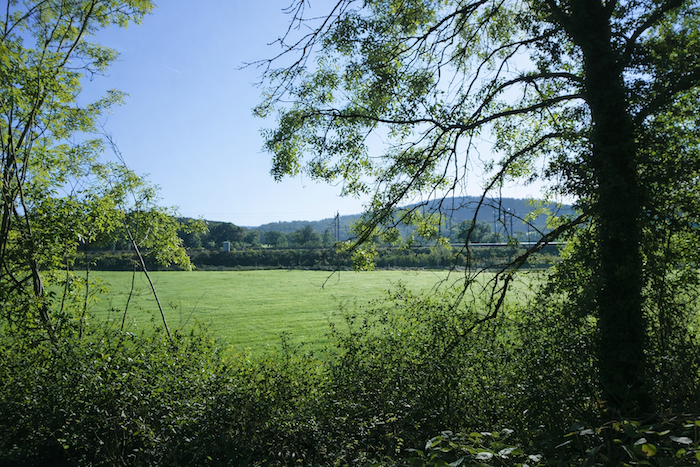
| Soon after, beyond the trees, the meadows widen once more. They appear like a promise of space and freedom, unfolding in green carpets where the eye can wander. |
 |
 |
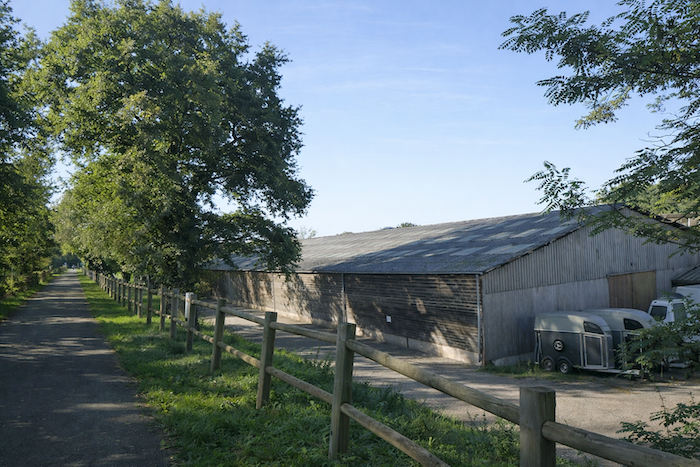
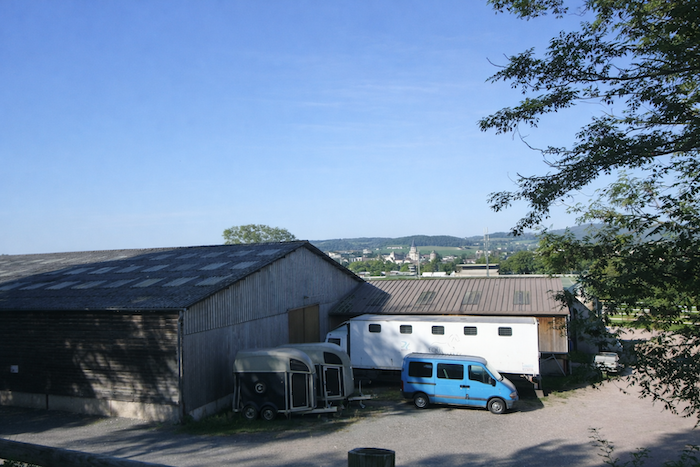
| Then, behind simple agricultural sheds, an unexpected vision appears, whole rows of horse trailers, like a silent army ready to set out. These white and metallic silhouettes create an unusual and almost theatrical scene, recalling the important place of horsemanship in the land of Cluny. |
 |
 |
| In the near distance, the high-speed train flashes past. Its slender shape cuts across the landscape in a streak of iron and speed. In a moment it crosses the scene, reminding you of the coexistence of two worlds, that of the motionless and contemplative walker and that of the traveler propelled forward at great speed. |
 |
 |
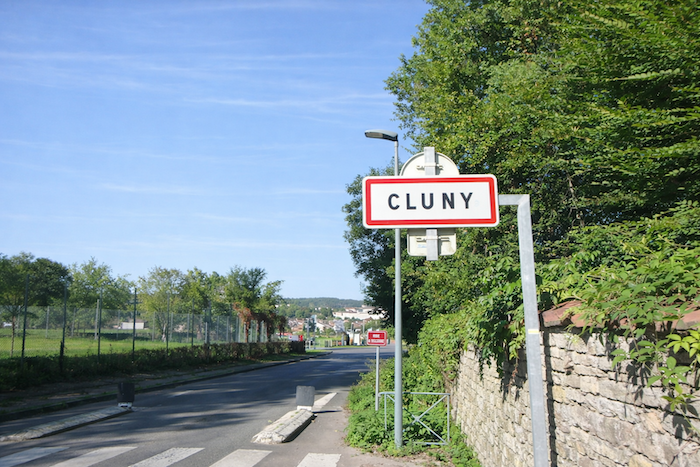
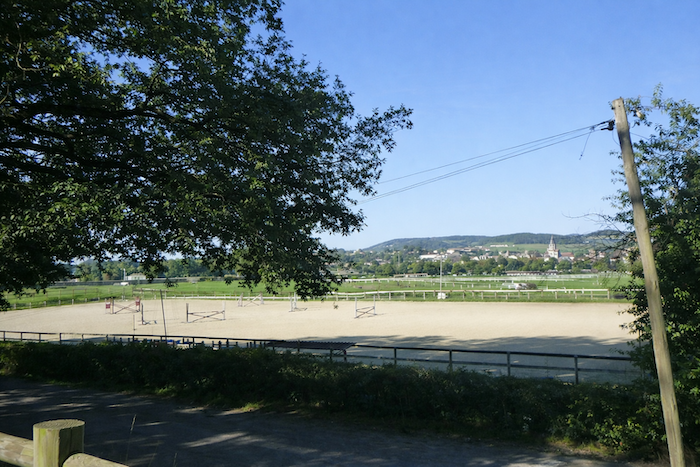
| Soon, on your right, the bell tower of the church of Cluny comes into view. The cycle path is nearing its end, like a sentence that at last finds its full stop. The route concludes in this vision, promise of arrival, of history and memory. |
 |
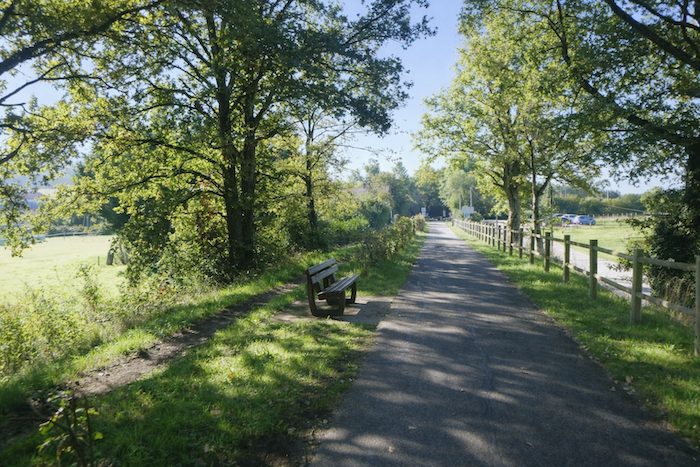 |
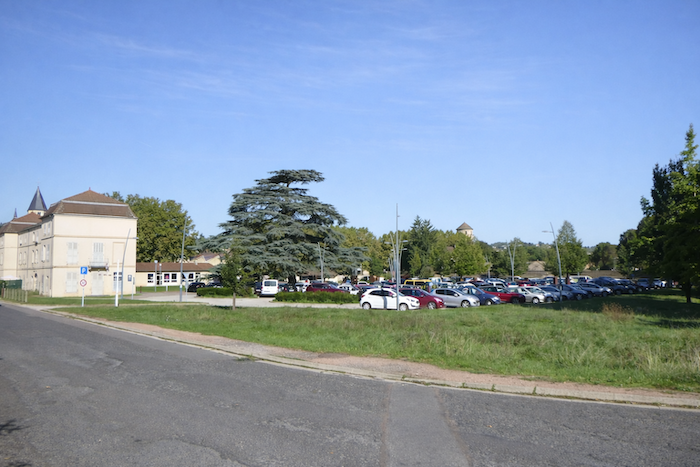
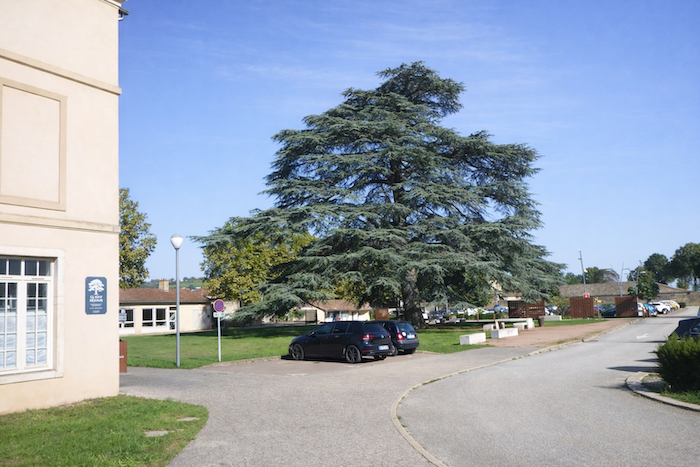
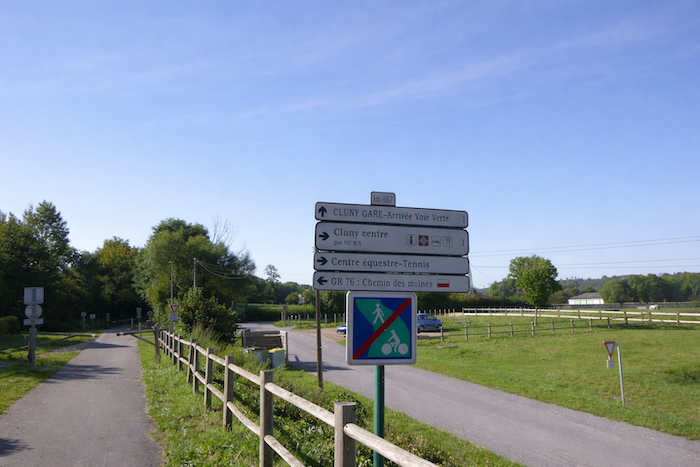
| For cycling enthusiasts, the cycle path continues beyond, but for you it ends near the parking area, just steps from an equestrian center. This is already Cluny, only one kilometer from the center. The town reveals itself in outline, poised between heritage and daily life. |
 |
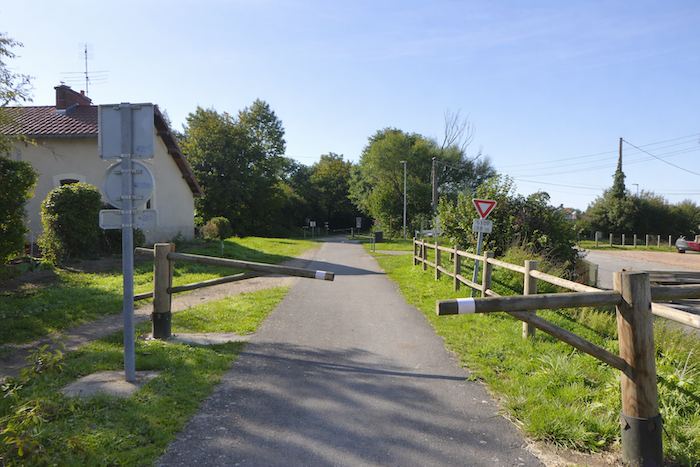 |
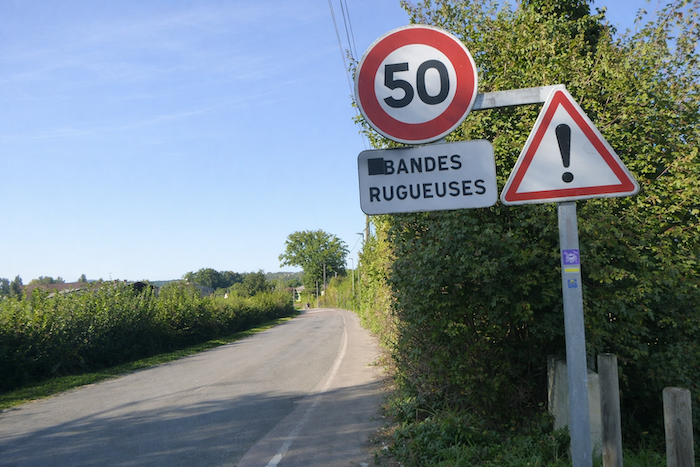
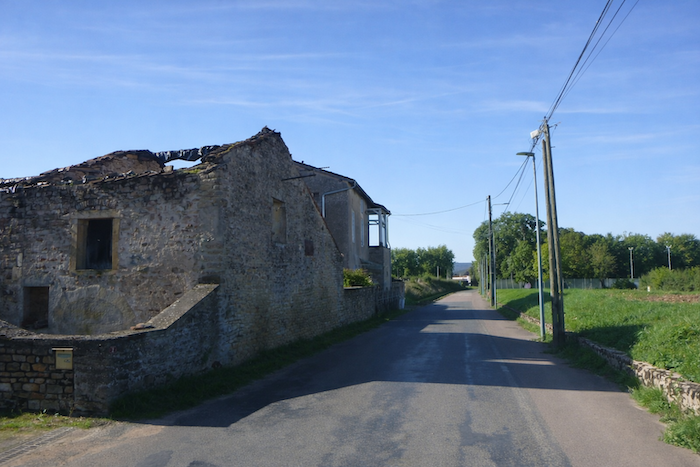
| Here you rejoin the official Camino de Santiago, the one that descends from St Gengoux le National. You find once more the familiar shell, universal sign of pilgrims and companion of the road for centuries. The path follows Rue des Brouillards, as if wishing once again to pass through a veil of mystery before reaching the gates of the town. |
 |
 |
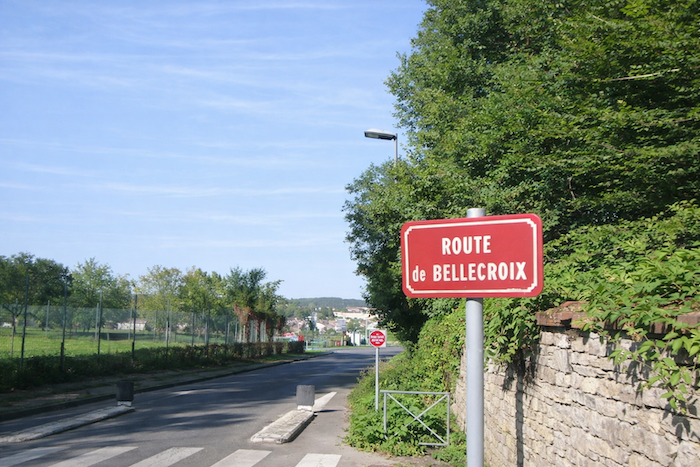
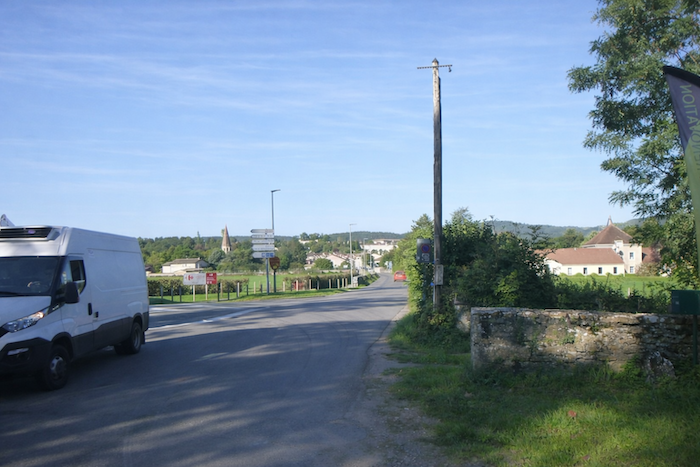
| A few more steps along the road of Bellecroix in the near outskirts. |
 |
 |
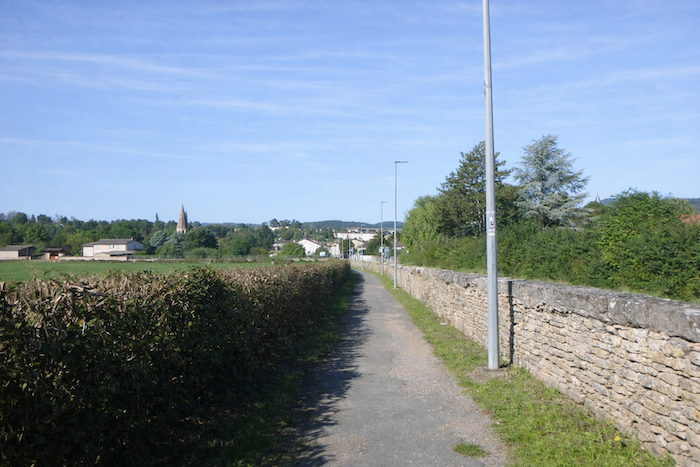
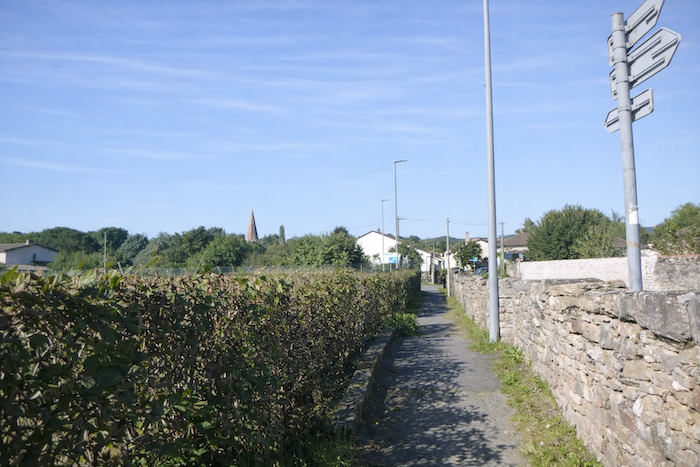
| Then a small path, discreet and protective, leads you away from the cars and toward a bridge. This almost furtive passage brings you into the very heart of the town, like a symbolic entrance into the living center. |
 |
 |
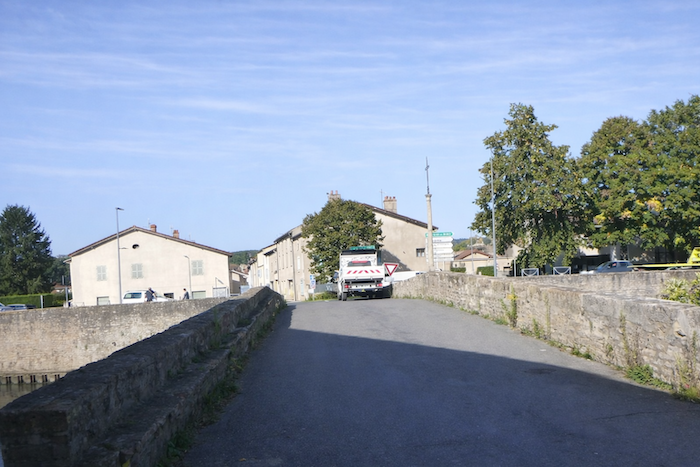
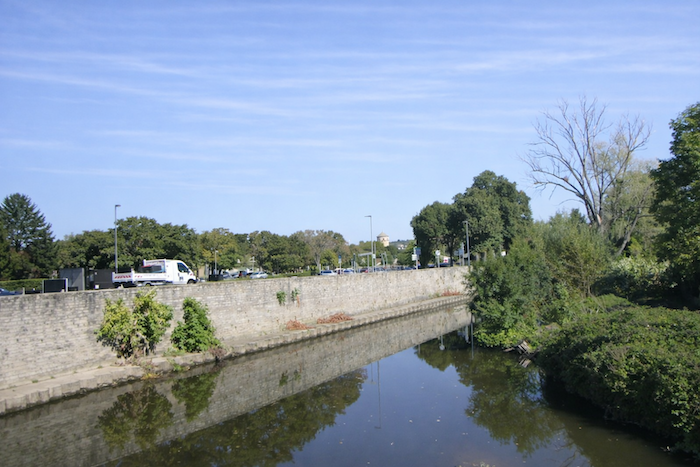
| The road crosses the Grosne one final time, and the landscape suddenly opens. The river spreads out in the light, and beyond it lies the town of Cluny with its rooftops, its bell towers and its medieval memories. The water becomes a mirror of stone and history. |
 |
 |
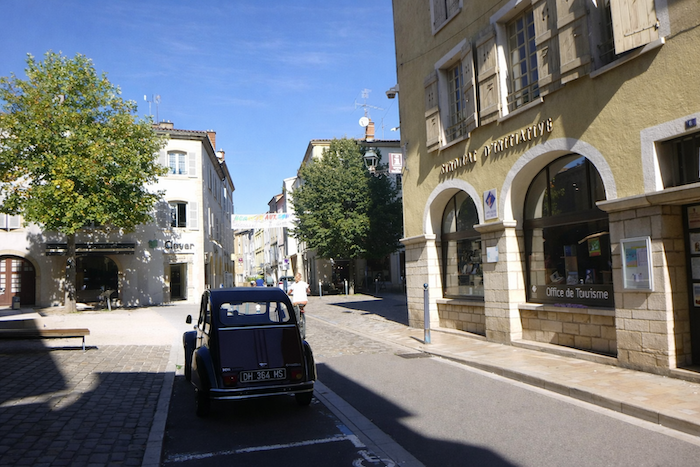
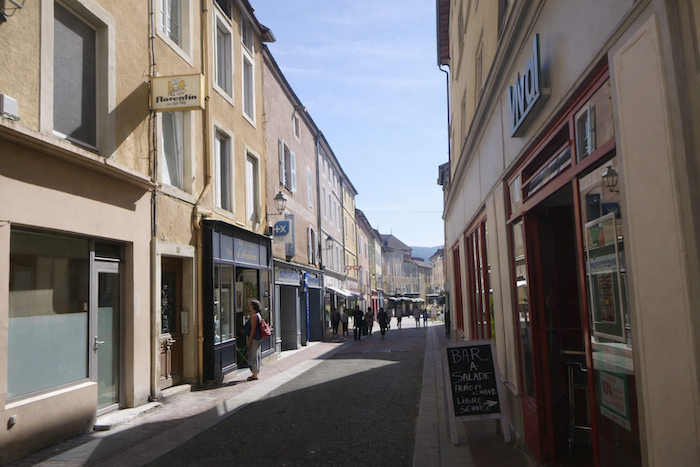
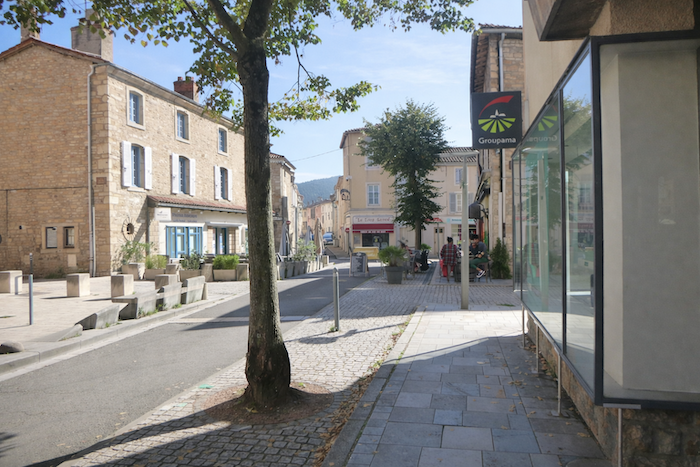
Here the traveler has a choice, to skirt the town center and wander toward the horse parks, or to continue straight ahead toward the commercial life. Rue de la Levée, Rue Lamartine and Rue Mercière then lead into the lively heart of Cluny. Let us go that way, straight ahead.
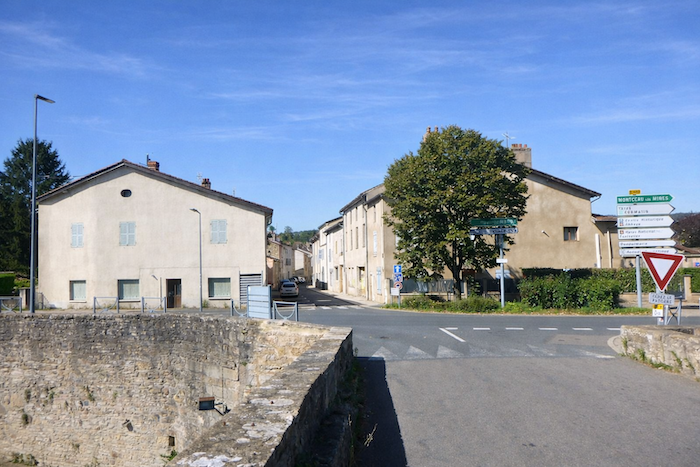
| The center, with its shops and narrow streets, possesses the simple charm of a provincial town. Cluny counts only five thousand inhabitants, yet on certain days visitors are almost as numerous as residents. The town breathes both the tranquility of a village and the vitality of a cultural crossroads. Here you stand only steps from the abbey. |
 |
 |
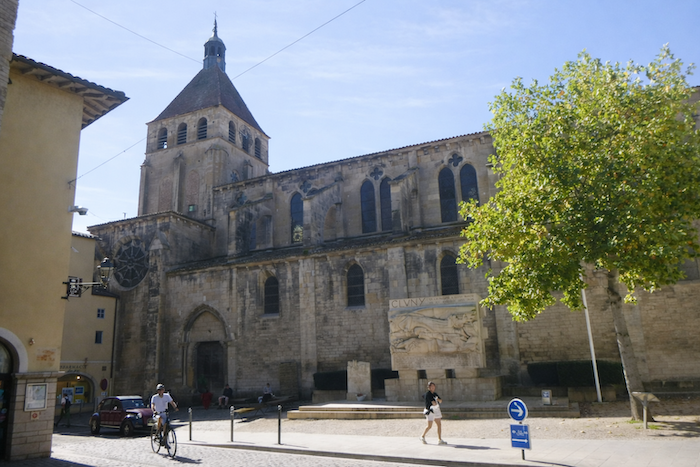
| Along your route, near the Tourist Office, you will pass the church of Notre Dame, the other great church of Cluny. |
 |
 |
| An alternative is also available from the bridge over the Grosne. Simply follow to your right toward the lower part of the town, where many parking areas are aligned. This route leads into a more open space from which the medieval town gradually reveals itself, like a promise of history and memory |
|
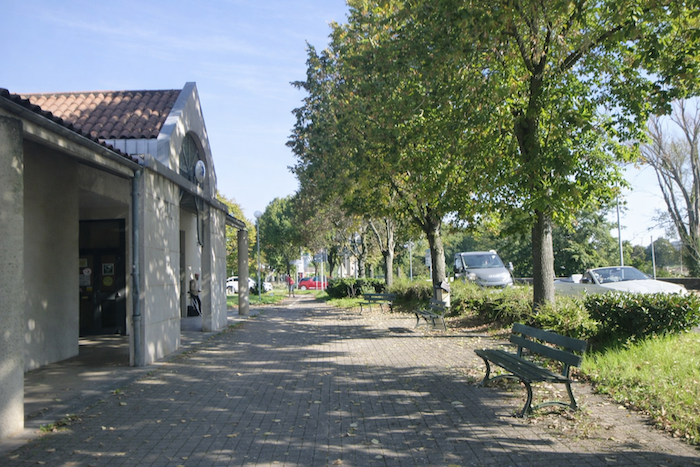 |
Very soon your steps are drawn toward the imposing silhouette of the abbey, which appears at the turn of winding streets like an eternal landmark in the heart of the urban maze. Its towers disappear and reappear according to the perspective, seeming to guide the walker through this labyrinth where every stone still echoes with ancient voices.
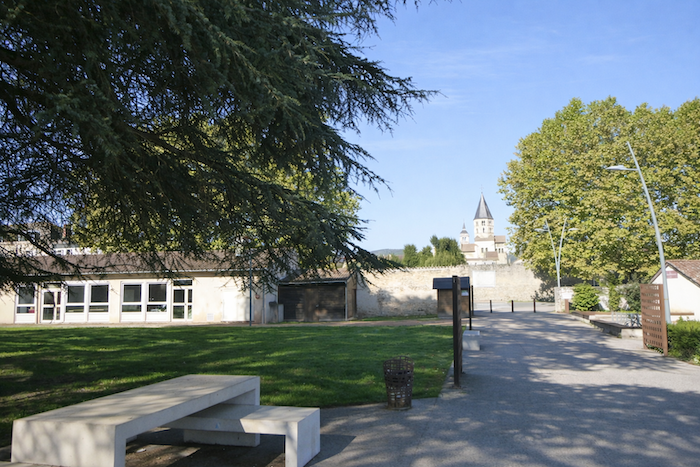
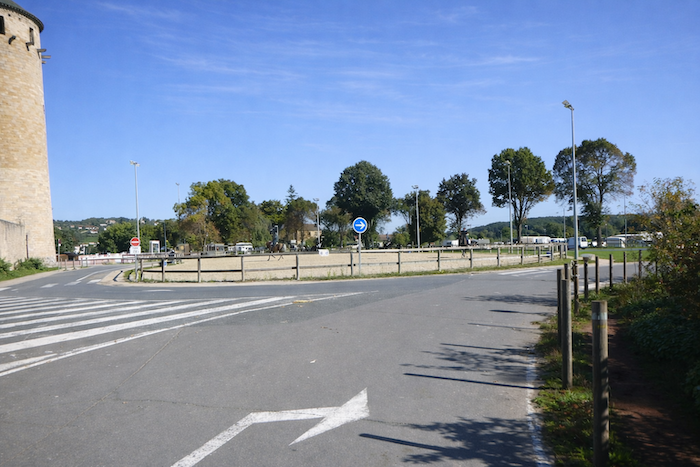
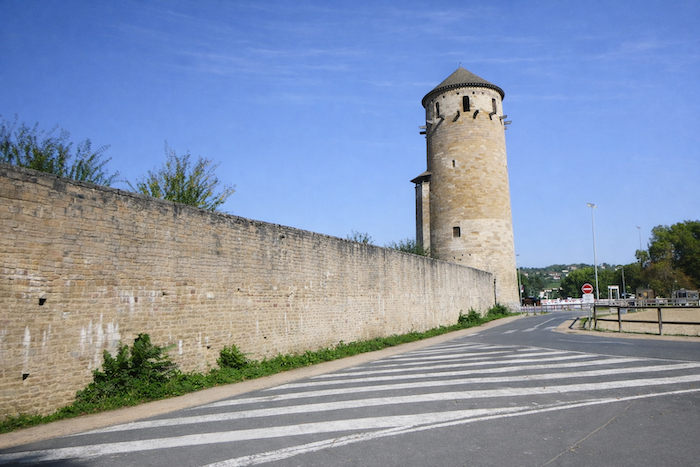
| The route quickly brings you before the Round Tower of the Abbey, whose massive presence seems to defy time. Once it formed one of the most impressive elements of the medieval defensive system of the town. The first fortifications began in 1160, gradually outlining the contours of a town under tension and under protection. The threat of neighboring lords indeed weighed upon the monastic community. A new wall then rose, broader and stronger than the previous one. This new wall, 1,3 kilometers long, 1,8 meters thick and rising between six point five and eight meters high, became their rampart against the perils of time. |
 |
 |
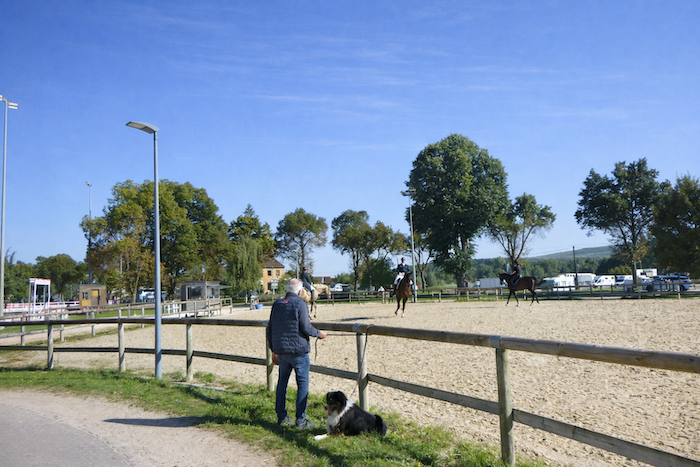
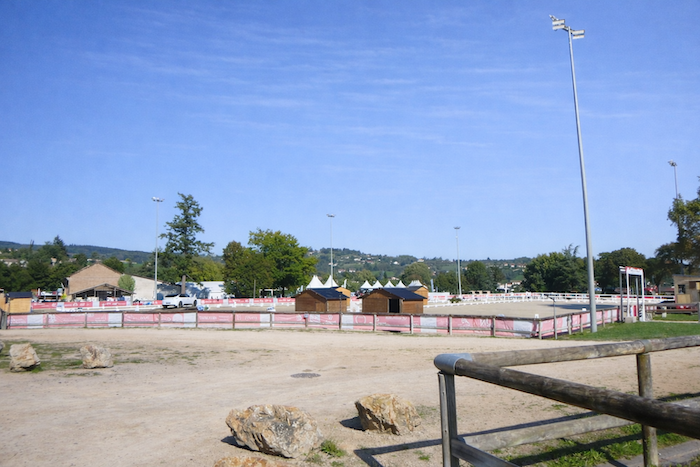
| Here are gathered the equestrian centers, close to the racecourse. The air seems to vibrate with the rhythm of hooves, and at times you may feel that there are as many riders as visitors on foot in this capital of the horse. The whole town breathes to the rhythm of mounts and the men and women who guide them, as if the spirit of Cluny still found part of its grandeur in this living heritage. |
 |
 |
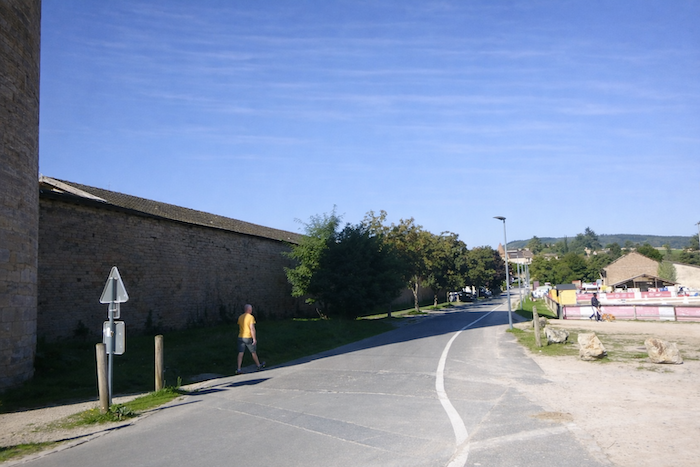
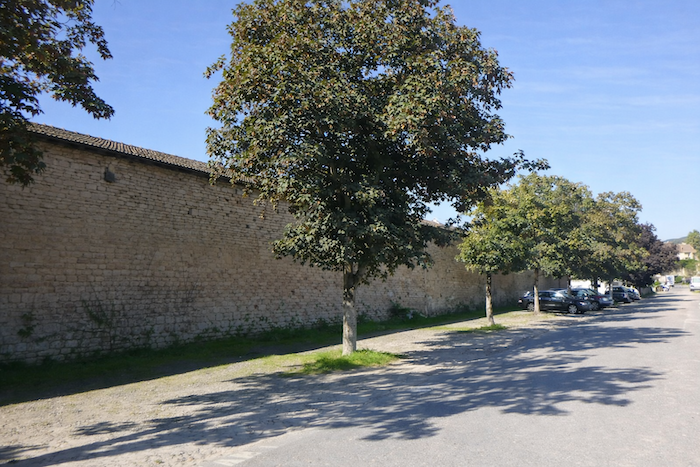
| Continuing your walk, you follow the enclosure wall of the abbey. These massive stones, burnished by time, silently recall the power and permanence of this great spiritual site, which continues to dominate the town with its majesty. |
 |
 |
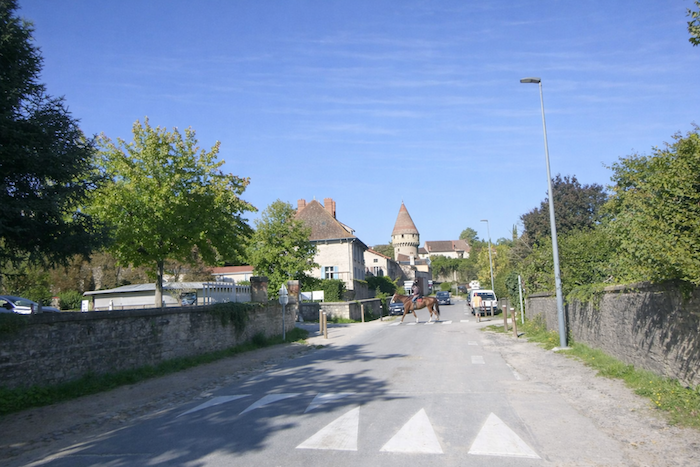
| At the end of the wall stands the National Stud of Cluny, offering a superb perspective on the abbey. Founded in 1807 by Napoleon the First upon the very foundations of the former abbey, this stud remains one of the most eloquent testimonies to the equestrian tradition of Burgundy. For a long time, it was a prestigious center dedicated to the breeding and improvement of horses, helping to shape the finest bloodlines. Even today, established within the historic dependencies of the abbey, it combines heritage and passion for the horse. Visitors discover splendid buildings and stables rich in history, as well as presentations, shows and demonstrations celebrating equestrian expertise. The place has become a living space, open to the arts, to culture and to the curious, where the elegance and strength of horses meet the memory of past centuries. |
 |
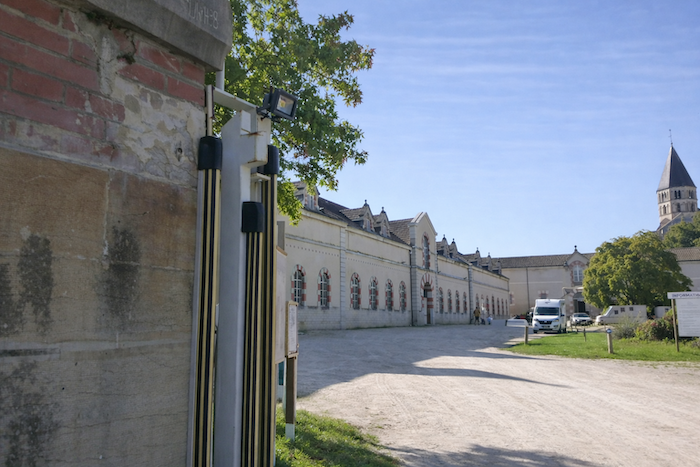 |
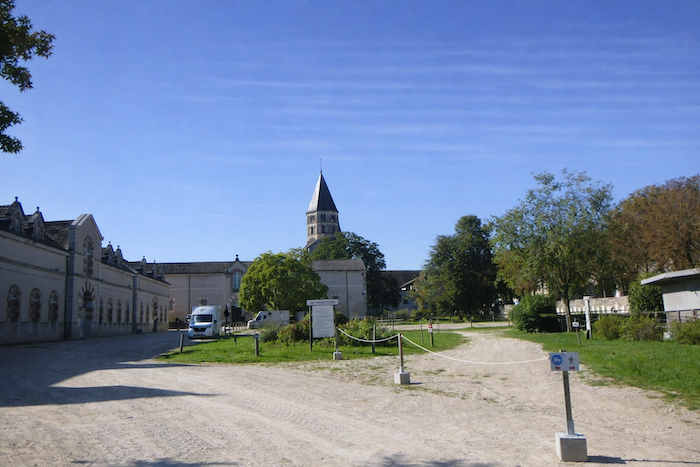
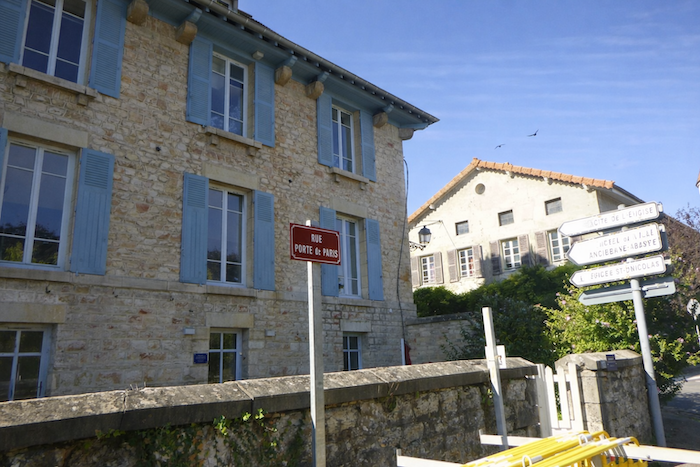
| Then, skirting the wall once more along Rue de la Porte de Paris, your steps naturally lead you toward the abbey. The path, punctuated by towers and ramparts, seems to guide you like an invisible hand toward the beating heart of the town. |
 |
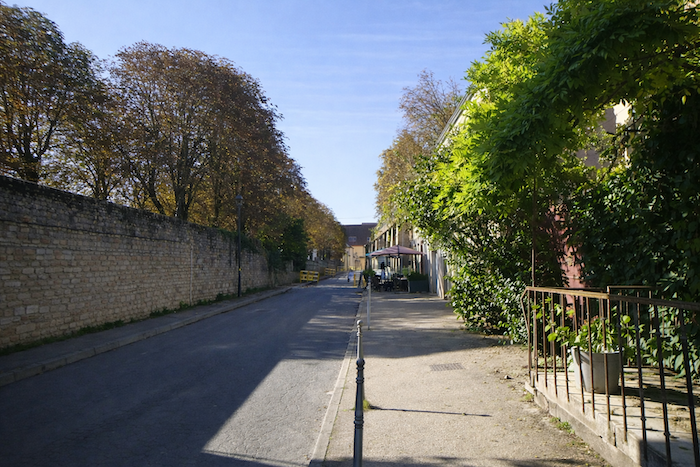 |
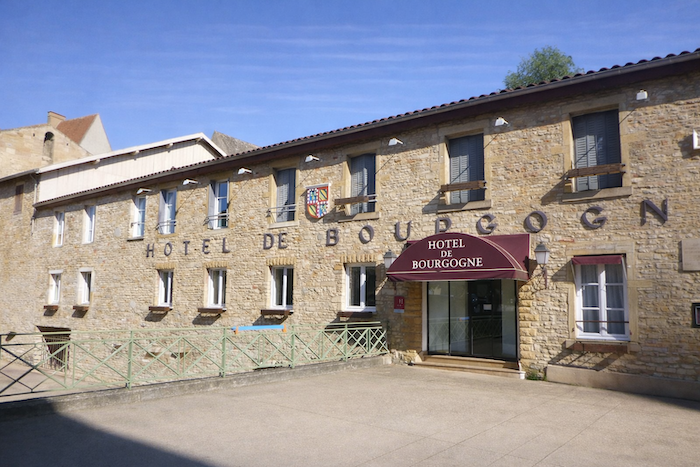
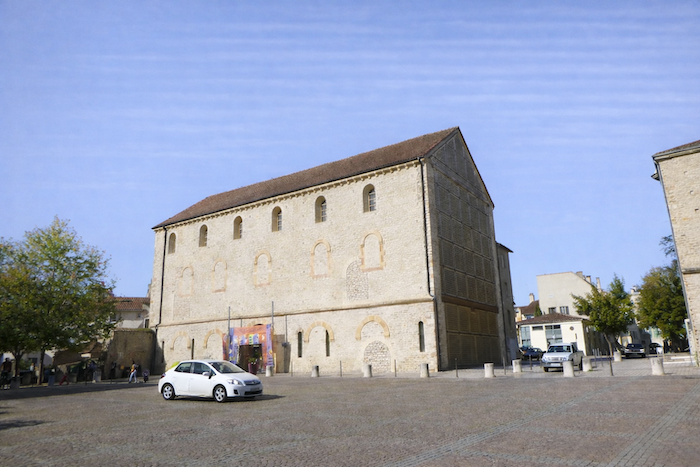
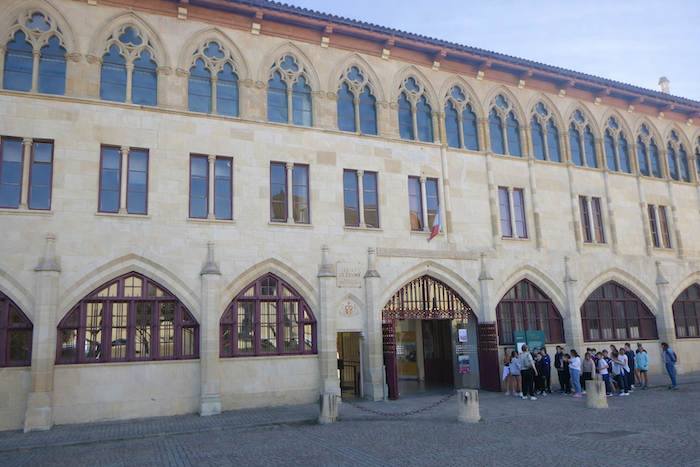
| At last, a vast square opens before the entrance of the abbey, dominated by the noble silhouette of the Hôtel de Bourgogne. Its facades in luminous ocher tones take on changing shades according to the light, as if the stones themselves wished to greet visitors and invite them to cross the threshold of the sanctuary. |
 |
 |
Section 7: Visit of the Cluny Abbey
The abbey of Cluny was founded in 910 by William the First, Duke of Aquitaine, who placed it directly under the authority of the pope, thus guaranteeing its independence. The first church, known as Cluny I, built under Abbot Bernon, was modest and suited to a small community of Benedictine monks. With the rapid growth of the Cluniac order, a second church, Cluny II, was erected around the middle of the tenth century. Larger and more richly decorated than the first, it already reflected the growing influence of Cluny in the Christian world. The summit of monastic power came in the eleventh century under Abbot Hugh of Semur. In 1088 he launched the construction of Cluny III, a gigantic church completed at the beginning of the twelfth century and consecrated in 1130. Nearly one hundred and eighty-seven meters long, provided with five naves, two transepts, a vast choir surrounded by radiating chapels and monumental bell towers, it was for centuries the largest church in Christendom before the rebuilding of Saint Peter’s in Rome. Around this abbey church rose the cloister, the dormitories, the chapter house and numerous conventual buildings adapted to a community of several hundred monks. From the fourteenth century onward, however, the power of Cluny declined, weakened by wars and by religious and economic crises. During the French Revolution, the abbey was suppressed and its church sold as a stone quarry. Most of the buildings were destroyed between 1798 and 1823. Today only certain remains of Cluny III survive, yet they still allow one to imagine the splendor of this masterpiece of Romanesque art and the extent of its spiritual and cultural influence in medieval Europe.
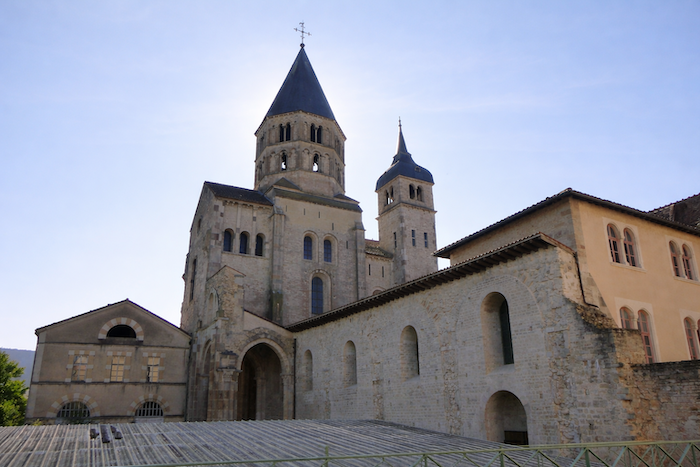
| You enter the abbey from the square. |
 |
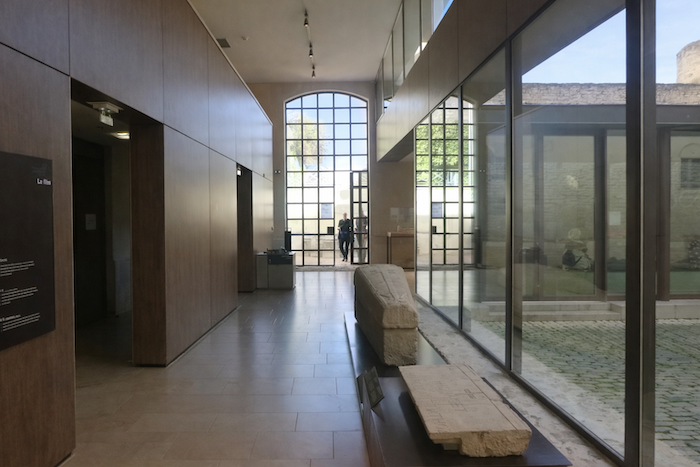 |
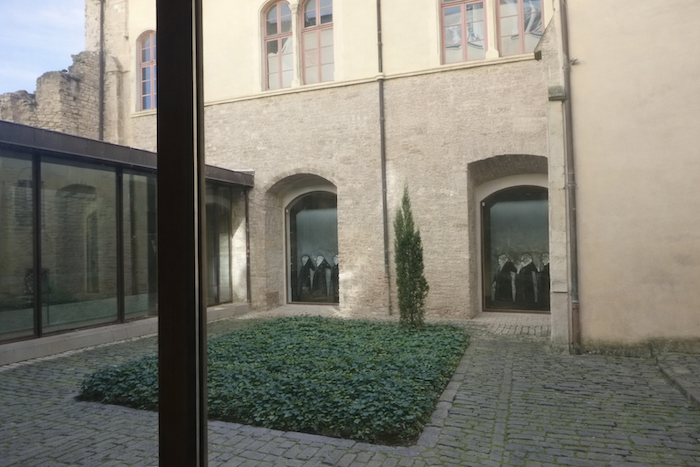
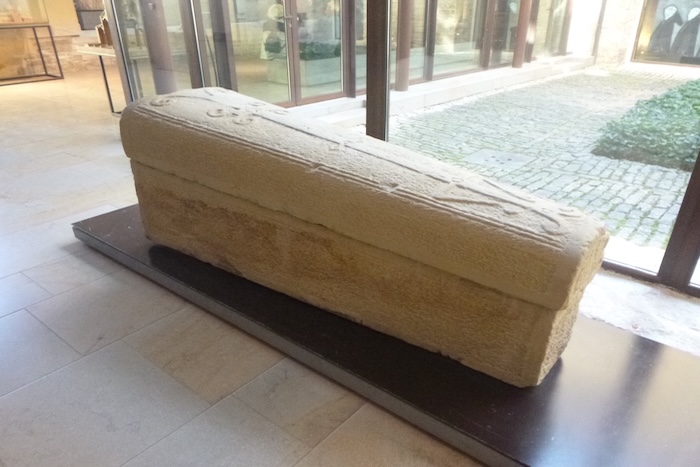
| The visit, twelve euros, begins with the small cloister. It was located to the south of the great abbey church. Built probably at the end of the eleventh century or the beginning of the twelfth, it formed a more intimate space than the great cloister, which was the heart of monastic life. Like every Romanesque cloister, it consisted of a square courtyard surrounded by covered galleries supported by small columns and adorned with sculpted capitals. These galleries allowed the monks to circulate under shelter and also offered a place for meditation and silence. Unlike the great cloister, around which the principal conventual buildings were grouped, the small cloister had a more secondary function. It served as a transition toward service areas or practical activities, thus providing a more discreet and functional setting for the community. Destroyed in the nineteenth century during the dismantling of the abbey after the Revolution, the small cloister has almost entirely disappeared. Only archaeological remains and a few sculpted fragments survive, which are visited almost as in a virtual museum. |
 |
 |
Voici à quoi devait ressembler Cluny III.
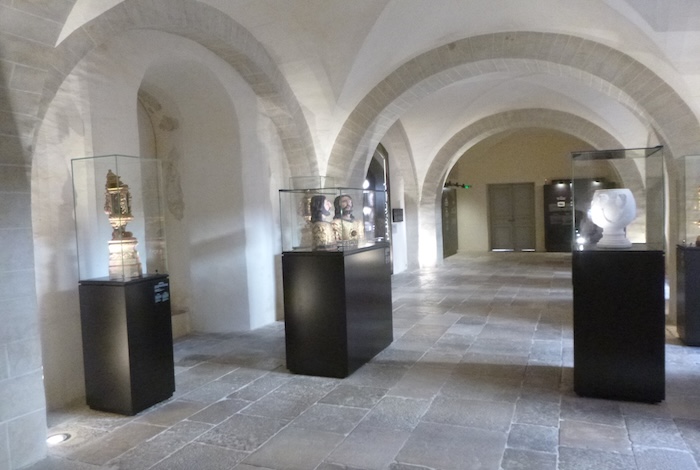
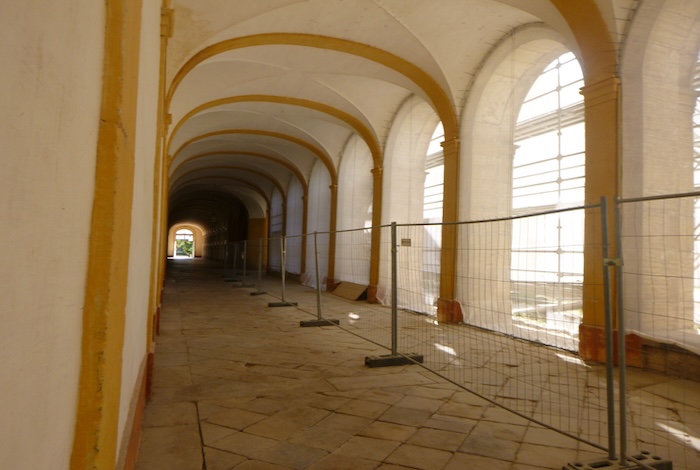
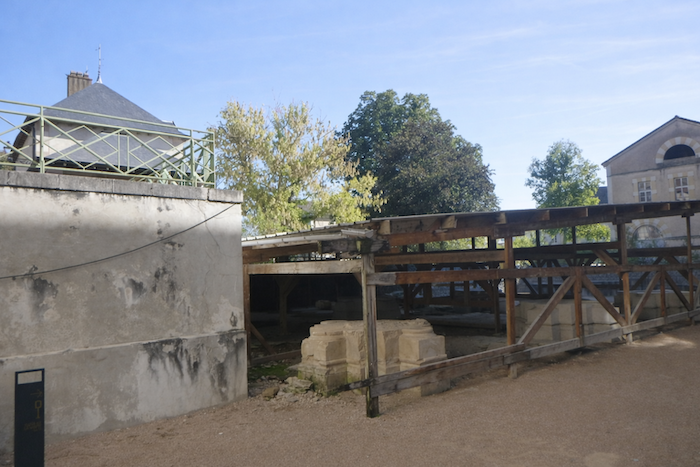
| The visit then continues through a wing of the cloister under restoration, where the stones, still wounded, seem to hesitate between ruin and rebirth. Soon the space opens to the sky, like a liberated breath, on the very site where the great nave once rose. |
 |
 |
 |
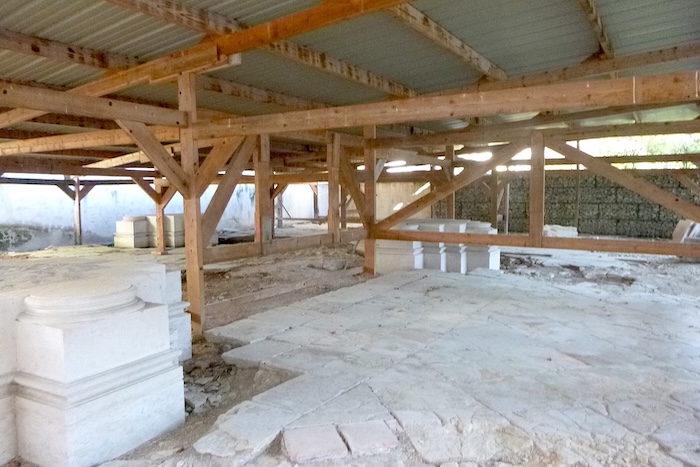 |
| Much is known today about the nave of Cluny III, thanks to archaeological excavations, ancient surveys and the precious descriptions of medieval chroniclers. In its time it was one of the most striking marvels of the abbey church. With its length of about one hundred and eighty-seven meters, it seemed to trace a road of eternity beneath the vault of the heavens. Its structure unfolded into five vessels. At the center stood an immense nave flooded with light, flanked on each side by two aisles accompanying it like a procession of stone. This arrangement did not serve only to receive a multitude of monks and pilgrims; it also exalted an idea of monumentality and grandeur proportionate to faith. The interior elevation was organized into three superposed levels. The great arcades formed the first level. Above them ran the tribunes, offering suspended paths above silence. Finally, the high windows allowed light to descend into the nave. The pointed barrel vault, a bold innovation compared with the classical semicircular arch, redistributed forces with new intelligence, while the aisles, groin vaulted, supported the whole. The nave of Cluny III was as much a technical feat as a spiritual manifesto.
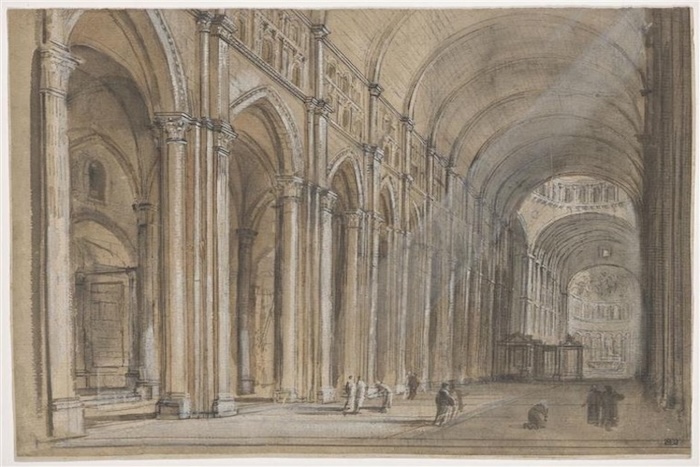
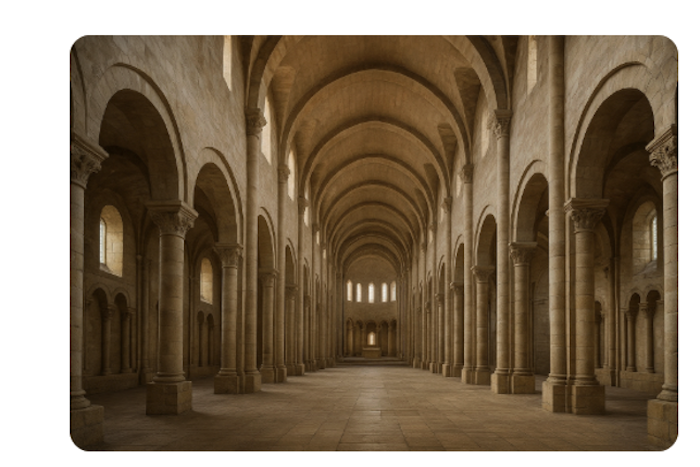
Today almost everything of this grand nave has disappeared, swallowed by the destructions that followed the Revolution. Yet a fragment of wall or a foundation emerging from the ground is enough for the imagination to reconstruct the lost splendor. These scattered stones become inhabited remains, carrying like a mute memory the shadow of the immense nave. Here are two images, one drawn from the archives of the Louvre presenting what history has transmitted to us, the other entrusted to the imagination of ChatGPT attempting in dream to approach what the eye will never see again. |
 |
 |
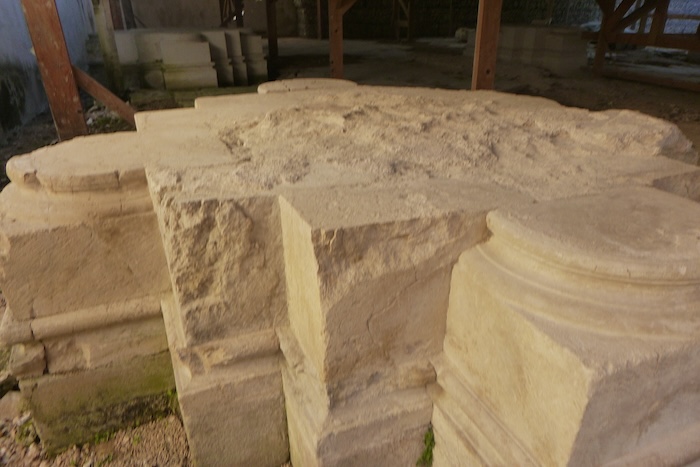
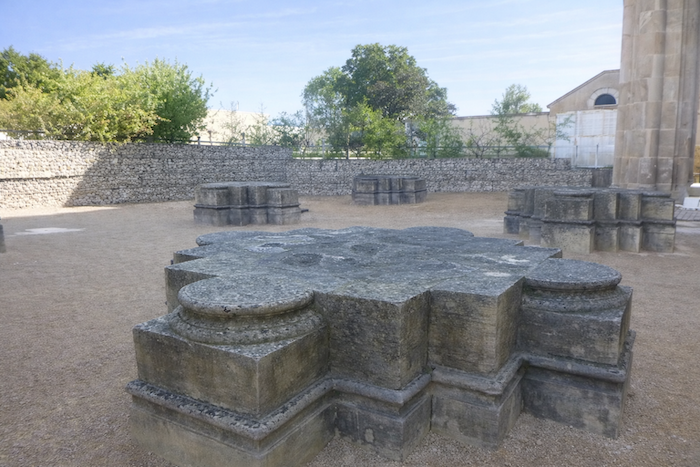
| In the open space lie the astonishing bases of column shafts, like frozen witnesses of a submerged world. These massive plinths, worn by time, raise before the eye the question of their true age. Are they the oldest foundations of the abbey church or the final remains of a forgotten reconstruction. The mystery of stone keeps silent the memory of its builders. |
 |
 |
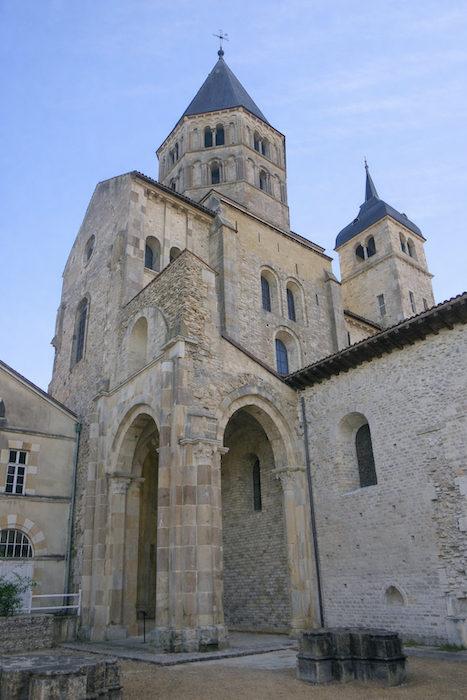
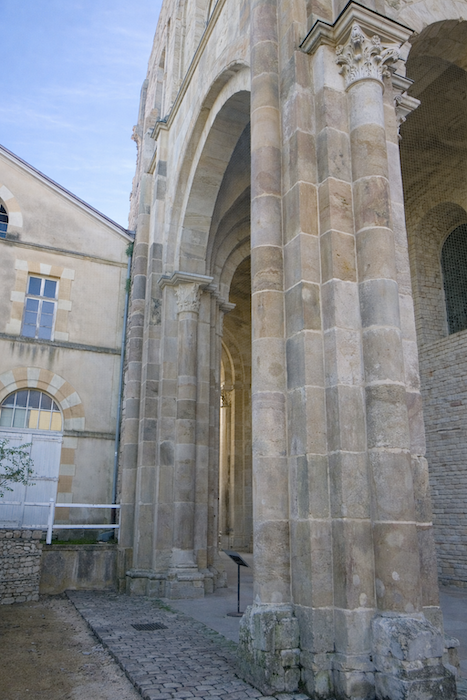
| The visit continues at the level of the transept. Monumental, it carried within it all the excess of the abbey church. It did not merely cross the nave, it extended immense, like two stone arms opened to east and west, tracing in space a Latin cross of colossal proportions. Its dimensions alone strike the imagination, nearly thirty-seven meters in width for each arm and more than sixty meters for the whole. Each crossing arm, like a sanctuary within the sanctuary, housed radiating chapels where masses were celebrated simultaneously, a striking sign of the liturgical intensity proper to Cluny. In this amplitude, monastic processions could unfold, cross and answer one another like voices in a choir without disturbing the majestic order of the offices. Today only fragments remain, yet excavations and surveys are sufficient to resurrect this gigantic transept, the beating crossroads of the abbey church where time itself seemed suspended beneath the vault. |
 |
 |
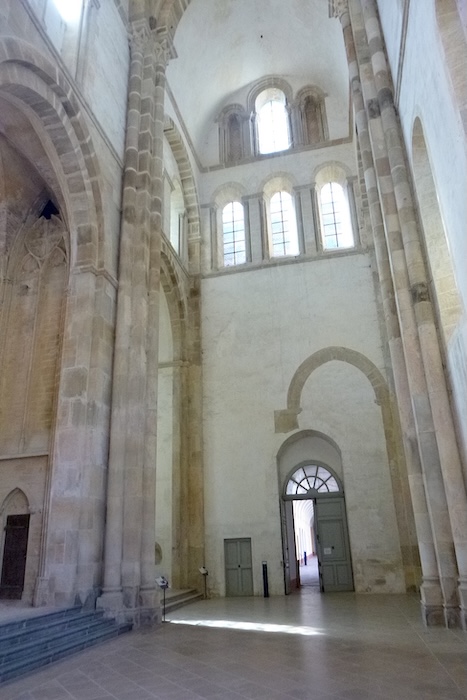
| Near the transept a few chapels still rise, like survivors leaning against the ruins. Among them, the chapel dedicated to Saint Martial draws the eye. It does not date from the first construction but was rebuilt in the fourteenth century upon the foundations of a Romanesque chapel. Its Gothic style, sober yet slender, reveals its more funerary than monastic character, offering a contrast with the monumental solemnity of the great church. |
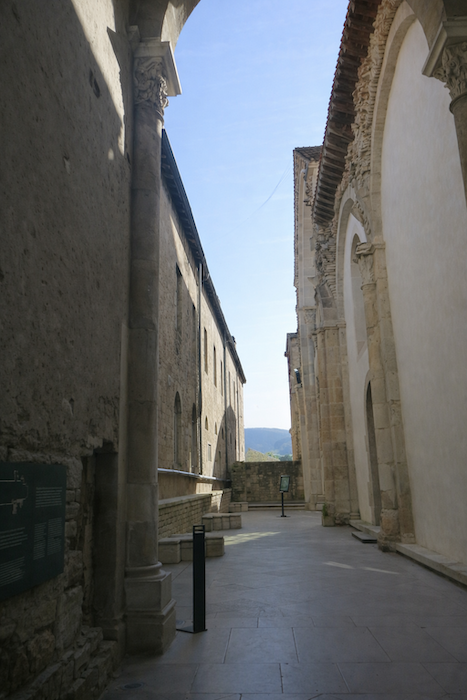 |
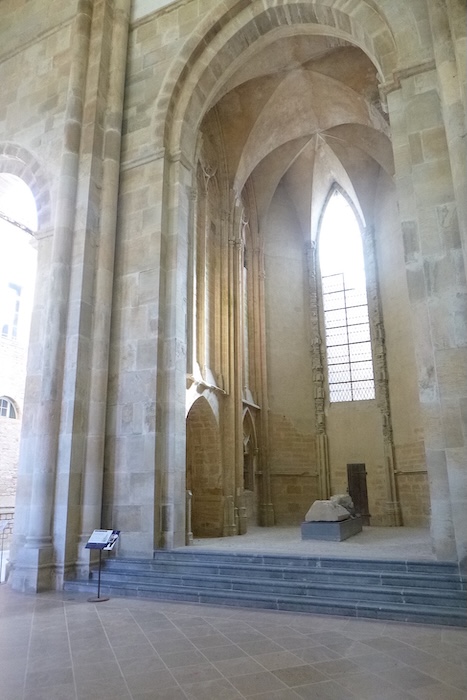 |
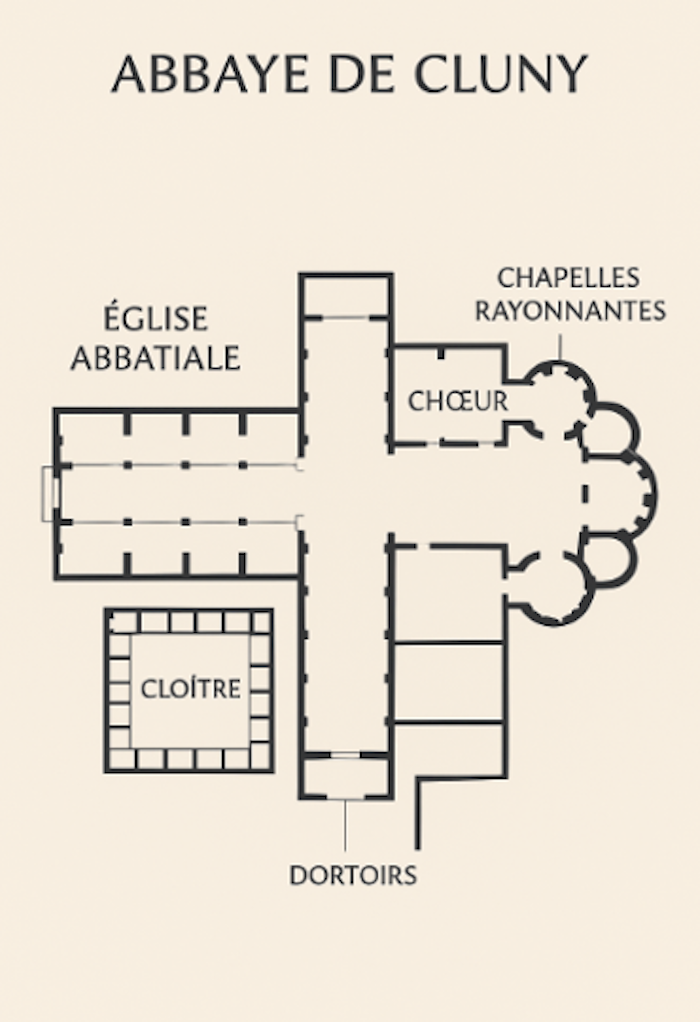
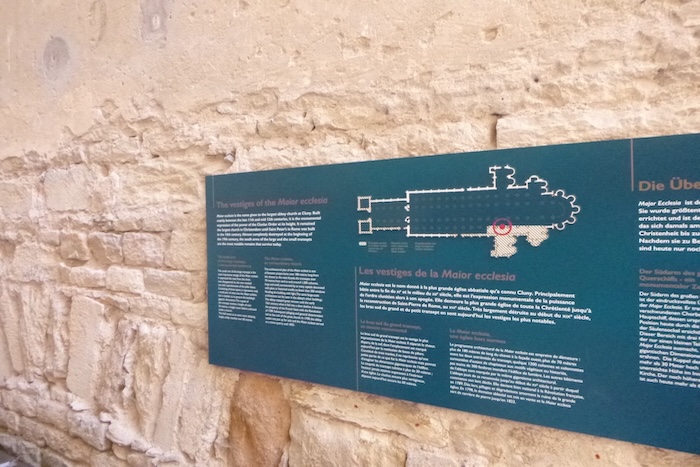
Through the centuries, generations have not always known how to protect the monuments inherited from their ancestors. Throughout Europe, churches were rebuilt, transformed and enlarged. Here at Cluny, however, it was not a natural evolution but a true mutilation. The plan presented shows in shading the only part that remained of the immense abbey church, as if history had reduced a cathedral of light to a handful of stones.
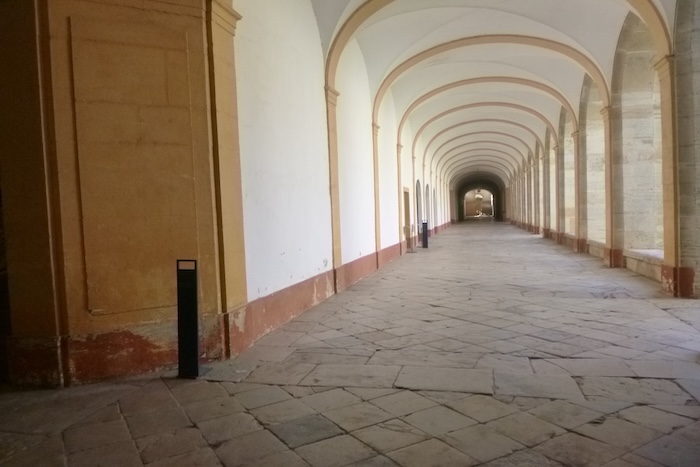
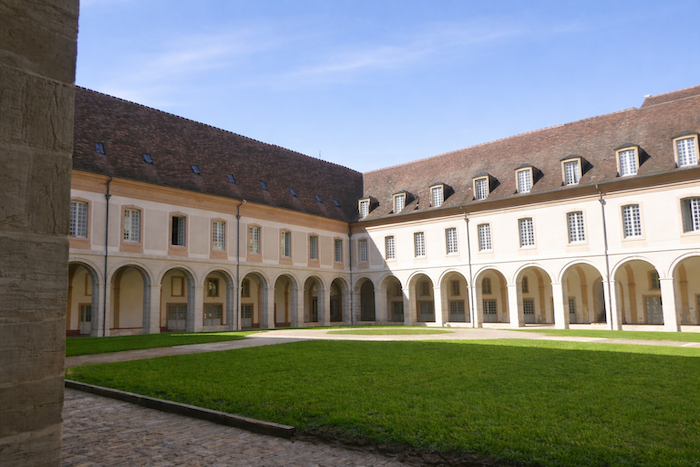
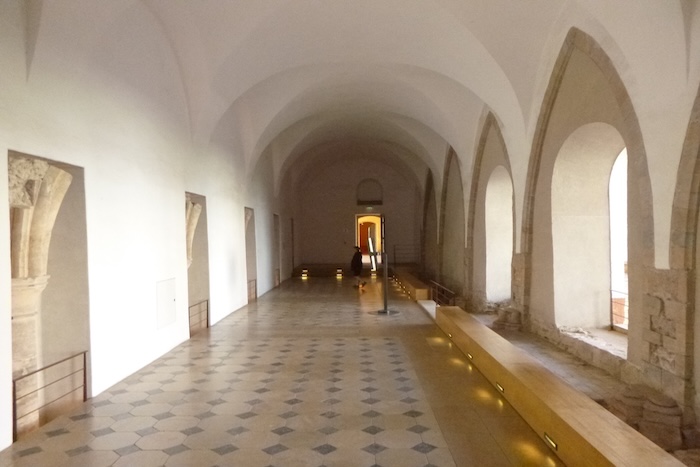
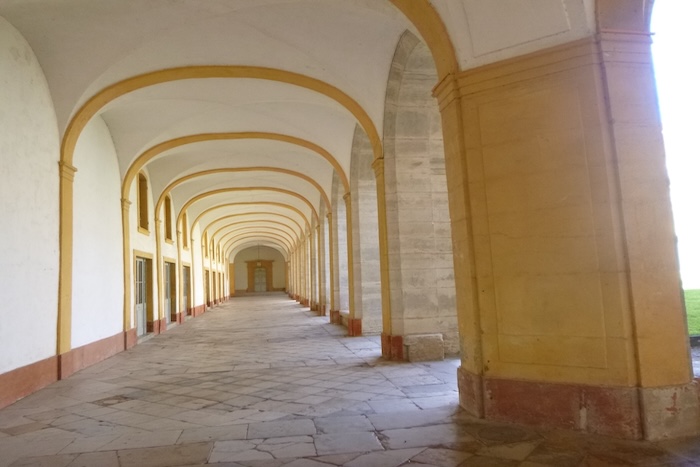
| The cloister of Cluny, established to the south of the abbey church, formed the true heart of monastic life. There, in the silence of covered galleries, the monks passed from one space to another, from the church to the chapter house, from the refectory to the dormitory. Yet the cloister was not merely a passage, it was a place of appeasement and contemplation. The central garden, image of paradise, reminded the brothers of lost and promised harmony, while the successive arcades offered at each step a frame upon the sky. Built first in the tenth century, it was magnified in the eleventh in order to match Cluny III. In the fourteenth and fifteenth centuries some galleries were rebuilt in a more delicate Gothic style, enriched with sculpted tracery that refined Romanesque austerity. Then came trials, time, wars and above all the Revolution, which reduced it to a ruin. Already in the eighteenth-century repairs had been undertaken, yet they remained incomplete. Of the former cloister only a part remains today, restored in the nineteenth century. In this mixture of Romanesque, Gothic and modern elements an entire history can be read, that of dazzling grandeur, brutal destruction and patient rebirth. |
 |
 |
 |
 |
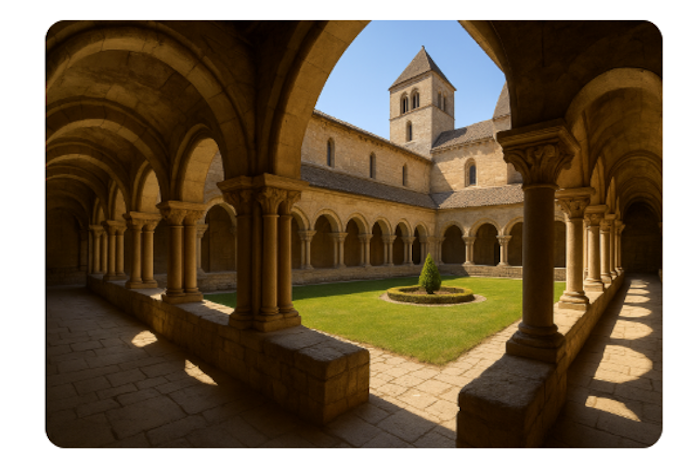
Let us play a little with ChatGPT. Here is what the software proposes for the original cloister of Cluny III. It is probably not far from reality.
Stepping out into the garden, your eyes discover what has become of the former service buildings of the abbey. The structures that stand today are not those known by the monks, they are later heirs, fruits of reconstructions or successive uses. What do we truly know of the origins. The main dormitory of the brothers stood to the south of the abbey church, directly adjoining the cloister according to Benedictine tradition. There, in a vast hall of sober lines, the monks slept, each upon a pallet or rudimentary bed, sometimes sheltered by a thin wooden partition, a fragile boundary between their slumbers. The space, vaulted and austere, was lit only by small windows cut into the thickness of the wall. A staircase, discreet yet essential, led directly to the sanctuary, allowing the monks to reach the night offices without crossing profane spaces. Not far away stood the refectory, a vast rectangular hall pierced by large windows, where meals were taken in inhabited silence. Aligned upon long benches, the monks received their portion of bread and soup, while a reader in a clear voice offered them nourishment for the spirit, biblical accounts and edifying lives of saints. Thus, earthly food united with spiritual manna, reminding all that the Benedictine rule was a symphony of silence, regularity and shared community.
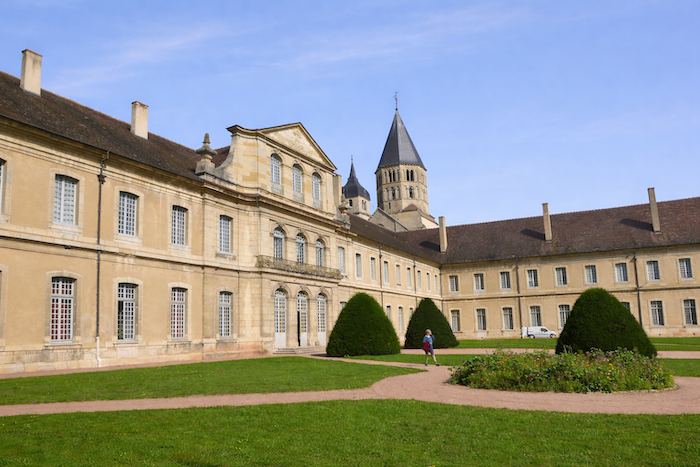
Today what your steps tread and your eyes observe around Cluny is only a fragmented inheritance. The Revolution, implacable, struck down the great abbey church and dispersed many conventual buildings. The stones were resold and integrated into village houses or civil constructions, as if the very flesh of the monastery had dissolved into the body of the town. In the nineteenth century part of the ruins was restored with romantic fervor, other elements were rebuilt or transformed for new public uses. What remains and is shown today therefore bears a double memory, that, mutilated, of the Middle Ages, and that, refined, of modern reconstructions. The contemporary eye may be deceived. These lines too neat and these stones too regular do not convey the roughness of medieval ruins but the patient reconstitution of the nineteenth and twentieth centuries.
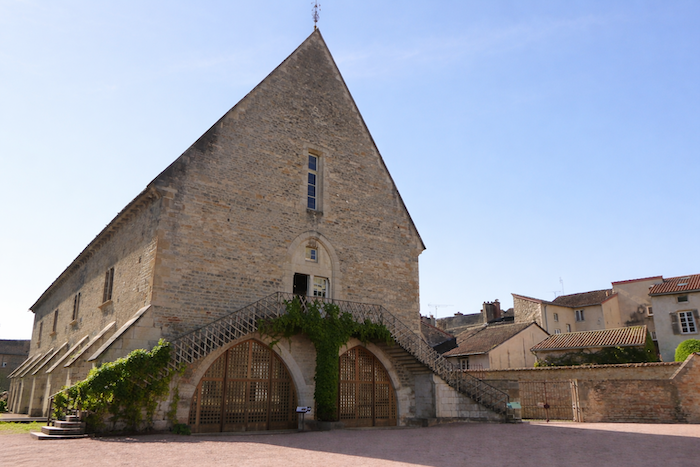
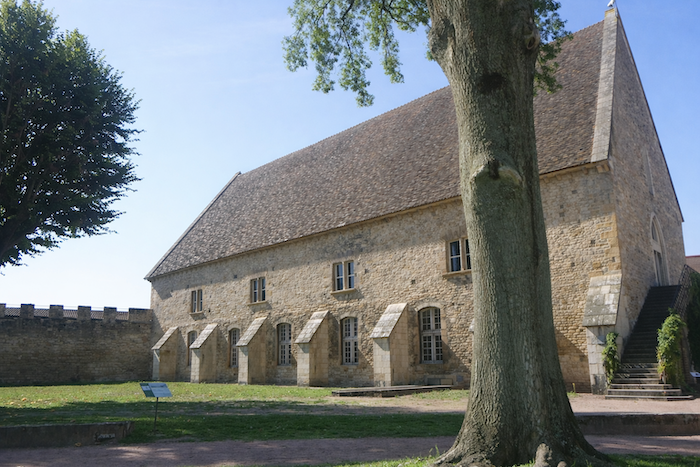
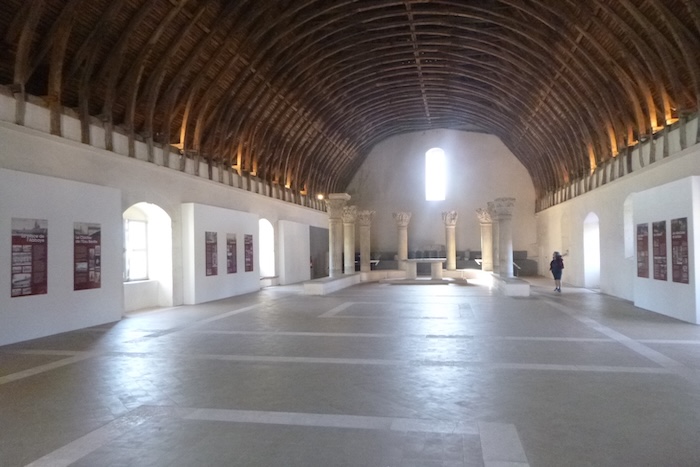
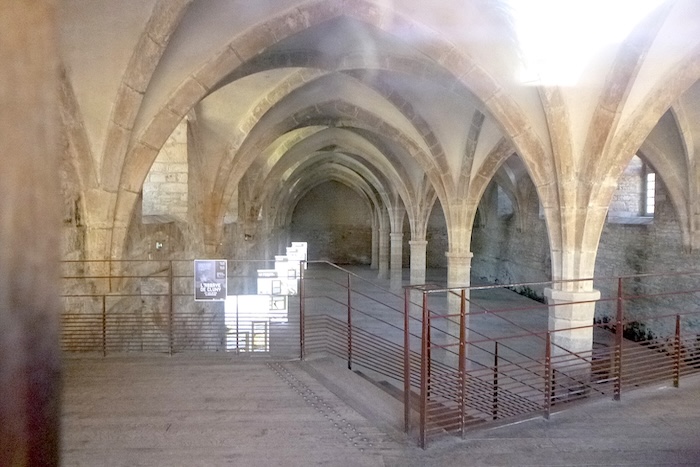
| Yet a true breath of the thirteenth century still survives in the walls of the “farinier” and the “cellier” of Cluny. These two buildings, obstinate survivors of the great era, carry in their stones the memory of the emerging Gothic style. The Farinier, raised toward the third quarter of the thirteenth century, is a solid construction both functional and majestic. On its ground floor opens a cellar with rib vaulted ceilings where cool shadow once sheltered reserves. The upper floor, the flour loft, still preserves its original framework, a forest of oak and chestnut beams precisely dated to the middle of the thirteenth century thanks to the meticulous science of dendrochronology. The building, however, no longer appears in its entirety, only two thirds of the original “farinier” have come down to us, partial witnesses of a structure once more ample. Certain parts were altered or modified in the modern period, notably in the eighteenth century when works affected the whole conventual complex. |
 |
 |
 |
 |
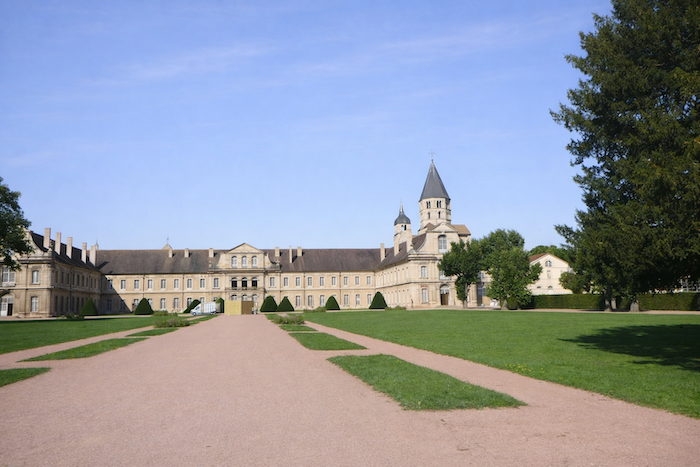
The garden is immense, calm and serene, enclosed by its walls, with the abbey rising in perspective.
LogOfficial accommodations in Burgundy/Franche-Comté
- Camping municipal, 30 Rue des Griottons, Cluny; 03 85 59 08 34; Camping
- Communauté Sœurs St Joseph, 7 Rue Ste Odile, Cluny; 06 11 95 08 43; Gîte
- Cluny Séjour, 22 Porte de Paris, Cluny; 03 85 59 08 83; Hébergement collectif
- Hôtel du Commerce, Place du Commerce, Cluny; 09 67 36 68 77/06 80 30 99 29; Hotel
- Hôtel de l’Abbaye, 14 ter Avenue Charles de Gaulle, Cluny; 03 85 59 11 14; Hotel
- Hôtel de Bourgogne, 1 Rue Porte des Prés, Cluny; 03 85 99 00 58; Hotel
Jacquaire accommodations (see introduction)
Airbnb
Each year, the route changes. Some accommodations disappear; others appear. It is therefore impossible to create a definitive list. This list includes only lodgings located on the route itself or within one kilometer of it. For more detailed information, the guide Chemins de Compostelle en Rhône-Alpes, published by the Association of the Friends of Compostela, remains the reference. It also contains useful addresses for bars, restaurants, and bakeries along the way. On this stage, there should not be major difficulties finding a place to stay. It must be said: the region is not touristy. It offers other kinds of richness, but not abundant infrastructure. Today, Airbnb has become a new tourism reference that we cannot ignore. It has become the most important source of accommodations in all regions, even in those with limited tourist infrastructure. As you know, the addresses are not directly available. It is always strongly recommended to book in advance. Finding a bed at the last minute is sometimes a stroke of luck; better not rely on that every day. When making reservations, ask about available meals or breakfast options..
Feel free to leave comments. That is often how one climbs the Google rankings, and how more pilgrims will gain access to the site.
|
 |
Back to menu |